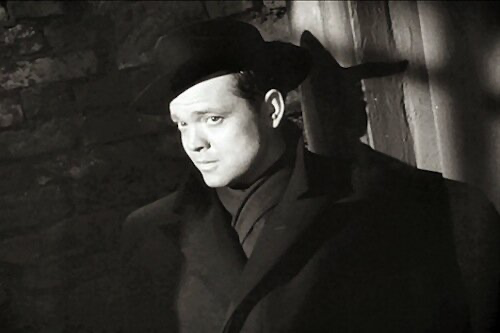
I’ve written before about this as a movie that lit my fuse for writing, but every aspect of this film is top notch and holds up.
It’s a story about profiteering in the shadow of chaos and bloodshed. About the myths we tell ourselves about heroism (brought into play by having the protagonist be an American writer of pulp Western novels and thinking like one of his own heroes until he realizes it’s not that kind of story). There’s a curdled friendship and the question of whether loyalty is stronger than morality.
Not only does it have Orson Welles putting on a lobster bib to chew the scenery every time he’s on camera, but you also get some of Joseph Cotton’s finest work as a man out of his depth, chasing shadows in a foreign country.
And the ferris wheel monologue still cuts as deep as the first time I saw it. An amoral capitalist literally looks down on the little people from up high and makes it clear that their suffering doesn’t matter if it helps him make a buck. Compare:
Would you feel any pity if one of those dots stopped moving forever? If I offered you £20,000 for every dot that stopped – would you really, old man, tell me to keep my money? Or would you calculate how many dots you could afford to spare? Free of income tax, old man…free of income tax.
with a modern equivalent:
“The endgame is to allow things to drag on until union members start losing their apartments and losing their houses,” a studio executive told Deadline. Acknowledging the cold-as-ice approach, several other sources reiterated the statement. One insider called it “a cruel but necessary evil.”
Hollywood Studios’ WGA Strike Endgame Is To Let Writers Go Broke Before Resuming Talks In Fall

 This Builds Character
You must be logged in to post a comment.