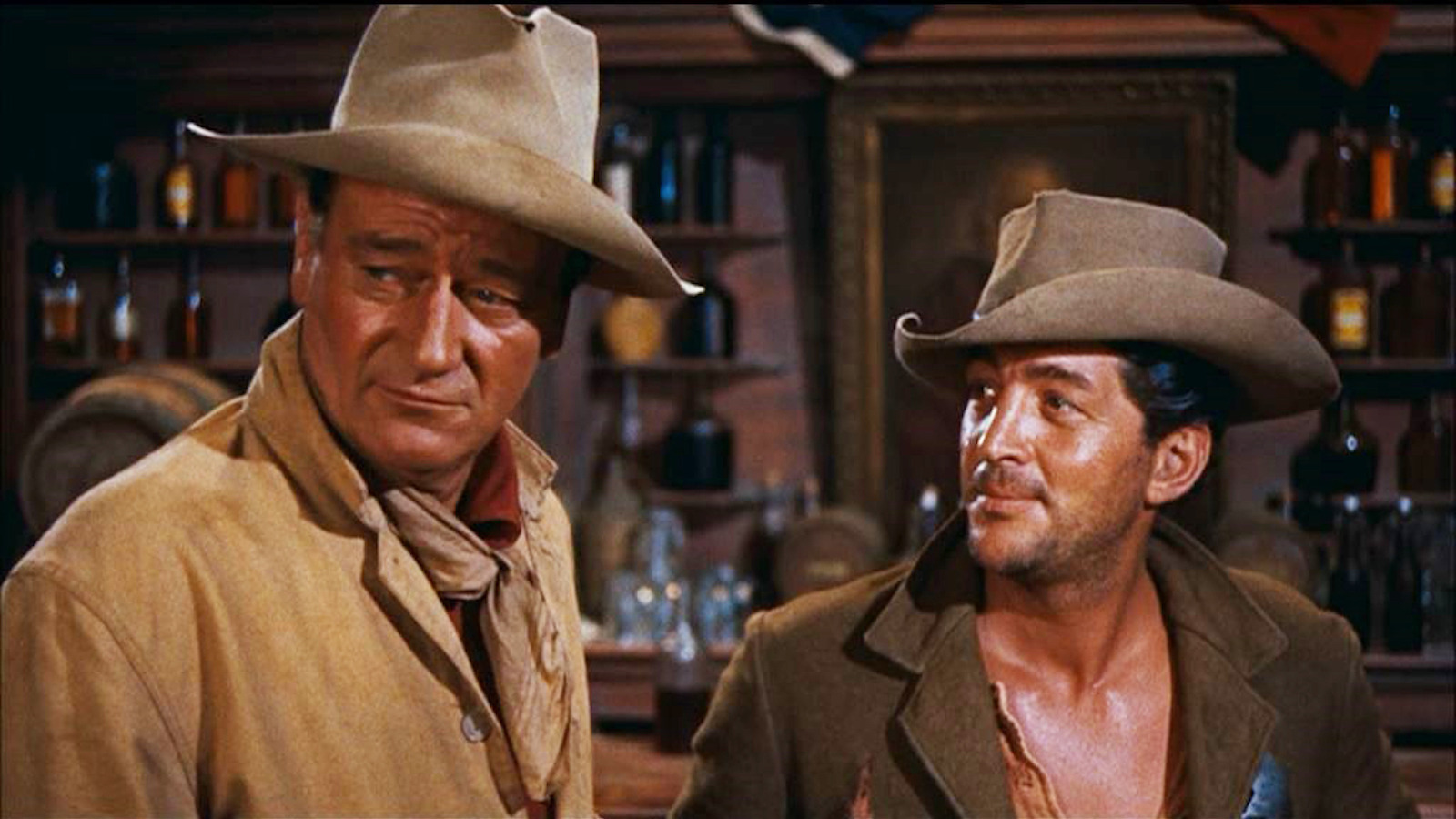
I cannot think about John Wayne without thinking about my grandfather. He’s the one who set me down and got me watching Westerns. Rio Bravo is one of those films that always feels like sitting in his living room and popping in a VHS tape. It’s a movie for me that smells like the woods and campfires and tastes like apple butter and biscuits and sausage gravy.
Part of that is the hangout vibe of the whole film. There’s singing to kill the time (because if you don’t have Dean Martin and Ricky Nelson sing, why are you even putting them in your cast?). There’s lots of hurry-up-and-wait pacing, because the main characters are mostly on the defensive, trying to keep a prisoner from being broken out of the local jail. Despite the danger and the gunplay, there’s a comfortable rhythm for the film that eases you through it.
One of the things that always gets me coming back to this movie is the relationship between Wayne’s John T. Chance and Dean Martin’s Dude. Dude starts off the movie as a shaky alcoholic. A washed up punch line and punching bag for everyone else in town. Chance is disgusted with what Dude has become, but he also knows that there’s an ally in there that needs to come back out. Chance needs Dude, and Dude needs help.
And it’s a movie about human connections. About brotherhood, and in this case, found family. Shared sacrifice and struggle to do what’s right. But it’s also about being unable to articulate the depth of your feelings. There’s a lot of unexamined toxic masculinity with John T. Chance, and it can best be seen in the way that he refuses to allow himself to be vulnerable with the people most important to him. How his love language is verbally abusive and sarcastic in a way that just isn’t what love should look or sound like.
In a lot of ways it’s the antithesis of High Noon, and that was purposeful.
“What a piece of you-know-what [High Noon] was,” he told me. “I think it was popular because of the music. Think about it this way. Here’s a town full of people who have ridden in covered wagons all the way across the plains, fightin’ off Indians and drought and wild animals in order to settle down and make themselves a homestead. And then when three no-good bad guys walk into town and the marshal asks for a little help, everybody in town gets shy. If I’d been the marshal, I would have been so goddamned disgusted with those chicken-livered yellow sons of bitches that I would have just taken my wife and saddled up and rode out of there.”
John Wayne, talking to Roger Ebert
John Wayne and Howard Hawks made no attempt to hide their disdain for the plot of High Noon. But I think the differences go deeper than the question of who’s going to help the Sheriff. Take a look at this (edited) scene from Rio Bravo and compare it to the moment when Amy Fowler Kane takes up a gun in High Noon:
Both of these moments feature women taking action to protect a male protagonist. But there’s a sharp difference. Feathers gets a flower pot that she’s told to throw by someone else so that he can do the actual killing. Amy picks up the gun to do the job herself. Nobody told her what to do.
There’s another parallel moment at the end of both films. In both, the protagonist chucks away something meant to be worn, but for different reasons and shown in a different way.
First, High Noon:
Then, Rio Bravo:
With High Noon, it’s a moment of on screen affection between Will and Amy, followed by a look of disdain for the town as he renounces his place. For John T. Chance, it’s an act of control and domination over Feathers, played off as a goofy joke by Dude and Stumpy when they put two and two together as the tights fall from the sky into the path of their nightly patrol.
One is the final statement on how broken a community is. The other is an attempt to suggest that there’s a new, restored order in town, and that everyone has found a place to fit in to the community with an acceptable role.
But unlike the partnership and shared sacrifice of Will and Amy, John T. and Feathers seem stuck at a point of friction and attraction. The whole notion of how they would both still need to change a lot for whatever is developing between them to work.
If it wasn’t for the fact that Wayne and Hawks were so vocal about their disdain for High Noon, I wouldn’t spend so much time thinking about the parallels and commentary between the two films. But that doesn’t mean I see it as one film being superior to the other. They’re parts of a conversation. They’re separate things.
There’s no need to make films into a zero sum game. Like I’ve said before, I like liking things. And with both of these movies, I have my reasons.

 This Builds Character
You must be logged in to post a comment.