
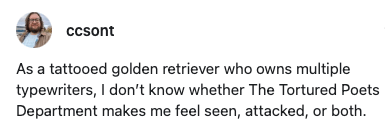
I was thinking about this over the past week as The Internet dealt with a new album from Taylor Swift. It came out while I was sleeping Thursday night and by the time I woke up Friday morning The Internet was raft with exceptionally strong opinions already. Just over a week later and the internet now has a number of, “actually, there’s more here than I initially thought,” articles coming out.
—Matt Birchler, Be quick to praise, but slow to criticize
I can think of a few times I felt this same kind of vibe.
The first was when we screened Breaking the Waves in my Intro to Film class in undergrad. Having just learned about the Dogme ’95 school, I spent a lot of effort grousing about how the film didn’t even fit the rules it claimed to be about. But the next semester, I watched and re-watched the film because it got such a strong reaction out of me. And eventually I stopped seeing how it wasn’t what I expected and started digging in to what was actually there.
I was late to the party with The Big Lebowski. After I watched it for the first time on DVD my reaction was little more than, “huh.”
So as soon as the menu came back up, I pressed play again. And it was that second viewing, where I knew more about what it was and could pay less attention to what I had learned second-hand about it where I started to find all the parts I enjoyed.
For the most part, if I didn’t like something I need to figure out why before I’ll speak to it. Part of that comes from spending so many years in writing workshops for school: You aren’t helping if you’re just pointing out flaws instead of working to understand choices. And there’s a healthy helping of being curious instead of judgmental.
I think Birchler picks a great example for this tension. Swift is an outsized force of entertainment, so lots of people are jockeying to get their reaction in first (or more likely in the first 10%). And those calculations aren’t just about reviewing the music itself, but about getting attention to the review.
That’s one of the reasons why my list of no-skip albums features stuff from the past that holds up.
If we want to serve capitalism, we rush to evaluate things as product and weigh its value to a consumer as a purchase. If we want to understand our connection to the work and let the art serve us, that takes time.

 This Builds Character
You must be logged in to post a comment.