7. Miracle on 34th Street

Still from Miracle on 34th Street with Edmund Gwenn as Kris Kringle and John Payne as Fred Gailey, listening to the judge in a courtroom.

“Your Honor, every one of these letters is addressed to Santa Claus. The Post Office has delivered them. Therefore, the Post Office Department, a branch of the federal government, recognizes this man Kris Kringle to be the one and only Santa Claus.

I love that this movie crafts a narrative in a way that affirms the idea of real magic in a way that feels plausible. It’s not about Santa Claus proving he exists or has magical powers. It’s not about him inspiring people to believe in him, though he does that.

Miracle on 34th Street is about how a corrupt system will twist its own internal logic around to allow for the possibility of Santa Claus because they can profit.

That’s what makes this movie for me. He’s not charming the cold hearts of a bunch of selfish people into changing their ways. We’re not all gathered round the fireplace with carols and cocoa at the end.

It’s an easier ask to believe. Whether you own a department store, have political goals, or just want to clear out some undeliverable mail taking up space, if you’ll just say this man is Santa, there’s something in it for you.

It’s a great trick: Showing a believable world much like our own to make it seem that believing in the impossible isn’t foolish at all.

6. It Happened One Night

Still from It Happened One Night - Clark Gable chews on a carrot while sitting next to Claudette Colbert on the side of the road, waiting to hitchhike.
Fun Fact: This scene inspired Bugs Bunny and the connection between rabbits and carrots.

Again, I need to question my ideas about romantic conflict and classic films. It Happened One Night has an amazing power struggle at its core with two characters who underestimate each other. In the end they admit their love for each other and it’s all hunky-dunky… And now I get thinking about cinematic stories attempting to bridge the class divide through marriage and/or love.

It’s the idea that the system doesn’t need to change, so long as the two main characters aren’t completely inconvenienced by it. He’s a struggling newspaperman with just a few bucks to his name trying to get a scoop. She’s an heiress without street smarts who wants to evade her wealthy father’s control. Their trip together shows her what she hasn’t seen while locked up in her father’s yacht, but it doesn’t spread her change any further.

This isn’t saying it’s a bad movie. I like this movie. But when there’s a story about two people who fall in love, what’s going to keep them apart? Is it something they need to change about themselves, or something they need to change about their world? If it’s the latter, how far does that change need to spread?

5. The Rules of the Game

Gamekeeper Schumacher holds several men inside the house at gun point.

On the eve of World War II, a group of the wealthy French elite gather together for a weekend of hunting, romantic misunderstandings, and murder.

I checked this one out for the first time after hearing it was a touchpoint for Gosford Park, which I had seen shortly before. I keep coming back to it. When I did a write up about villains and evil in movies, when I think about character motivations in general, and when I think about the way people will blind themselves to the dumpster fire igniting next to them if they’re distracted by their own selfish ambitions or appetites.

Like Jean Renoir’s Octave says in the film:

The awful thing about life is this: Everyone has their reasons.

It’s funny. It’s disturbing. And it feels just as potent and relatable now as it must’ve felt when it was first exhibited.

4. The Wizard of Oz

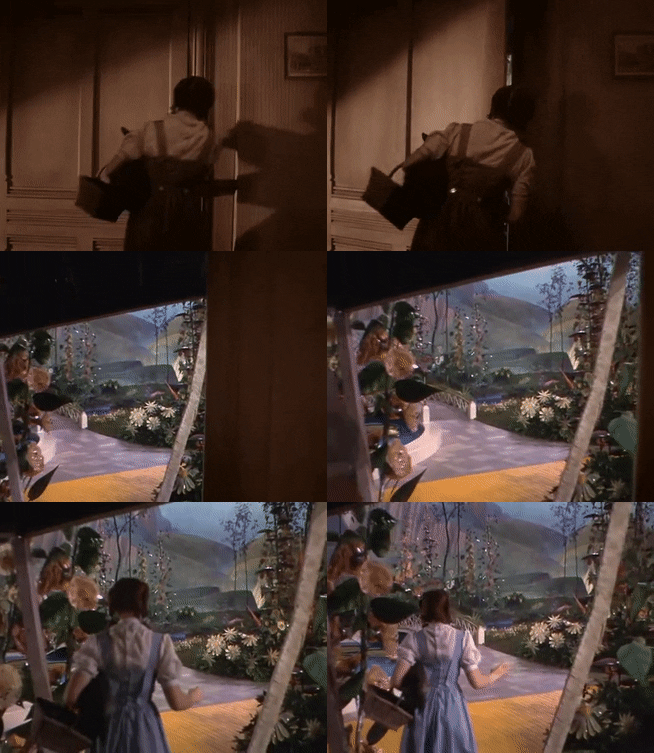
GIF from The Wizard of Oz with Dorothy opening the door of her home to reveal the Technicolor splendor of the Land of Oz.

This movie always amazed me on a technical level, even before I understood how a lot of it was done. That shock of seeing the colorful world revealed behind a sepia-toned door is one of the purest moments of movie magic I can think of.

In one shot, an impossible thing happens. A door opens up, but instead of seeing Kansas, the other side has shifted.

It’s a perfect metaphor for going to the movies. You begin in darkness, but then a familiar, recognizable space fades away as a new world opens up in front of you and invites you in. But just like Dorothy, we return home at the end of the journey.

But for a little while, we get to make new friends, see things from another perspective, and step outside of ourselves.

3. Bringing Up Baby

Cary Grant and Katharine Hepburn stare at each other, in close, while Grant clutches a box.

Sometimes it’s just fun to watch performers bounce off each other. Cary Grant and Katharine Hepburn could make reciting dictionary definitions entertaining and combative, but when they have this script to work from?

I wonder what kind of influence seeing so much screwball comedy at a young age had on my ideas about romantic love. Bantering isn’t the same as bickering, and animosity doesn’t mean affection. Opposites can attract, but we never get to see how long their differences balance each other out once the external conflict resolves.

Then again, it also gave me expectations for a partnership of equals. Power dynamics where someone’s love wasn’t a prize to be won, but something that builds upon your time together and the complications you work through together.