Even the best batting averages are pretty low

In the 2019 Major League season, the best batting average belonged to Tim Anderson, who had a .335 average. This means that he would get a hit roughly one out of every three times he would come up to the plate.

Hugh Duffy, the diminutive Hall of Fame player, holds the record for the best single season batting average of all time. In 1894, he had a .4397 average, which means he got a hit from less than half of his at bats.

#BostonStrong

These aren’t just people doing the job professionally. These are players who are the elite of the elite. And they still struck out more than they got on base.

Because even when you’re among the best at something, you’re not infallible.

So if you hold yourself to impossible standards, or feel a deep frustration with how many times your best efforts wind up with little to show for them, there’s no time like now to stop.

I’ve had students telling me that they don’t understand why they can’t push themselves to do work up to the quality they held themselves to back in February.

I’ve seen it in myself, wondering why it is that even when I can clear some time off, my focus isn’t as strong as it could have been a few weeks ago.

Any number of people I’ve spoken with have talked about the sense that there may be something wrong with them since they’re not one of the people who have taken to this quarantime with aplomb.

Those people showcasing their bread, crafts, writing, music, community organizing, or hilarious videos? That’s not everyone. Not by a long shot.

There’s the line of thought that we should just snap back to normal after adjusting our lives to staying at home, staying safe, and confronting the realities of a pandemic. But we can also see this as an opportunity to reflect, and re-evaluate the things we’ve taken for granted before we were forced to choose what’s essential and what commands our attention.

And one of those things I’ve been revisiting is the idea that one bad day doesn’t need to mean all that much in the grand scheme of things.

Which is what brings me back to batting averages.

Under the best of conditions, with a singular goal and a life built around pursuing it, professional baseball players still regularly strike out more than they get on base.

So no matter what goal you’re pursuing, one bad day doesn’t hurt your average all that much. It doesn’t deserve your anger. It doesn’t deserve all that much of your focus.

You need to work for the average. Play the full season.

From that view, even a string of bad days isn’t that disruptive.

So if you feel like you’re in a slump, or that things aren’t moving as quickly as you’d like, or that today is just another example of why “I cannot do The Thing That Matters To Me,” stop.

Breathe.

Remember what game you’re playing.

And remember that even Hugh “Nobody Has Had A Better Single Season Batting Average Than Me In Over 100 Years” Duffy wound up back on the bench more times than he got on base.

Get back up. Tap the dirt from your cleats. Keep swinging.

Don’t just follow the recipe

I’ve made a dog’s breakfast of some of the last few dinners I’ve cooked for my family.

There was the pork loin that I pulled too soon after failing to temp properly. We wound up eating ham sandwiches instead while it finished cooking and went directly to becoming leftovers. There were chicken legs that I flipped too frequently on the grill, and the charcoal died down before they were cooked all the way through. I didn’t take enough time to fully sweat the vegetables for a minestrone before adding in the broth, meaning we had to boil everything longer.

Dena could see the common thread: I was following recipes too closely. I was looking at recommended times without stepping back to make sure that I was accomplishing the goal of that step of the recipe.

I’ve been rushing. We’ve been spending so much time for the last few weeks reminding our five-and-a-half-year-old daughter that she needs to be patient, yet I completely missed my own impatience.

I was trying to make the recipes conform to the written time instead of accepting that they’ll be ready when they’re ready.

When I cook a meal I have down cold, I know what I’m looking for. With those meals, I don’t set a lot of timers. I can tell by texture, or smell, or any number of little indicators that I’ve learned to watch for.

I know how to let the food tell me when it’s ready.

That waiting is important, because if you decide ahead of time how long you need to cook a chicken, your family winds up with salmonella on their plates.

It’s only natural to want to know how long things are going to take when we start them. The mind sees something starting and begins imagining what completion is going to look like.

We’re narrative creatures, and we want to get to the end of the story.

And all this gets me thinking about the bigger picture of the moment.

Right now, as we wait for the relaxing of social distancing and a view of what normal is going to look like for the conceivable future, there are plenty of people who want to conform to a set time table.

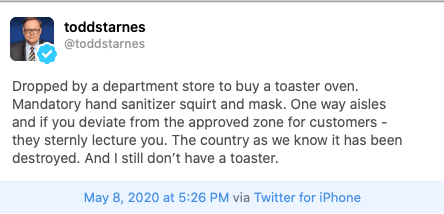
There are even people who want to demand we end things now: That we’ve done enough and it’s time to move on. That their impatience and personal freedom is more important than following the indicators of the virus and our responsibilities to each other.

But if we rush to try and return to what things were like before, to make the new normal as close to the old normal as fast as possible, we’re liable to wind up causing more harm.

You can’t tell a virus when it’s done spreading any more than you can demand for chicken legs to temp exactly when you want them to be done. You can’t make the natural world re-order itself according to your impatience.

We need to pay attention to the worthwhile indicators, and accept that things will be ready according to their time, not ours.

It’s an idea worth carrying beyond These Uncertain Times™ and into our daily life. Your willpower can help you get things done, but your willpower and efforts cannot enforce the desired consequences of your actions.

All you can control is what you put out into the world. The rest is up to the actions and reactions of others.

All you can control is what you do and how patient you are for the results.

I want to be where the people are

As the conversations start about how and when to peel back the layers of restrictions set up by stay at home orders, I’m thinking about one part of this as a person who loves going to the movies:

Until there’s a widely available vaccine, how are we going to go back to movie theaters?

How can we return to being comfortable sharing that much personal space with a room full of strangers, sitting elbow-to-elbow (or recliner-to-recliner)? Even if theaters adopt a practice of underselling venues, that doesn’t change the basic theater layout that requires you to squeeze past each other to find your seat, go to the bathroom, or get a refill.

But if we’re unable to confidently return to the theater, part of what makes movies so memorable and engaging could be drastically altered.

The crowd is part of the story

My high school drama teacher always reminded us that “acting is reacting,” and that it wasn’t just about reacting to the other performers on stage, but knowing how to draw energy from the audience. It made every performance different.

With a film, the performances are always the same, but the people you view those performances with can shape a completely different experience.

It’s like in 12 Monkeys, when Bruce Willis’s James Cole sits in a theater with Madeline Stowe’s Dr. Kathryn Railly as they watch a movie he remembers from childhood:

“The movie never changes. It can’t change; but every time you see it, it seems different because you’re different. You see different things.”

I thought about this when I read the Indoor Voices blog post I Miss Audiences Losing Their Shit, because it reminded me of all the times that the people I was in the theater with changed the way I saw the movie.

Because it wasn’t just the film that was memorable

I think about the night I went to see Snakes on a Plane on its opening weekend, and how the entire packed theater started howling with laughter from the moment the title card appeared on screen and didn’t stop until the credits rolled.

Or seeing Toy Story 3 at a late evening screening in a theater with few, if any children. Most of us in the seats had been kids when the first Toy Story came out, and while we’d grown up a little faster than Andy, his sense of putting away childish things still felt raw, and the toys’ fears of annihilation felt a little more tangible.

There wasn’t a dry eye in the house, and knowing that the other adults in the room were sobbing just as hard over a cartoon gave everyone that little bit of emotional space to let it all out.

There was the opening night of the 46th Ann Arbor Film Festival, where I sat with my co-workers from the festival in the Michigan Theater, enjoying not only the films that were programmed that night, but the fact that we’d kept the doors open with a Hail Mary fundraising drive and survived a First Amendment lawsuit against the state government.

We weren’t just celebrating the films, but the triumph of preserving a showcase for this type of independent, experimental filmmaking.

And there was the entire third act of Avengers: Endgame, where ten years of storytelling came together, plants were paid off, the crowd cheered at all the big moments, and that long fought battle of good vs. evil finally, finally gave the good guys a win that didn’t hint at a larger conflict still to come.

For once, good could rest knowing its work was done, and we as an audience could exhale, feeling like the most important thing to talk about as we left the theater was the movie we just watched, and not the next one.

But it’s not just the audience: It’s the theater itself

The theater provides a sense of place for the story you’re about to watch. We buy our tickets, find our seats, see an uninterrupted story from start to finish, and watch our hopes and fears made manifest.

It’s a sacred space, cut off from the rest of our day, in which we enter the dark to briefly dream together.

I think about the time I took my daughter to see her first film in the theater. It was Despicable Me 3. She was going to go on a field trip to the movies with her day care the next week, and I didn’t want her first major theatrical experience to be without me.

We were able to go to a matinee on a Tuesday and do the whole traditional theater experience thanks in part to discounted tickets and half-price popcorn.

There weren’t many people there (the film had been in release for over two weeks at the time), and we settled in to our seats. We ate popcorn. We laughed. She was incredibly focused for being so young and never having been in the theater before. But that’s part of it.

There are rules. This isn’t sitting at home on your couch. You can’t just pause the movie, or trade seats, or decide that you’d rather wander over to another corner of the room and play with some toys for a little bit.

When we go to the theater, we share the space and should be mindful of the others we share it with. We want to be a good audience, not only for the film, but for each other.

It’s not the same if the movie plays in your home.

Our family rented Trolls: World Tour when it was released on demand. We talked about how it was actually kind of nice to be able to see a brand new movie without setting up a sitter for our youngest, and not having to schlep ourselves to the theater. To be able to pause the movie (and to watch it again if we started it within the next 72 hours). We talked about the fact that it cost less than taking our whole family to a matinee.

But all the convenience and economy of the moment couldn’t replace the idea of fully surrendering to another world.

We were watching the movie in the same room that we FaceTime our extended family, or do Cosmic Kids yoga videos, check work emails, or let Button roll and wiggle on the floor as he tries to figure out how to crawl.

There was no sense of surrender to the film, or of communion with strangers. We weren’t stepping into another world, but bringing a story into our private space. The story was framed by all the reminders of our present daily life, good and bad.

Right now, a chance to step outside of our world, even for 80 or 90 minutes, would be a welcome thing.

But the calculus has changed

We will be told it’s safe to come back probably sooner than many people will feel comfortable doing so. Our individual hope to return to some sense of normal will tug at us, and make us want to believe that it will be easy to slip back into at least some of our old routines.

But I think about how people are reacting to a clear and present danger right now, and wonder how I’ll feel about them after the current crisis has been contained.

I think about the people who are ignoring (and in some cases, flaunting their refusal to follow) social distancing guidelines at this time of high rates of infection. And I think about how these are potentially the same people who may also have shrugged off actually washing their hands when they left a public restroom before concepts like “flattening the curve” became part of our daily conversation.

Because if there are enough people not taking hygiene and communicable disease seriously now, chances are they’re only going to continue to laugh it off later.

It’s not just a question of when will infection rates and precautionary measures make the risk low enough to return theater-going to a normal part of life: It’s a question of if we will we feel we can trust our seat neighbors to care about the people around them.

Because if we want a chance to share the experience in the theater again, we will all need to agree how to safely share space.

Birthday party planning in the new now

The other morning Sprout was hovering by my elbow while I got Button out of his nighttime pajamas and into his daytime pajamas (because, after all, pandemic fashion is all about cozy comfort) and she started planning his birthday party at the end of summer.

“We can invite all of his friends to video face chat!”

I reminded her that he’s not even one year old, so most of his friends are family members, but she was breezed past that.

“We’re going to have to order his presents early so they can get here. Because we can’t go to the store.”

She made all these logistical pronouncements in a matter-of-fact way. She’s not sounding anxious or disappointed at the idea that maybe we wouldn’t be able to have family members over to our house, or get together with people in person for Button’s birthday.

She’s just internalizing and trying out a new sense of normal based on how things are going currently.

She’s had weeks of only seeing cousins, grandparents, her teachers, and some of her friends from school on the other side of a screen. She’s barged in on some of my online classes (as my unofficial TA) and told knock-knock jokes.

She misses people. She misses school. When the sadness comes, it hits in waves: peaking fast, then subsiding.

But there’s a streak of resiliency coming through as she adjusts to new routines.

Can’t have school recess with all her friends? Then every day there needs to be backyard recess with Dad. After dinner must be Family Time, lunch needs to fit a routine, and so on. She has blocks of time that make up the schedule of her day, and she even wants to stick to it on weekends.

Because right now for her, what even are weekends?

It’s not always easy, but I’m glad to see those moments where she’s rolling with the punches and finding her footing.

And I hope, as I have to adapt to the changes still to come, that I can greet the logistics of it with the same straightforward, beginner’s mind that she’s started to use.

What gets done first gets done.

Since the stay at home order started in my state, the first thing I do after my alarm goes off is come downstairs before everyone else is awake, pour myself a cup of coffee, and sit down to meditate.

It’s not starting out with the most urgent or overdue task on my list, setting me up to think about the pile of deadlines hanging over my shoulder. It’s not just faffing about, using the time to “just wake up.”

It’s a choice to remind myself that I can greet the day with intention.

I’ve noticed that since I’ve adjusted my mornings to start this way, I’m less likely to do those “just checks” on my phone first thing. Or second thing.

It’s not necessarily a concrete form of habit stacking, but it does set the tone for the rest of the day. I’m more likely to move from meditation to something else that feels important, instead of getting sucked in to an endless scroll on the internet.

It’s a choice to remind myself to greet what comes during the day on its terms instead of mine.

I don’t have complete control over how (or when) my kids wake up, or what mood they wake up in, but I can choose to accept it without feeling like they’re supposed to behave in some predetermined way that lets me keep powering through my to-do list.

That’s a feeling that I’ve had to fight with since being required to do all my work from home. They’re not my co-workers. They’re not in my office. I’m trying to do work in their home, and I need to respect that difference.

And it’s a choice that helps me feel confident in my priorities.

I’m choosing to start the day focused on what’s going on directly around me and inside me. Instead of steeping my brain in fresh memes or outrage fuel from the moment I wake up, I’m taking stock of what I have direct influence over at this moment.

And I can see results from this.

I can do more good in a day if I start focused on what I have influence over instead of reminding myself about all the things that feel overwhelming, or create a sense of powerlessness.

Because while those bigger picture things can’t be ignored, that doesn’t mean they need my full attention before I’ve put on real pants or finished a cup of coffee.

I don’t always know how much I can do in a day, but I know that if I wake up on time and get started on one thing, that one thing is 99.9% likely to get done.

Starting my day with meditation isn’t just empty navel gazing. It’s a way to try and get in touch with things as they are, separate from my thoughts or feelings about them. It’s a way to make sure that the first thing that gets done in the morning is something that helps me focus on what I value most and what I have influence over.