Don’t burn your bagel

We have a finicky toaster oven. The done-ness indicators on the dial are basically meaningless. I have a suspicion it’s collecting data on our use and reactions for a psychological experiment.

So when I put a bagel in the other morning, I knew I had to keep an eye on it. It’s also the moment Sprout decided she needed a refill on her Rice Krispies. And more banana.

And we had the radio on, which I was semi-paying attention to, since they were doing a news update.

Then Button decided to drop his teething chew thingamajig. This displeased him.

With these competing demands and draws for my attention, it would be very easy to forget the need to watch my bagel. The more I paid attention to these other inputs, the more likely it was that I’d be spreading cream cheese on a charcoal-tinged disc.

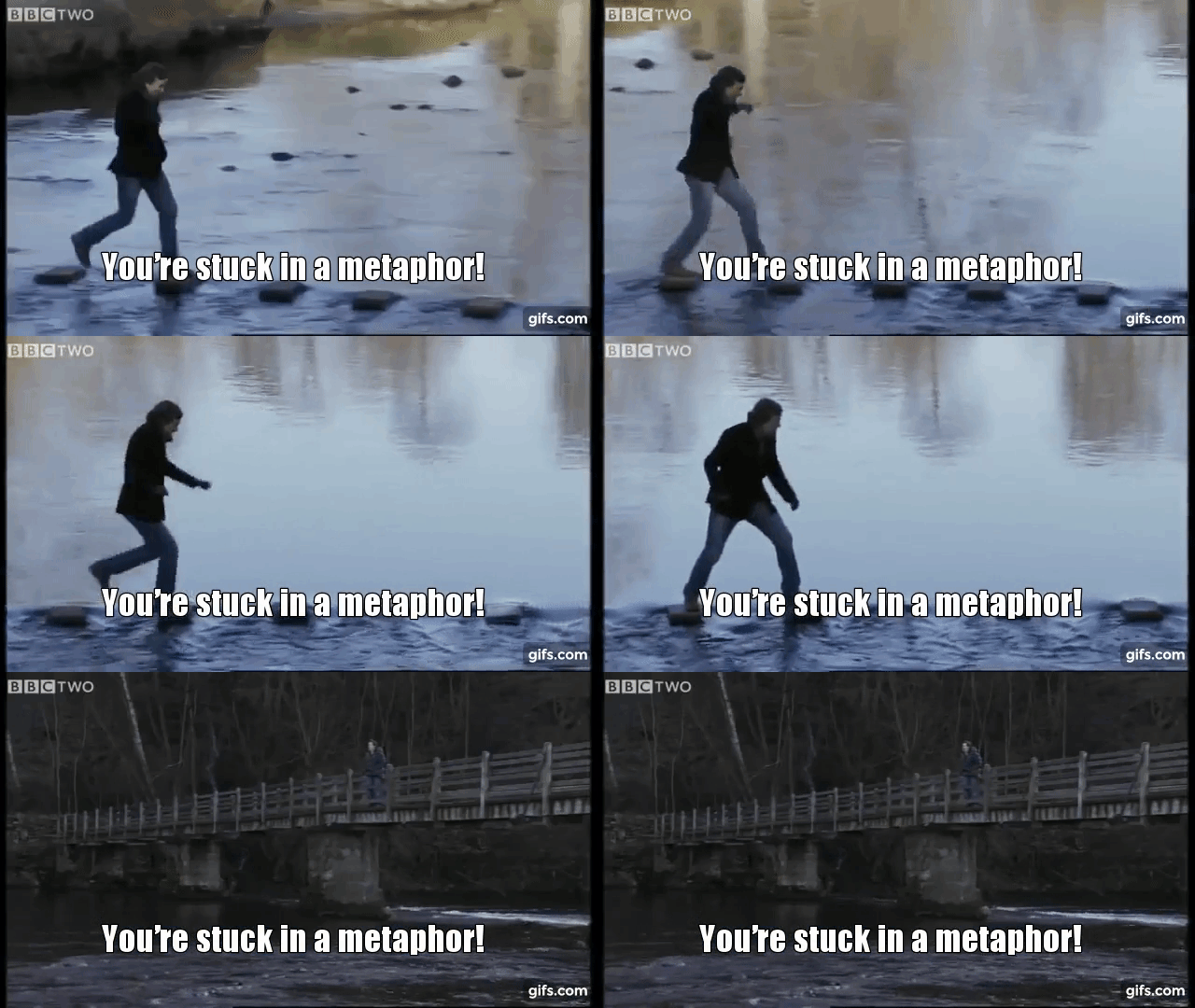
I won’t belabor the metaphor: This is all about avoiding burnout.

The repeated mantra somebody sent me that I’m keeping close to heart right now is “You’re not working from home. You’re at home trying to work.”

My job teaching at a university is not one designed to be done from the corner of my house over a webcam. Even if it was, the added complications of schools being closed, needing to be socially distant from our primary child care providers (aka, Sprout & Button’s grandparents), and losing just about every pressure release valve getting out of the house can provide… It can be easy to take your eye off the bagel.

Honestly, it got to the point where I wasn’t even sure where the bagel was, or what the bagel was.

P.S. “The Trip” is one I’m rewatching as mental comfort food right now.

But in this case, the bagel is what sustains you. It keeps you going. It gives you energy and pleasure and a reason to get up in the morning.

And right now, that bagel is jammed in an unpredictable toaster oven of a world. There’s no telling from moment-to-moment what the day or the week will try to do to that bagel.

You’ll miss the signs that something is going wrong if you get distracted.

And right now, it is very easy to get distracted.

Maybe it can help to use a timer, like the one on the toaster oven. To tell yourself that for X amount of minutes, this next thing is your bagel, and it’s going to have your complete attention. It’s one step I’m trying.

For me, it feels like my focus is an important tool to sharpen right now. Maybe you feel it, too.

Mindfulness, Meditation, and actually talking (a little) about Buddhism

“Wherever you are, make sure you’re there.”
— Dan Sullivan

“Wherever you go, there you are.”
— Buckaroo Banzai

One semester when I was in college and in need of electives to fill out my schedule, some friends mentioned they were looking into a class on Buddhism. I previously took a course on near eastern religion (Christianity, Judaism, & Islam), and figured this would be a good continuation of that deep dive.

Early on in the course, the professor used a metaphor to explain the idea that reincarnation had a lot of misconceptions around it.

As I remember it:

Imagine a film strip. Thousands of individual pictures. Thousands of moments. When you run the strip through a projector, it looks like you’re watching one continuous moving picture, but that’s just an illusion created by your mind.

You’re watching a series of moments that begin and end.

So instead of thinking of reincarnation as you are born, you live however many years you live, you die, and then you come back, think about how every single moment is like one frame of a movie.

The moment begins. You are there. Then it ends, and you are not. And it all happens so rapidly that it doesn’t even seem like they’re separate moments

You are born in that moment and you die in that moment, over and over.

Which would mean that there is very little difference between two frames that you believe are part of the same life, and two frames where you become a new self.

The film strip keeps moving, feeding each frame through, but each frame is only a single moment. You just believe that they’re showing continuous action because that’s how it appears to you.

If you wanted to pitch a film student on accepting the Buddhist worldview of non-being, that’s a damn good way to do it.

I don’t talk about this often, because despite all my reading and time spent meditating on my own, I’ve never sought out a community of other people walking this path. It’s been personal and mostly solitary, and in some ways that made me feel like I’m doing it wrong.

But even my limited glimpse of this larger world has helped me in ways I wish I could have seen earlier in my life.

I’m a person who survives with depression, and because of that, it can get easy to be pulled out of experiencing the moment and replay the past, or to see what’s happening in the present moment as part of an endless string of negative, connected events. It’s easy to construct a narrative tying together your worst feelings or lowest moments when you can’t separate out one moment from the others.

But the mindful awareness I try to tap into through meditation isn’t just about calming these impulses. It’s about working to focus my attention on what matters in the moment.

One quote I’ve recently grabbed onto about the effect of honing in on just one moment at a time:

“One day at a time. One. Day. And beyond this, one thought, one moment, one heartbeat. This, by the way, is why we practice meditation, which is not a life hack to become more awesome. Meditation is a path of fierce warriorship. It teaches you how to meet your experience on the spot, without embellishment, fully and courageously”

Susan Piver, Lion’s Roar

I’m writing this now, and opening up more about this part of me, because it feels like a time for fierce warriorship.


It’s easy to get bogged down in the endless refresh cycle, checking social media and news sites for updates on what we should fear and feel angry about.

It’s easy to feel powerless in the face of a global threat, especially one that seems invisible and nigh-invulnerable to direct human intervention.

And there’s a massive gravitational pull from the fear of what might happen to those closest to us, and how our personal worlds could be made much more empty by a disease for which there is no vaccine, no scientifically-proven cure, and a paucity of resources to properly treat those afflicted if its spread is allowed to go unchecked.

It’s all so much, and it all seems to keep building and getting worse.

And yet, for those of us still fortunate enough to stay healthy, we are here in this moment.

So I ask you to consider, if you’re able, and if you’re willing, to try to confront this moment on its terms, as it exists, and not through the lens of fear or anger.

Because we can do nothing for ourselves or each other if we shut off. If we let the enormity of this all pin us down and hold us powerless, we can lose sight of our role and our strength.

And without a clear understanding of our strength, it can be hard to find hope.


I know the full Buddhist toolkit isn’t for everyone. I know because I haven’t taken it all on myself. But I have gotten some help from some of these texts:

Or if you just want to dip your toe in first before committing to a whole book, this blog post from Rebecca Toh I linked to on Twitter the other day is a good way to test the waters.


It’s something I hope you’ll consider right now, especially if you’re a person staying at home for the good of your community, or by necessity. It can be easy when sheltering in place for an extended time to feel like every day is part of one endless slog.

Maybe it will help you to feel less like the days are all repeating or merging together if you’re alone.

Maybe it could help you treat the people you are staying inside with with more patience and grace, and see their actions as existing in only this moment, instead of part of a narrative you’re stringing together during your extended time bottled up together.

Maybe it will help you feel like less of a passive observer of events and consider ways you can offer help to those in need.

Even if it’s only for the space of one breath, or the time it takes to wash your hands, maybe it will help you step outside of the narratives hanging over you and find some space to be the kind of fierce, compassionate warrior this world needs right now.
Tomorrow could be better.

It’s not much, but that’s the idea that sustains me.

Developing coping mechanisms for depression (and actually seeking treatment) before the world went into a state of isolation and fear is something that’s helping me keep perspective.

No matter what today throws at me, or how disappointed and weary and angry I might feel at the end of the day, I made it to the end.

Tomorrow could be better. I don’t know yet. I have to get there to find out.

Because no matter how hard I think about the things I could’ve done differently in the past to make this a better day, that’s a fruitless exercise.

There’s a name for a mental habit connected to depression: rumination. It’s all about focusing on the past, mulling it over, trying to solve it like a problem.

There’s a passage in The Mindful Way through Depression about it:

When we ruminate, we become fruitlessly preoccupied with the fact that we are unhappy and with the causes, meanings, and consequences of our unhappiness. Research has repeatedly shown that if we have tended to react to our sad or depressed moods in these ways in the past, then we are likely to find the same strategy volunteering to “help” again and again when our mood starts to slide. And it will have the same effect: we’ll get stuck in the very mood from which we are trying to escape…

Rumination invariably backfires. It merely compounds our misery. It’s a heroic attempt to solve a problem that it is just not capable of solving.

Dissecting the day doesn’t make it any better. And analyzing how you would make different choices about today doesn’t necessarily apply to tomorrow, since every day might feel the same (especially now, when so many people are isolating themselves and their families away from the rest of their communities), but it won’t work. No two days are the exact same.

Today is already written. There’s no erasing it or tearing out that page. I can’t make tomorrow simply a more polished revision of today.

So I need to turn to the next blank sheet and start again. Start over.

Because tomorrow could be better.

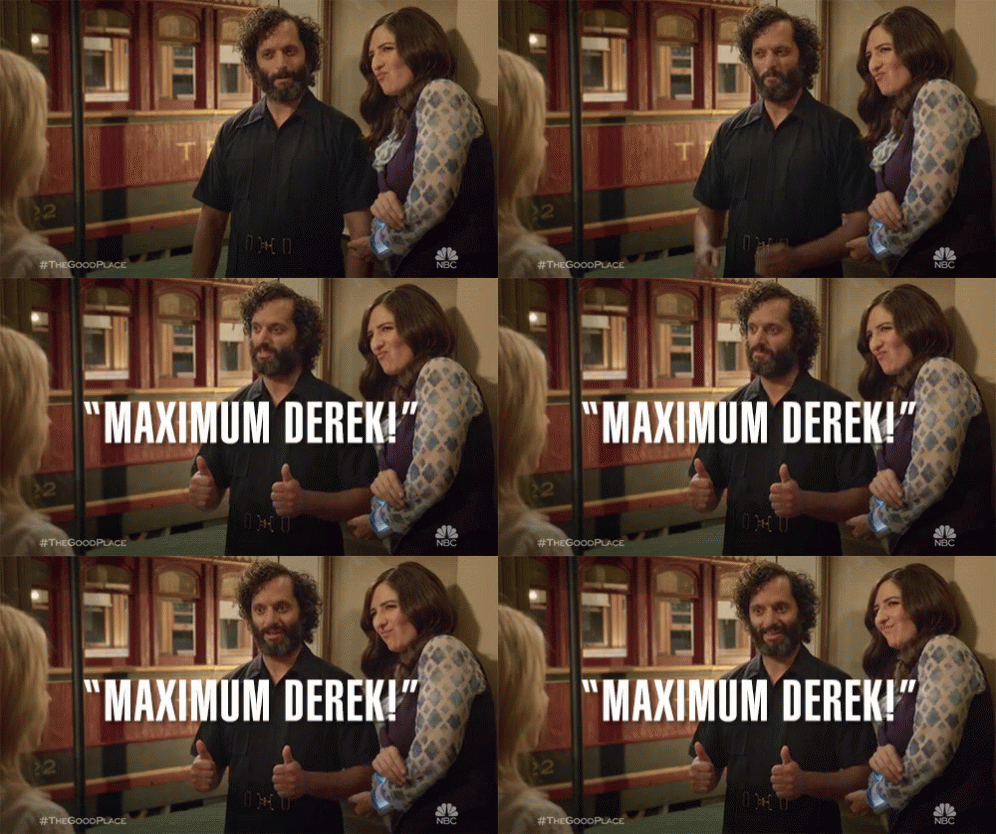
“Derek doesn’t have a penis. He has wind chimes.”

We’ve been watching The Good Place with our five-year-old.

Don’t make that face. I see it.

Dena and I are huge fans of The Good Place, just like we were fans of Parks & Recreation, but we were moved to start introducing it to our daughter as a way to prompt discussion with her about being kind, and what it means to think about doing kind things for other people and for herself.

Yes, the show has a lot of fart jokes, but it also has teachable moments about making good choices and being honest.

Some of the stuff flies right over her head, and we’re fine with that. Even when things like this happen:

(Sprout’s grandfather’s iPhone makes the Chimes alarm sound)

Dena: (under her breath, to me) Derek?

Sprout: (enthusiastic, to her grandma) There’s this show called The Good Place and there’s a character named Derek. Derek doesn’t have a penis. He has wind chimes!

Look… I regret nothing.

Yes, watching this show with her means that we have embarassing moments like that, and it also means we have to watch her imitate Bad Janet farts so, so many times.

But it means that we get to talk with her about big, important ideas about being a good person.

It means she gets to watch a show that had a strong commitment to purposefully diverse casting, showing her a more accurate depiction of the different people that make up our world and our communities.

And it will give us a chance to talk about doubt, and fear, and despair, and cruelty. Because there’s plenty of reason to discuss those things, and to start giving her the tools to call them out and rise above them.

We would never stick her in front of a TV and hit autoplay on this show. It’s a lot, even for grown-ups. If we watch an episode, we usually spend time afterward talking through what we saw.

But the act of watching with her is important. So she sees us actively engaging with the story and the ideas in the story. So she can ask us questions. And so she can get into the habit of treating the media she consumes more thoughtfully.

When I was a kid, I watched movies as a way to talk with my dad about atomic bombs and the Cold War. These were heavy topics, but the giant monsters and cheesy effects made it palatable.

But the message of the act of watching stuck with me: Never take a story for granted, and always ask why this story is being told.

That’s a question I want my kids to be confident in asking.

Subtitles for Early Readers

We leave subtitles on the TV as a default in our home. It started as Dena’s personal preference, but became a necessity in order to keep the volume down due to apartment living and shared walls. Then we had a baby, and we didn’t want to disturb Sprout while she slept.

Keeping the subtitles on became habit, and a useful one. Little jokes didn’t fly by unnoticed. Shows and movies became more quotable.

And then Sprout started reading.

The moment this all came together was while watching the Sesame Street anniversary special. Dena and I watched as Sprout used the subtitles to sing along with a song she’d never heard before, and my heart became a puddle of feelings.

Then came the Sunday morning Sprout tromped downstairs to find me watching Solaris. She grabbed a blanket, snuggled up next to me, and started reading the screen.

“That’s not what they’re saying?”

“No. They’re speaking in Russian. Those words on the screen tell us what the words mean in English.”

“Oh.”

(five minutes pass)

“Can I watch PBS Kids?”

The next weekend, she comes down while I’m watching Floating Weeds. She grabbed a blanket, snuggled in, and this time started asking questions about the story.

We watched about a half hour before she got bored and wanted to see if there were new episodes of Xavier Riddle and the Secret Museum. But for that half hour, we were sharing a lazy morning with an Ozu film.

I know it’s still a long time before she’ll be fully onboard and I’ll get to watch some of my favorite foreign films with her. I’m not expecting to have a five-year-old who wants to start her day watching Wong Kar-Wai or Ingmar Bergman films.

What I want is to plant the idea in her head that the subtitles are just there. They don’t make the movie something other or more difficult. If anything, I hope she’ll see the value they offer, giving her a gateway to stories from all around the world that she wouldn’t otherwise have access to.

We set expectations for kids with what we enjoy and share with them. My parents watched a lot of black and white movies, so I thought it was normal to watch older films. And that habit never really went away for me.

Or when we listen to music, and we pepper in some of our favorites, or some other genres, in with the kid music. It doesn’t always pay dividends, but when I start a jazz playlist during breakfast and Sprout puts down her spoon to snap along, well… It’s a good feeling.

But I need to remind myself with all of this that it’s not about making sure she likes the same things I like.

Whenever I’m sharing music, or movies, or food, it needs to be about the idea of making sure she gets to try new and different things. She’s very five, so she’s not shy about what she does and doesn’t like.

My hope is that she’ll get a strong sense of her personal taste. She’ll be able to explain and understand what she likes and doesn’t like. She’ll seek out and explore. She won’t passively shrug and accept whatever’s presented to her as vaguely okay, but instead, she’ll look for something to love.

Or, at the very least, that she won’t roll her eyes and think it’s weird when I suggest we watch a movie with subtitles.