When writing feels like cutting teeth

My son is teething hard. I had a dream that he suddenly went from no teeth to eight teeth overnight, and some days it seems like he’s determined to make that a reality.

“nom nom nom”

It’s a hard process. Each tooth needs to erupt from the gums, which takes a lot of time, force, and pain.

And when it’s all done, and they get those baby teeth in, that’s not the end of the story. There’s a second draft of that mouthful of teeth, waiting on deck.

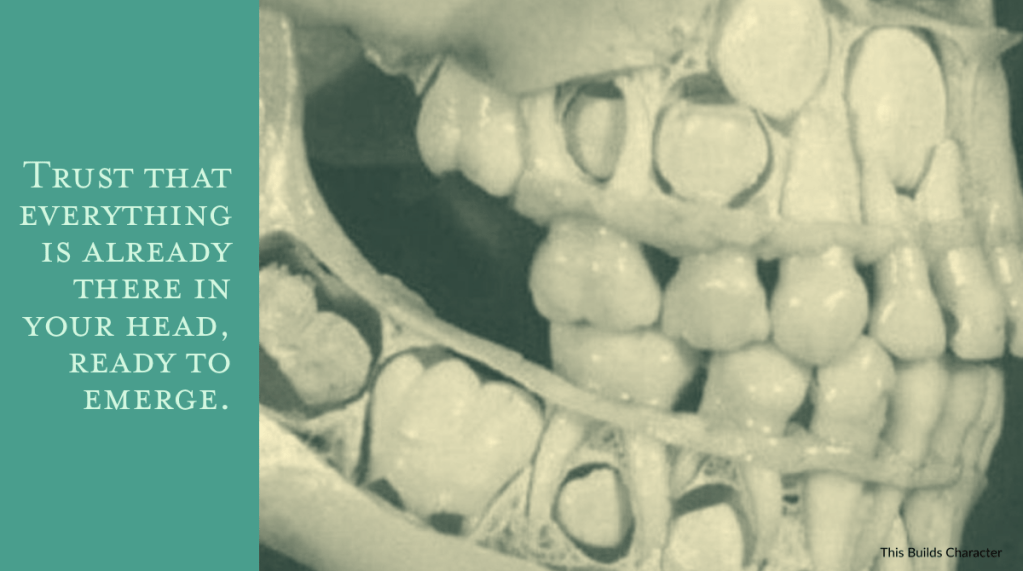
If you’ve never seen an image of a child’s skull with both sets of teeth inside, it’s… something else.

I’m a little sorry if this makes you horrified of small children.

I’ve been focused on new projects lately. First drafts and new collaborations. Ideas pushing hard, trying to break through and emerge.

And there are times when it feels painful. Like things aren’t moving fast enough, and you just wish you could force things along faster, (like how I imagine Button feels when he’s gnawing on a teether).

Yes, it looks like a coffee cup. I am relentlessly #onbrand, even when picking out baby stuff.

Or when you know that you need to choose to put your butt in the seat and get some ideas out onto the page, but you have to choose that over other things that might also be be fun or important.

But I have to remind myself that the work can continue, and the pages will come, and then… well that’s when it’s time for the next draft.

Which brings me back to that baby skull full of teeth.

Because getting the idea out into the world isn’t the final act. Those pages and ideas fall out and get cast off to make way for bigger, stronger ideas.

But trust that even before that first idea has broken through, the full shape of what’s to come is there, in your head. And it just takes time, and force, and pain.

Really Wash Your Hands

It’s not just about fear. If you want to make this about COVID-19 or flu season, you can. But those aren’t the only reasons hand washing is worth talking about.

Go ahead and sing the ABC song to make sure you’re taking enough time to effectively remove germs and bacteria from your hands, but don’t switch to auto pilot while you do it.

Use this time as a moment for meditation.

Think about what your hands do for you. What they touch. How they feel. What the water feels like against your skin, and how your hands feel touching each other.

Take time to think about each part of your hands. The fingernails. The tips of your fingers. The knuckles. The palms. The back of your hand.

How well do you really know the back of your hand?

Are you taking care of yourself? What can your hands tell you about that?

Is the skin on your hands dry or cracked? Are the nails in need of clipping? Are there callouses or sore joints? Minor cuts that you ignored that could use a bandage?

And if you’re ignoring these problems with your hands, take that moment to ask yourself if there are other problems you’re ignoring; other ways you could better care for your body.

This is time to slow down and feel grounded.

This is time to feel gratitude for the soap and clean water that help keep you and those you come in contact with healthy.

This is a time to remember your body needs your attention in ways great and small.

Treat washing your hands like a gift to yourself; a gift of time and presence.

Your hands empty. Your mind focused. You have the chance to reset from a rough day, or to reinforce the calm and focus of a good day.

Commit to slowing down and taking time to wash your hands.

Advertising to the Affirmative Audience

Early on in the semester with my advertising classes, we talk about the relationship between the intended audience and the brand doing the advertising. The idea is that you’re not always trying to change people’s minds, but sometimes you’re trying to excite people who are already fans of the brand.

It’s called advertising to an Affirmative Audience.

It seems on the surface to be a little silly: Why spend money to get the attention of people who already like you and what you sell?

Advertising to the Affirmative Audience helps keep them aware of new products (like, for example, a new iPhone or Playstation). It also encourages them to feel good about their continued use of a product or service (say, if you’re a subscription service like Netflix or Spotify).

It’s a way to get people to reaffirm their enthusiasm, so that they don’t lose interest, and so that they maintain that positive relationship with the brand.

Which is why I want to take a quick moment to talk about foreign election interference.

A possible relationship between disinformation campaigns and advertising strategy

While scanning the comments to a New York Times article on an intelligence briefing about Russia’s desire to interfere with the 2020 election, I saw the following:

Okay, I’ll bite.

Let’s say the point of election interference isn’t about changing people’s minds from one party to another. Let’s take the perspective that the goal is to preach to the choir.

When advertising to an Affirmative Audience that already agrees with you, you strengthen their connection to your message.

The more a message connects with an audience, the more it becomes a part of their personal identity.

You can refute a loosely held belief with some effort, but if a person sees multiple messages reinforcing a misconception it can help to entrench that idea in their mind.

It’s part of how our minds work. The more connections we have in our brains to a central idea, the more likely we are to believe that central idea.

It’s unlikely a dank meme would turn a Democratic voter into a Republican voter, or vice versa.

But if a certain message, targeted at a person who is already predisposed toward the opinions of one party, gets repeated over and over, that becomes easier for them to believe.

If you see a piece of disinformation presented enough times, from what seems like a variety of different sources, it seems more believable. And if it already confirms something you already loosely believed, you’re even more likely to take it as the truth.

The more convinced a person becomes of the truth in a false statement, the less likely contradictory information will have any impact on their opinion—especially if the contradicting, true, information doesn’t agree with their previously held beliefs.

“But this still doesn’t explain how disinformation could affect an election.”

Take somebody who isn’t a regular voter and give them a steady stream of disinformation that supports one candidate while affirming their previously held beliefs, and now you have someone who will show up on election day to cast their ballot.

Take somebody who had an interest in a candidate and regularly present them with disinformation supporting their interest and they’ll be less likely to believe contradictory information that shows that candidate in a negative light.

A disinformation campaign doesn’t need to change minds to be effective. It might be more effective if it works to prevent people from changing their minds.

What happened at my grandfather’s funeral

For years, my grandfather’s health has been a swinging pendulum. Every time I would get the call saying that this looked like he had hit a point of inevitable decline, he recover. Sure, these things seemed to be losing momentum for his body, but the pendulum always swung back.

Then the clockwork mechanism finally gave up.

During these years of pre-mourning, my grandfather had asked me to be a pall bearer at his funeral. He said it the way most people end a visit with “Drive safe,” or “See you soon.” Every time we would part company, or end a phone conversation, I would be reminded that he was thinking about his funeral.

It weighed on me, thinking about how myself and my cousins (two of them his other grandchildren) were tasked with carrying him this last distance. At least I knew that we had a role to play.

He had always said he wanted a simple, brief service, so I wouldn’t be contributing my words or memories. Most of us wouldn’t. All he said he wanted read was a short piece he had written himself a few years ago, to say goodbye to his wife and children.

But I could carry him and lay him to rest, and that would be enough.

I prepared for the task, pounding down a scalding hot bowl of chili from The Custard Stand. The place was a favorite destination whenever I would visit West Virginia.

I thought about the apron laid out on the table in the funeral home, which had the title “Junk Food Angel” added to it. It was a nickname I gave him as a child because he loved to make cakes and fudge, and I always wound up loaded with an amount of sugar that was expressly forbidden in my own home every time I would come down for a visit.

I thought about him teaching me how to drive at much too young an age out on his property in his old GMC truck. Teaching me about how to safely handle a rifle. How to make sausage gravy.

But when my family arrived at the funeral home, my dad took me aside. There had been a change.

I wouldn’t be a pall bearer. None of the grandchildren would.

Because my grandfather had asked for Masonic Rites at his funeral. The freemasons declared that they were the ones to carry the casket (or else they wouldn’t do any of the other rites). It was all or nothing, and they were prepared to leave.

With ten minutes to go before the start of the service, my grandfather’s wishes for his funeral were apparently being altered, and some of us were blindsided.

What’s easy and what’s necessary

It was easy to get angry.

For years I had built up this moment in my head; prepared myself to carry a casket and bear this weight. A cathartic moment to put a button on years of close calls and premature emergency trips. The moment had come, and now it would pass.

And then a dozen guys, all strangers, most of them in ratty jeans and t-shirts, show up in their gloves and tiny white aprons and demand to take over.

It was easy to be mad at how the role of the grandsons was reduced to kind of putting a hand on the flag-draped casket as the freemasons yanked it away from us into the hearse.

And as they rushed down the hill at the cemetery, where each of them had driven their oversized trucks separately (causing a pile up in the tiny dirt parking lot), it was easy to fume about the way they’d taken over this whole ceremony, leaving the rest of us to try to keep up as we dodged tombstones, mud puddles, and piles of deer droppings.

Anger came easily, but it wasn’t what I needed.

I needed to be present. I needed to feel my loss, my grief. I needed to be here as part of my family.

This wasn’t the moment I had anticipated, but it was the moment I had, and it was the only time I would get it.

And while I had to work to get there, I came to the comforting thought that I didn’t need to compartmentalize. I didn’t need to pour all of my grief and sadness into a single day that had been chosen for it.

I don’t need to make an appointment for my emotions. I am able to grieve on my own time.

A person’s life is like a song

Every day they add a little more to it: A melody, a rest, another sounding of a pedal tone. And when they die, they stop composing.

Maybe we’re lucky and they leave behind a recording; something we can listen to when we want to remember them and hear that song exactly the way they played it.

Or we might be fortunate to see that they left sheet music behind. It’s up to us to practice it and make our best guess as to how they played it when we want to remember them, but they gave us a strong indication of what they wanted to leave behind.

But sometimes we need to be content with that part of the song that gets stuck in our head. The tune that we can whistle. The barest scrap of the composition, left to stand in for the absent whole.

But it’s something to remind us. Something to carry forward.

Because it doesn’t matter who got to carry my grandfather’s body to where it rests now.

It matters if I live up to my promise to my daughter and make apple butter for her so that she can still put it on literally anything and everything, and so that she remembers she had a great-grandfather that always wanted to make sure she had jars of it, made with love just for her.

It matters that I remember his words, reminding me about the importance of my education; of taking care and ownership of my mind. How one of the last times I spent a great deal of time with him, everywhere we went, he introduced me as his grandson, “the professor.”

When I watch a Western. When I make his recipe for sausage gravy. When I share the road with a semi truck and remember his instructions about never being behind one when going uphill, or in front of one headed downhill.

And I’ll remember his last years, too. And how I won’t want to emulate those parts of the end that put such a weight on the rest of his family. Because you can still honor someone’s memory by taking a different path, so long as you remember why you’re making those choices.

I was not able to carry his body, but I know I can carry a tune. I hope I will be able to stay in the right key.

Coffee and Gratitude

Truth.

Coffee is essential to my morning routine. Even if I get a good night’s sleep, that first (or third) cup of coffee in the morning is really what sets the tone for my day.

And some mornings, if I’m having a hard time waking up and doing anything else while I drink the coffee, I like to take the time to meditate on how grateful I am for that coffee. I remind myself about how this small, warm cup of energy in front of me is the result of my connection to a much larger world.

There’s the ingredients to the coffee. The beans themselves were stocked on store shelves by people who work on the store. They were brought to the store on a truck, and somebody had to load, drive, and unload that truck. People roasted and packaged the beans before they were put on the truck. Other people shipped the beans from where they were grown to the place they were roasted. People grew those beans, tended to the plants, and harvested the crop. Which means that I’m also thankful for the place that the beans grew: for the soil, the plants themselves, and the climate that allowed for planting coffee there.

So yes, if I buy a bag of beans that originated in Kenya, I am taking a moment to bless the rains down in Africa.

There’s a similar chain of people involved if I put sugar in my coffee. If I add cream, I also get to feel gratitude toward cows.

The water from my coffee comes from our well, so I’m thankful to the people who drilled our well, to the people who installed the plumbing in our home so I could use that water, and to the aquifer that we draw our water from.

There’s my coffee maker, which had to be assembled by people according to a design made by people. My coffee maker uses electricity, so I’m thankful to the people who installed the wiring in our home, to the people who maintain the power lines that run to our home, and the people who operate the power plant that provides us with electricity.

I’m drinking the coffee from a mug. In this case, it’s a Star Wars mug with a picture of the Death Star that my in-laws got me as a Christmas gift, so I’m thankful to them (especially because it’s a huge mug). I’m thankful for the people who made the mug. I’m thankful to the people who decided to put Star Wars branding on the mug, since it encouraged the gift purchase.

So I’m also thankful to George Lucas when I’m drinking coffee this morning.

“I bet this will look great on a coffee mug in 30 or 40 years.”

And this has barely scratched the surface, because you could think about how all those trucks that had to carry different goods to stores were traveling on roads that had to be built and maintained by people. They had to be planned out by people. They had to be funded by many, many people through taxes.

If there were boats involved in shipping some of the goods, well there’s room to feel gratitude toward the people who designed and built those boats. There’s also cause to be thankful to the designers of the first boats.

And if I’m stretching back that far, I should feel gratitude to the first people who decided that they should throw some ground up beans in boiling water and drink the result, because that was a stroke of genius.

There is little we can enjoy in this world that hasn’t in some way been touched by other people.

When we don’t remember that; don’t acknowledge that, it can harden our hearts. It can lead us to giving ourselves too much credit for our joys and our successes. It can make us feel disconnected from others.

And it can make us forget how much we owe to each other.