Current Mental Conditions vs. The Mental Forecast

It was a Saturday morning, and my daughter had been awake for forty-five minutes. By that point she had already peppered me with questions about what family birthdays are in which month, fourteen pieces of Star Wars minutiae, and three requests to look at her baby pictures. That’s when Dena texted from upstairs that our son was awake and needed his diaper changed.

Somewhere between closing the snaps on his pajamas and heading back downstairs to start toasting bagels, I looked over my to-do list. That’s when I had The Thought:

“It’s 8 a.m., and the productive part of my day was over an hour ago.”

A few months ago, this thought would’ve locked me in for (to paraphrase the words of The West Wing’s Charlie Young) a “low self-image day.” That to-do list would’ve been set aside, and lethargy would have taken over.

But not this day. This day I thought about the difference between the current mental conditions and the mental forecast.

Even if you hyper-schedule your day, you still don’t know exactly how you’re going to feel a few hours from now, or if the reality of your day is going to match your plan. Unless, that is, you decide that your interpretation of your current mental state and the outside forces acting on it are a prediction of what’s to come, and you live out your self-fulfilling prophecy.

At any given point, our mood is a snapshot of the current conditions. It’s useless, at best, to assume that how you feel now is how you will feel in the future.

Like any good forecast, you need to look at other conditions that hold influence over you.

Because unlike the weather, you have options to head off a storm front moving in inside your head. You need to be able to take that moment to step back and clearly see what you’re looking at when you look at your mental state.

This isn’t just for people with depression. Every person makes predictions about what might happen in the future, but the only information we have is what we can see and hear in the present. Any person might make a bad prediction. While my depression doesn’t create a unique problem in that sense, it does make it harder to differentiate between the current conditions and the forecast.

But I’m learning.

I ate my bagel. Had some coffee. Washed some dishes. Gave my son a bath. Wrote the first draft of this post, and got a lot of other boxes checked off in my to-do list.

And a big part of why the day didn’t stop at 8 a.m. was because I’m learning to be a better emotional meteorologist.

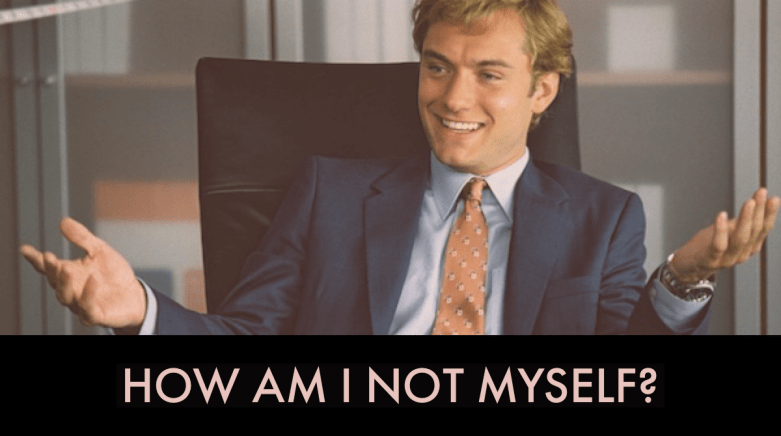
How am I not myself?

Ever since I started using streaming music services, I’ve wondered about how much of my listening choices have been shaped by the service. Am I really listening to what I want to, or have I been going with the algorithm’s flow, listening to minor variations on what it knows of my past preferences?

Then again, I was never really picking songs out of nowhere.

There was my father’s record collection in the basement, where his taste shaped mine. There were recommendations from friends. There were the songs on the radio, selected by tastemakers and marketers. There was what was available to me in local stores, or who I might see perform on the tv shows I watched (which were determined by the people who booked talent for those shows, and the network executives that decided what shows to produce).

Other people already shaped my taste, but I could exert control by saying yes or no to their suggestions.

The same goes for films that I watch and re-watch. Sure, Netflix may try to suggest what it thinks I would like to see next, but I have final say. Like with music, when it comes to film, I never made choices in a complete void. I was influenced by everything from professors in school, my friends, the “Best Of” list books I pored over, the programmers at Turner Classic Movies… And so on.

What I was exposed to created a rubric for me to interpret my reactions and opinions, but in the end I would get to say yes or no.

And I’m thinking about this more when I question why it took me so long to make the leap and try antidepressants.

While growing up, people would talk to me about the way my brain seemed to operate differently than other people’s. That it was unique in a positive way.

During one long night in high school, working on a homecoming float, a friend took me aside and told me that I shouldn’t ever take drugs, because “They’ll just make you like everyone else.” It was a pretty odd PSA moment, but it stuck with me.

For a long time, I consciously connected the idea of drugs that alter your mood or perceptions as changing something essential about you. Maybe it had to do with the way I identified as a creative person, and there were so many creative people who were heralded for making beautiful art out of their pain. Creative people who talked openly about their disdain for the idea of doing anything to alter their relationship between their mind and their work.

And there were direct testimonials from people whose work I respected, like when reading David Lynch’s comments on drugs (in general) from Catching the Big Fish:

We all want expanded consciousness and bliss. It’s a natural, human desire. And a lot of people look for it in drugs. But the problem is that the body, the physiology, takes a hard hit on drugs. Drugs injure the nervous system, so that they just make it harder to get those experiences on your own.

The messages about how drugs (of all types) work sunk in. That altering your chemistry altered something essential about you. I had a fear of becoming somebody else. Dulled. Losing my edge.

And I lied to myself that it was worth all the suffering so long as I could hold on to those occasional moments and fight through it to think up something beautiful or original.

But at some point I had to ask the question out of I Heart Huckabees: How am I not myself?

16A615B3-C2FD-4457-AD0A-FFECED97DFED

If other people, other stories, other choices, other influences touch my life every day, but I’m still somehow essentially me, why should medication be any different?

It was a risk I was finally willing to take, because of two things:

  1. Acknowledging that the version of myself that I became without some kind of intervention had become someone incapable of properly doing the things I care about, or being helpful to the people I care about.
  2. Acknowledging that nothing is permanent, and that if one intervention doesn’t work or has negative side effects, there are other methods to try.

And I feel different. I feel more resilient. More able to grasp moments of happiness.

But am I myself?

When am I not?

To say that medication makes me no longer myself is to suggest that a person has little to no free will, that we’re just chemical processes dancing with our reactions to our environment. If changing the internal chemistry of my body makes me a fundamentally different individual, then so would taking a vitamin C supplement or an aspirin.

A person has to be more than their chemistry, their DNA, their “programming.” Otherwise, there would be little difference at all between a human and an algorithm.

There’s no difference between what’s inside a bedroom with the lights on or off. It’s just that when you turn the lights on, the shadows stop looking like monsters.


Other uses for seeds that don’t sprout

This morning, I watched a squirrel eating helicopter seeds off the ground.

Look, when your mind latches on to an analogy, and the world around you seems to be prompting you, just run with it.

The tree made the seeds to try and grow more trees. Instead, that tree was feeding a squirrel, so that squirrel had the energy to keep running around, being a squirrel.

When the helicopter seeds come raining down heavy, on a windy day, or in a storm, sometimes they can clog the gutter on a house. Maybe that causes the owner of the house to climb up on a ladder to clear the gutter, changing the shape of their day. Maybe they go to a home improvement store to buy some gutter guards, creating another project that takes some of their time (and moving money around in the economy).

The seeds aren’t fulfilling their intended purpose, but they’re not without purpose.

Pages might not make the finished draft of a story. Your script might not make the cut for the next round of the competition. Your tweet might get a lackluster number of Likes.

Only attaching value to an action if it gets the desired result diminishes your ability to see inherent value in the action itself. It diminishes your ability to see value in yourself.

Don’t get discouraged. Do the work. Clog the gutters.

On continuing to try

Out for a run this morning, I watched a helicopter seed spiral out of a tree and land on the concrete.

Nothing will come of that seed. It has nowhere left to go.

But the tree has hundreds more seeds to drop, just waiting for the right breeze.

Any one of them might land somewhere that it might take hold and sprout, but the tree needs to keep producing seeds, regardless of where each one lands.

And that’s what I want to think about when I try to remember the importance of valuing the process and the habit of work instead of only valuing the end results.

Because a helicopter seed can spiral gracefully no matter where it lands.

The One Where I Write About Depression

At the beginning of this year, my four-year-old daughter was interrogating me at the breakfast table.

Sprout: What did you want to be when you were a kid?

Me: When I was about your age, I wanted to be a paleontologist and dig up dinosaur bones. But when I got a little bit older, I wanted to make movies. So that’s —

Sprout: You must be sad.

Me: What?

Sprout: Because you’re not doing any of the things you wanted to do.

There are layers to that conversation, and it put me in a deep rut. For days. It kept repeating in my head, having my daughter call me out in such a direct way.

Was she just being precocious, or was she right on the money, and noticing something I hadn’t?

It would take me a while to acknowledge that there was a deeper problem. I needed help, and it wasn’t just about my career.

When I was in grad school, it was easy to ignore issues I was having because of my general busyness and the novelty of living in a new place. It was the same when I would start teaching at a new school, or with Sprout coming into our lives. So long as there was a Big Important New Project to throw myself into, I could use that work to paper things over and ignore what was beneath the surface.

But no success was ever enough. Every failure or missed opportunity felt apocalyptic. It got to a point where I would mull over and second-guess a three sentence email for several anxious hours.

And with the end of the school year, I was spending afternoons on the couch, eating junk food and letting auto-play on the TV do its thing. I kept telling myself tomorrow might be better. And then tomorrow would wind up just like the day before.

Sure, there were lots of things to prep for a new baby, and lots of other work to be done, but I still had plenty of time for the things that I enjoy the most. If I could just get to them. If I could just get myself to try.

And getting myself to try kept getting more difficult.

So I did what the commercials tell you to do: I talked to my Doctor.

As of writing this, I’ve spent almost a month taking an SNRI antidepressant.

I’m sharing this because so far it seems to be helping. It’s not a night-and-day difference. I’m not suddenly one of the happy, peppy people crushing it 24/7. But I’m more resilient. The strategies I have to bounce back are working better. I feel more aware of what I’m feeling and why I’m feeling it.

I’m sharing this to acknowledge that this is something I should’ve tried years ago. Looking back, I can see how a lot of the choices I made, the missed opportunities that passed me by, and my reactions were related not to some kind of innate unworthiness, but a glitch in brain chemistry. I can’t get that time or those choices back, but I can change how I see myself today and what I do from now on.

I’m sharing this because if even one person reads this and asks questions, or goes to get help, then I can feel like I’ve left a ladder behind after I climbed out of this hole.

Because living with depression was like being haunted. But instead of having books launch off your shelves, or spectral visions trying to teach you the true meaning of Christmas, it was like seeing shades of your past self taunting you.

The person you thought you were, who thought they’d be somewhere else by now. The person you thought you’d be. The multitude of different “yous” that never got a chance to exist. All there. Darting in and out of your peripheral vision. Distracting you and keeping you frozen in place, feeling trapped and powerless compared to them.

And in just a few weeks, I see small ways that I’m busting those ghosts. Making room to feel positive things again. And it’s not just me who sees it. Like in a conversation with my wife the day after I made some pretty excellent shrimp tacos with homemade guacamole and pico de gallo.

Me: I think I like cooking again?

Dena: I think you like a lot of things again.

I like liking things.

What I’m doing right now may not be the only answer for me, but it’s an answer that’s helping right now.

Medication is giving me the leverage I need to do the heavy lifting of fighting these ideas that my brain was misinterpreting as facts. It’s helping me to get my butt in a chair and put words back on the screen.

It’s helping me fight to make the most of today. It’s helping me start to fight for tomorrow as if tomorrow matters.

But most of all, I hope it can help me show my daughter that what I’m doing right now, in this moment, does not make me feel sad.