How am I not myself?

Ever since I started using streaming music services, I’ve wondered about how much of my listening choices have been shaped by the service. Am I really listening to what I want to, or have I been going with the algorithm’s flow, listening to minor variations on what it knows of my past preferences?

Then again, I was never really picking songs out of nowhere.

There was my father’s record collection in the basement, where his taste shaped mine. There were recommendations from friends. There were the songs on the radio, selected by tastemakers and marketers. There was what was available to me in local stores, or who I might see perform on the tv shows I watched (which were determined by the people who booked talent for those shows, and the network executives that decided what shows to produce).

Other people already shaped my taste, but I could exert control by saying yes or no to their suggestions.

The same goes for films that I watch and re-watch. Sure, Netflix may try to suggest what it thinks I would like to see next, but I have final say. Like with music, when it comes to film, I never made choices in a complete void. I was influenced by everything from professors in school, my friends, the “Best Of” list books I pored over, the programmers at Turner Classic Movies… And so on.

What I was exposed to created a rubric for me to interpret my reactions and opinions, but in the end I would get to say yes or no.

And I’m thinking about this more when I question why it took me so long to make the leap and try antidepressants.

While growing up, people would talk to me about the way my brain seemed to operate differently than other people’s. That it was unique in a positive way.

During one long night in high school, working on a homecoming float, a friend took me aside and told me that I shouldn’t ever take drugs, because “They’ll just make you like everyone else.” It was a pretty odd PSA moment, but it stuck with me.

For a long time, I consciously connected the idea of drugs that alter your mood or perceptions as changing something essential about you. Maybe it had to do with the way I identified as a creative person, and there were so many creative people who were heralded for making beautiful art out of their pain. Creative people who talked openly about their disdain for the idea of doing anything to alter their relationship between their mind and their work.

And there were direct testimonials from people whose work I respected, like when reading David Lynch’s comments on drugs (in general) from Catching the Big Fish:

We all want expanded consciousness and bliss. It’s a natural, human desire. And a lot of people look for it in drugs. But the problem is that the body, the physiology, takes a hard hit on drugs. Drugs injure the nervous system, so that they just make it harder to get those experiences on your own.

The messages about how drugs (of all types) work sunk in. That altering your chemistry altered something essential about you. I had a fear of becoming somebody else. Dulled. Losing my edge.

And I lied to myself that it was worth all the suffering so long as I could hold on to those occasional moments and fight through it to think up something beautiful or original.

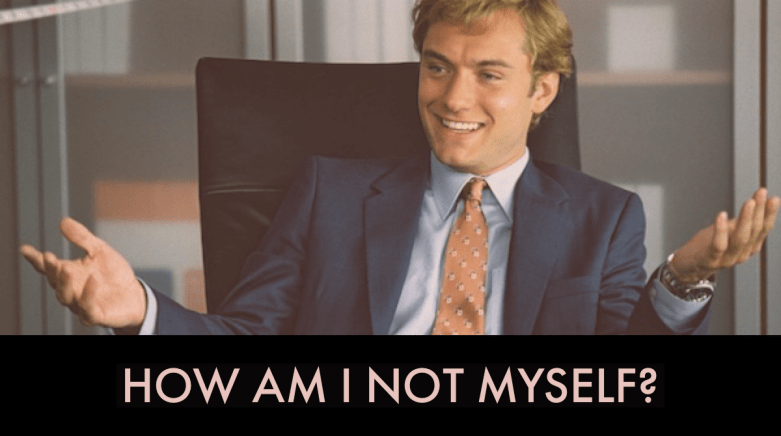
But at some point I had to ask the question out of I Heart Huckabees: How am I not myself?
16A615B3-C2FD-4457-AD0A-FFECED97DFED

If other people, other stories, other choices, other influences touch my life every day, but I’m still somehow essentially me, why should medication be any different?

It was a risk I was finally willing to take, because of two things:

  1. Acknowledging that the version of myself that I became without some kind of intervention had become someone incapable of properly doing the things I care about, or being helpful to the people I care about.
  2. Acknowledging that nothing is permanent, and that if one intervention doesn’t work or has negative side effects, there are other methods to try.

And I feel different. I feel more resilient. More able to grasp moments of happiness.

But am I myself?

When am I not?

To say that medication makes me no longer myself is to suggest that a person has little to no free will, that we’re just chemical processes dancing with our reactions to our environment. If changing the internal chemistry of my body makes me a fundamentally different individual, then so would taking a vitamin C supplement or an aspirin.

A person has to be more than their chemistry, their DNA, their “programming.” Otherwise, there would be little difference at all between a human and an algorithm.

There’s no difference between what’s inside a bedroom with the lights on or off. It’s just that when you turn the lights on, the shadows stop looking like monsters.
 

Other uses for seeds that don’t sprout

This morning, I watched a squirrel eating helicopter seeds off the ground.

Look, when your mind latches on to an analogy, and the world around you seems to be prompting you, just run with it.

The tree made the seeds to try and grow more trees. Instead, that tree was feeding a squirrel, so that squirrel had the energy to keep running around, being a squirrel.

When the helicopter seeds come raining down heavy, on a windy day, or in a storm, sometimes they can clog the gutter on a house. Maybe that causes the owner of the house to climb up on a ladder to clear the gutter, changing the shape of their day. Maybe they go to a home improvement store to buy some gutter guards, creating another project that takes some of their time (and moving money around in the economy).

The seeds aren’t fulfilling their intended purpose, but they’re not without purpose.

Pages might not make the finished draft of a story. Your script might not make the cut for the next round of the competition. Your tweet might get a lackluster number of Likes.

Only attaching value to an action if it gets the desired result diminishes your ability to see inherent value in the action itself. It diminishes your ability to see value in yourself.

Don’t get discouraged. Do the work. Clog the gutters.

On continuing to try

Out for a run this morning, I watched a helicopter seed spiral out of a tree and land on the concrete.

Nothing will come of that seed. It has nowhere left to go.

But the tree has hundreds more seeds to drop, just waiting for the right breeze.

Any one of them might land somewhere that it might take hold and sprout, but the tree needs to keep producing seeds, regardless of where each one lands.

And that’s what I want to think about when I try to remember the importance of valuing the process and the habit of work instead of only valuing the end results.

Because a helicopter seed can spiral gracefully no matter where it lands.

The One Where I Write About Depression

At the beginning of this year, my four-year-old daughter was interrogating me at the breakfast table.

Sprout: What did you want to be when you were a kid?

Me: When I was about your age, I wanted to be a paleontologist and dig up dinosaur bones. But when I got a little bit older, I wanted to make movies. So that’s —

Sprout: You must be sad.

Me: What?

Sprout: Because you’re not doing any of the things you wanted to do.

There are layers to that conversation, and it put me in a deep rut. For days. It kept repeating in my head, having my daughter call me out in such a direct way.

Was she just being precocious, or was she right on the money, and noticing something I hadn’t?

It would take me a while to acknowledge that there was a deeper problem. I needed help, and it wasn’t just about my career.

When I was in grad school, it was easy to ignore issues I was having because of my general busyness and the novelty of living in a new place. It was the same when I would start teaching at a new school, or with Sprout coming into our lives. So long as there was a Big Important New Project to throw myself into, I could use that work to paper things over and ignore what was beneath the surface.

But no success was ever enough. Every failure or missed opportunity felt apocalyptic. It got to a point where I would mull over and second-guess a three sentence email for several anxious hours.

And with the end of the school year, I was spending afternoons on the couch, eating junk food and letting auto-play on the TV do its thing. I kept telling myself tomorrow might be better. And then tomorrow would wind up just like the day before.

Sure, there were lots of things to prep for a new baby, and lots of other work to be done, but I still had plenty of time for the things that I enjoy the most. If I could just get to them. If I could just get myself to try.

And getting myself to try kept getting more difficult.

So I did what the commercials tell you to do: I talked to my Doctor.

As of writing this, I’ve spent almost a month taking an SNRI antidepressant.

I’m sharing this because so far it seems to be helping. It’s not a night-and-day difference. I’m not suddenly one of the happy, peppy people crushing it 24/7. But I’m more resilient. The strategies I have to bounce back are working better. I feel more aware of what I’m feeling and why I’m feeling it.

I’m sharing this to acknowledge that this is something I should’ve tried years ago. Looking back, I can see how a lot of the choices I made, the missed opportunities that passed me by, and my reactions were related not to some kind of innate unworthiness, but a glitch in brain chemistry. I can’t get that time or those choices back, but I can change how I see myself today and what I do from now on.

I’m sharing this because if even one person reads this and asks questions, or goes to get help, then I can feel like I’ve left a ladder behind after I climbed out of this hole.

Because living with depression was like being haunted. But instead of having books launch off your shelves, or spectral visions trying to teach you the true meaning of Christmas, it was like seeing shades of your past self taunting you.

The person you thought you were, who thought they’d be somewhere else by now. The person you thought you’d be. The multitude of different “yous” that never got a chance to exist. All there. Darting in and out of your peripheral vision. Distracting you and keeping you frozen in place, feeling trapped and powerless compared to them.

And in just a few weeks, I see small ways that I’m busting those ghosts. Making room to feel positive things again. And it’s not just me who sees it. Like in a conversation with my wife the day after I made some pretty excellent shrimp tacos with homemade guacamole and pico de gallo.

Me: I think I like cooking again?

Dena: I think you like a lot of things again.

I like liking things.

What I’m doing right now may not be the only answer for me, but it’s an answer that’s helping right now.

Medication is giving me the leverage I need to do the heavy lifting of fighting these ideas that my brain was misinterpreting as facts. It’s helping me to get my butt in a chair and put words back on the screen.

It’s helping me fight to make the most of today. It’s helping me start to fight for tomorrow as if tomorrow matters.

But most of all, I hope it can help me show my daughter that what I’m doing right now, in this moment, does not make me feel sad.

Clean Your Plate

Picture yourself in a restaurant.

The server hands you a menu and lets you know they’ll check back in a few minutes to see if you’ve decided on what to eat. You look over the available options and make a choice.

When the server returns to your table, they ask if you think you’re ready to order, but then offer you an additional menu. Specials the chef thought you might enjoy, they say.

Do you stick with what you picked from that first menu, or would you rather take a moment to see if there’s something better available on this new list?

Now imagine that server returning every few minutes with another supplemental menu. Each one unique. Each one with at least a few options you might enjoy.

You start thinking about if you need to come back to this restaurant again soon, because you can only eat one thing tonight, and you’d better make a decision soon, because you’re only getting hungrier.

But there are just so many choices, and the server refuses to stop providing you with more options.

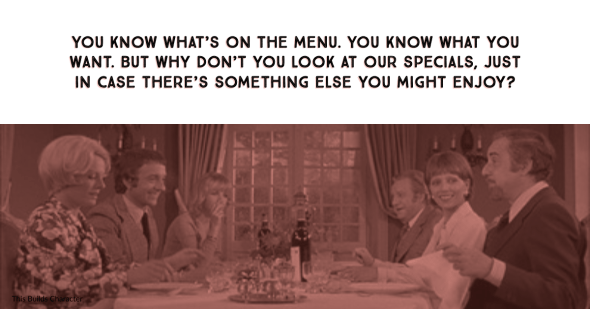
Picture from The Discreet Charm of the Bourgeoisie with quote from the blog post

It’s absurd, right? Total Buñuelian nightmare. You’d never go to that restaurant willingly.

But you might be doing just that, except it’s not with what you eat. It’s with the other things you consume.

What is your intention with your attention?

You make choices, moment to moment, about how to spend the finite amount of attention you have. When you choose to act based on your intention, you need to navigate the pathway between that intention and satisfying the desire that lead to that intention.

Let’s say you want to watch a movie, the movie is on Netflix, and you have a Netflix subscription. What greets you when you load Netflix?

First, you get an ad for whatever movie or tv series their algorithm thinks you’re likely to enjoy right at the top, filling most of your screen. Then you get a set of similarly-formatted lists; rows and rows of colorful pictures to entice the eye.

While the top one is most likely the list you populated with choices you intend to watch, you’re also presented with an array of options aside from what you told Netflix you have an interest in.

This is a design choice. Your interaction with Netflix is not crafted with the purpose of helping you follow through on your intention. It’s designed to lead you toward discovery.

You know what’s on the menu. You know what you want. But why don’t you look at our specials, just in case there’s something else you might enjoy?

Compare this to the actions that went with watching a movie on DVD. The advertising, selection, and viewing processes had more distinct separations.

Maybe you went to the store, or to a video rental outlet, and made your choice about what to watch. When it was time to watch the movie, you put the disc in the machine, and only that movie was available to watch.

When the disc would first load, you’d see trailers. Sometimes you could skip them. Sometimes you couldn’t. But one thing you were never able to do was switch what movie was about to play. The advertisement wasn’t linked to the immediate act of consumption.

You were still going to watch the movie you intended, even though you had to see trailers and commercials first (just like at a movie theater, where you lock in your intent with the purchase of a ticket).

Think about the goal of each distribution mechanism. A movie theater wants you to pay for one movie and stay for its duration (and maybe buy some snacks and drinks). A video rental store wants you to pay per movie you watch and bring them back in a timely fashion (which encourages you to watch the movies promptly).

Most streaming services don’t charge you based on how much you watch, and there’s no physical media to return. Their interest is in keeping you paying a regular subscription fee, and the best way to ensure that you want to stay subscribed is to create the feeling that you will continue to find new content worth watching.

A digital service has more interest in helping you discover new menu items, than it does in making sure you clean your plate because you loved what you ordered.

This push toward discovery over intention also holds true with the shift from physical media to streaming media in music.

Open up a music app and check to see if the first screen is your saved library, what you last played, or if you see suggestions of other artists or playlists you might like.

Sidebar: This also relates to the promotion of The Playlist over The Album, because it’s a way of rapidly introducing you to more artists instead of focusing you on any particular musician or group.

Now look at a news site. Individual articles still have a prominent place, but there’s often a sidebar with popular links, or links to additional articles interspersed with the text. You may read your way through a single article, or you might wind up with 18 open tabs and no time to scan them all.

There are tools to combat this, like Reader View in Safari or services like Instapaper and Pocket, that remove extraneous links to aid you in focusing on what you intended to read.

But these are additional tools on top of what was designed and presented to you by the news source. These are workarounds to assert your intention instead of the default.

These design decisions are about fostering hunger instead of enabling satisfaction.

This is not to say “DIGITAL BAD!”

There are some amazing things that have happened due to the proliferation of new distribution methods and channels. In particular with video streaming services, there are new outlets for a more diverse set of storytellers and types of storytelling.

And the ability to access this material easily, quickly, and (relatively) cheaply is a boon for many reasons.

But the design decisions behind how we interact with these services are antagonistic toward user intention. These interfaces can easily turn you into a digital hoarder, always hungry, and rarely satisfied.