Addressing my holiday anxiety

But Christmas? For we seekers after the perfect daily routine, Christmas and other holidays are the worst. The season of rest and good cheer merely exacerbates the drama involved in trying to find some kind of rhythm. In our house, by this point in December, we’re a good week into the period when no day is a “normal day”, thanks to school plays, school fairs, school holidays, carol services, parties, shopping trips, travel plans or family visits… and there are a couple more weeks of it to go yet. 

How’s an uptight misanthropist-perfectionist supposed to keep a daily routine going in the midst of all that? You can’t, obviously. And so the risk is that a period with the potential to be absorbingly delightful (because really, I love school plays and carol services) becomes something to “get through” instead – an obstacle one must get past before “real life” can resume, simply because it can’t be made to conform to how you think your days ought to go. 

The more general (and marginally less Grinchy) point here is that there’s often a deep tension between the desire many of us feel to exert control over our time – because we believe, if perhaps only subconsciously, that something will go very wrong if we don’t do so – and the possibility of actually being fully absorbed in that time. Trying too hard to dictate how things unfold stops them unfolding properly. So it’s not really that the Christmas holiday gets in the way of real life. That would be absurd: Christmas is part of my real life, and a part I cherish. It’s my desire to control things that causes the real trouble.

Oliver Burkeman, Because the bell rings (from The Imperfectionist)
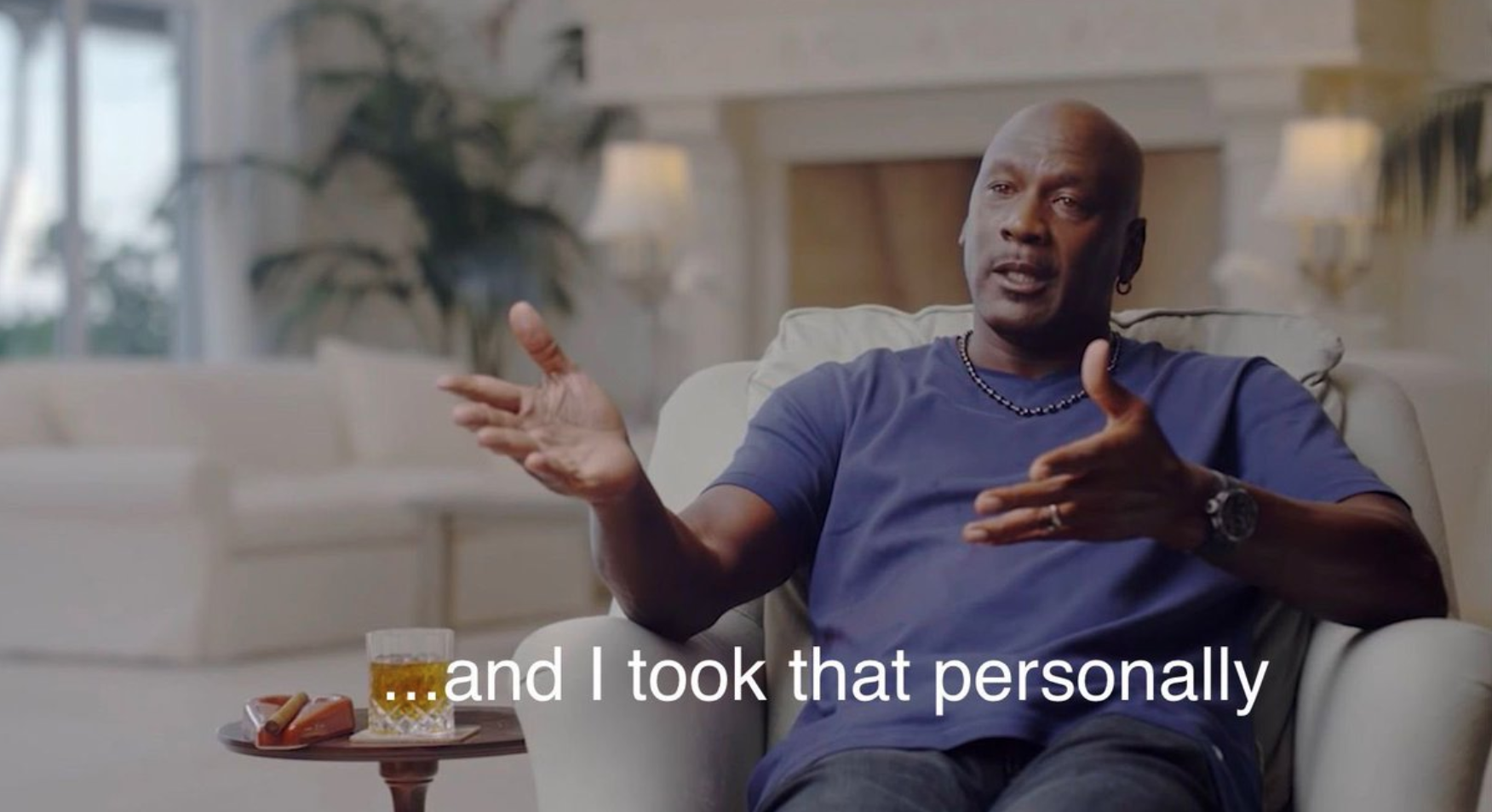
Michael Jordan interview captioned with "...and I took that personally."

This holiday season I asked myself why the holidays make me feel anxious.

There’s definitely an aspect of it about wanting to do things the “right” way, or at the very least not feeling like the person responsible if things don’t go as planned.

But maybe the biggest issue I have is the internal battle for emotional regulation and self control.

There are things I want to do, and ways I need to work to maintain a positive (or at least functional) mental state, and a wave of holidays is inherently disruptive to that.

Looking at it from Burkeman’s perspective, maybe there’s a way going forward where I can find the things that anchor me and prioritize them, instead of thinking that reactively trying to “get through” the tasks and worries of the moment.

That I can better enjoy the moment as it happens if I make sure I’m taking that time to ground myself in the moment.

We needed to limit things this Christmas with a family member testing positive for COVID. So we focused on the essential and made sure enough Christmas happened while prioritizing taking care of each other.

Did it mean that I didn’t feel some degree of guilt about the things I wasn’t doing? Of course not. Who do you think you’re dealing with?

One step at a time.

Negative noise machine

Paul Jun loaded his post Twitter Brain with plenty of quotable moments, but this stood out to me:

Twitter, I realized, is a stationary bicycle to self-generate chaos. It is a buffet of madness. It is a marketplace for anyone who wants a desire for any desire—and most of the time what you’ll get is anger, outrage, and stupidity. No one leaves Twitter feeling better. But what’s sickening is how hooked we can get.

What I learned from my burnout—and trying to reorganize my life—made me face the reality that being comfortable in chaos can be an excuse. It can be a form of trauma response. It is easy to find identity in trauma and pain, to make that the background music of your life. When we crave chaos, and life is actually good, oddly we want things to be bad again. It’s a vicious cycle. It’s a profound realization. 

When I pull up Tweetbot, it’s a filtered experience. I check in on people I know with their tweets in chronological order, check my replies, and can’t do a lot of interaction with trending topics unless the people I follow participate.

If I go to the website, though, I’m choosing chaos.

This bothers me as much about my behavior as it does about the platform itself.

It may not be true of everything, but plenty of aspects of my life are much better than they were two, four, or six years ago. There’s still a lot of work to be done, but the volume on the ambient daily outrage and confusion isn’t what it used to be.

The fact that I’m even interested in talking about Twitter to talk about Twitter feels like a weird negative feedback loop. A conversational Groundhog Day.

Back in undergrad, my friend Sam and I were talking about drawing from negative memories when writing fiction, and he said “You don’t have to feel it now in order to remember it and use it.”

I understand now that part of what was going on was undiagnosed depression, but there’s also something going on with that back-asswards craving for the stability of knowing things are terrible and on fire.

That compulsion to wallow in the negative used to only have a home inside my own head. Now I can take on other people’s misery, and there’s always something wrong.


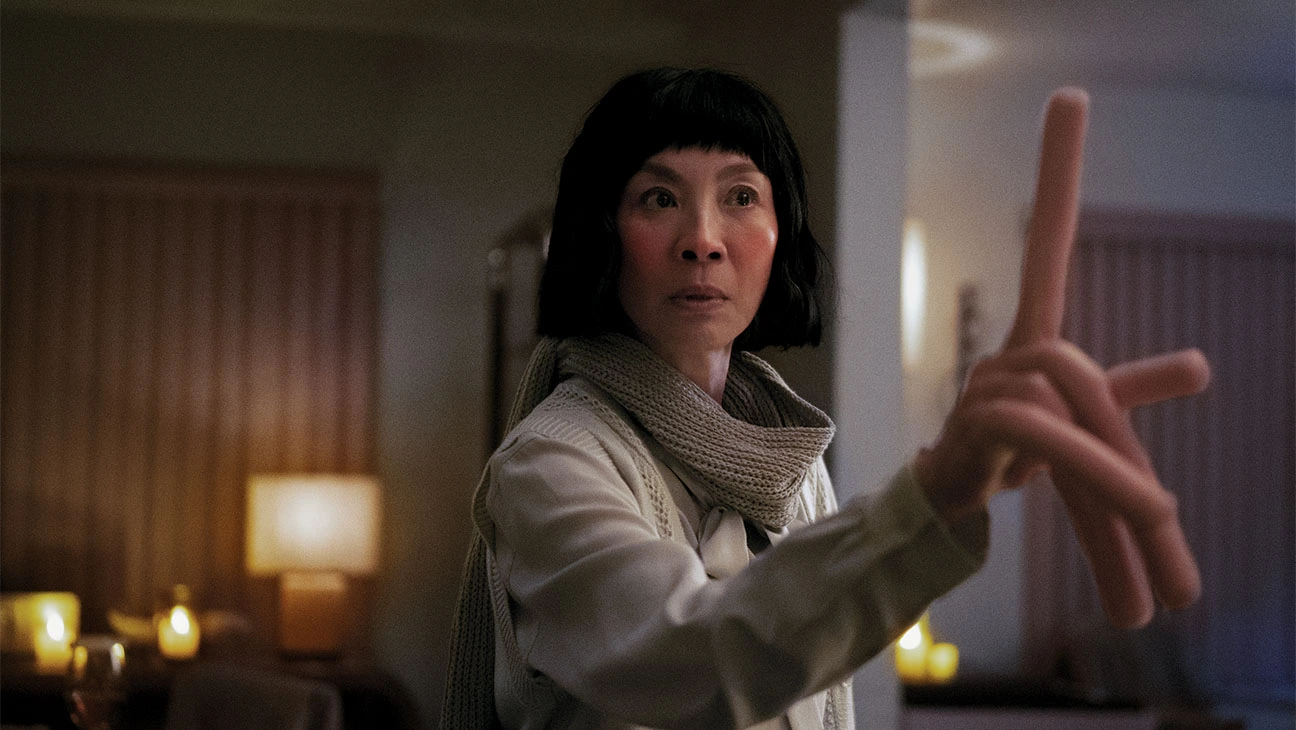
Michelle Yeoh with hot dog fingers in Everything Everywhere All at Once
Seriously, this movie deserves all the awards.

Last night I finally watched Everything Everywhere All At Once. What an explosion of joyous creativity! A heartfelt story about breaking the cycle of generational trauma, an action film, an absurd existential comedy, and a pitch perfect parody of a dozen genres at different points.

Enjoying something like that requires disconnecting. Giving yourself over to the whirlwind.

And when I think about how I feel after watching something like that versus how I feel after a check in on social media, I know the difference. I know what gives me energy and creativity and ideas, and what makes me want to roll over and have a good wallow in the muck.

But change doesn’t come from acknowledgement alone. It’s a step.

Mistakenly baking for the judges

Paul Hollywood gives a contestant's explanation side-eye.
Nobody wants to see this face while they’re talking about what they’re doing.

My kids get picky about food at dinnertime. It’s gotten to the point where I’ve hit a slump with a rotation of the few things that they normally will eat, or just grabbing some carry out/dining out.

When Dena tested positive for COVID right before Christmas, I went into meal planning mode. Instead of going with the same old options, I went for things that would help Dena feel better, and things that I felt I could cook well.

The shocking thing? The true Christmas miracle? The kids liked almost all of it.

Instead of trying to adjust things for them or make concessions and tweak recipes, I just did things to spec.

On cooking shows, one thing that often gets a ding from the judges is when somebody tones down their flavors or their spices. They worry the judges can’t handle what they like, and the judges almost always ask them why they did that.

Maybe the error I’ve been making is trying to guess what the kids want instead of just offering up something Dena and I want and hoping our enthusiasm is contagious.

Maybe there’s a broader lesson here about creative work and trying to second guess your audience instead of being true to your flavors.

I’ll think on that. But mostly I’m glad I had a few days of enjoying cooking again, and want to see if I can keep that going.

Treat yourself as your majority shareholder

Austin Kleon discussed Bo Burnham’s quote about social media companies “coming for every second of your life” by saying:

One reason I feel so lucky to be an independent writer with a great audience: I don’t answer to any shareholders but readers. I don’t have to grow my business if I don’t want to. I can do my thing the way I want to do it for the people who want it.

Austin Kleon, They’re coming for every second of your life

I’ve posted a lot less to social media lately. I’ve already talked about some of the why.

I keep coming back to the question: Who could profit from me making something for a platform?

I may not have the audience of a lot of the people I read or watch online, but I still spend time thinking about things to make and post and where I should do it.

I want that time to be spent on things that return value to me.

When I wrote How Up Makes You Cry, it was for me. I wanted something that would flex my film school muscles, and I needed a project to keep my mind off the fact that I was still unemployed while waiting for a new teaching contract to start. I was living in a moment where I couldn’t see the connection between the life I wanted and the life I was living. I turned to four minutes of film that dealt with that same disconnect and poured my heart into it.

Seeing that project through to the end was valuable to me. Finding out that other people enjoyed reading it was another boost to my mood.

And it started the conversation that lead me to my current job, which has allowed me to step away from teaching at a time I needed to.

So I’m pro-posting stuff online. I’m pro-making things.

But where and how matters. Owning your space is important, even if there aren’t the easily displayed metrics of shares and likes.

It’s easier to be found when you’re not sharing somewhere that only prioritizes the last thing you posted.

Looking back at my stats for this year, most of my popular posts are from one or two years ago. Evergreen content that I shared and left up to be found.

I’m happy with that. I’d rather share something that might still be of value to some people years from now than spend time trying to game an algorithm to make something that’s wildly popular for a day.

A deeper appreciation for Home Alone

On Thanksgiving we introduced Button to Home Alone. He loved it. Being three, that meant it was the first thing he wanted to watch again the next day. And the next. And the… you see where I’m going.

Look, it holds up. Solid holiday viewing.

But that much exposure to the movie in a few days made me notice some things.

Home Alone. Kevin sits on his sled at the top of the stairs.
“I have made a terrible mistake.”

The genius setup for the cartoon violence

There are three key moments that prime the audience to accept that the brutal assaults on Harry and Marv won’t actually kill them.

  1. Kevin sleds down the stairs into the front yard; survives.
  2. Kevin gets up from under the collapsed shelves in Buzz’s room; shakes it off without a scratch.
  3. Kevin slides across the ice like a frictionless penguin when evading a police officer.

The movie aside from these scenes tends toward the realistic. It’s not completely of our world, but these three scenes show us some elasticity in the rules about momentum and impact.

If we didn’t see Kevin get up from under that pile of shelves, we wouldn’t believe that a burglar could get back up from an iron to a face, or slamming into a brick wall, etc. etc.

Kevin's family glares at him after the pizza incident.
Seriously, does anyone want to see any of these characters ever again?

Kevin’s family is uniquely terrible

Watch the first act of Home Alone on its own. Now ask yourself if you think any of these people should be allowed around Kevin ever again.

The movie pushes their mean-spirited treatment of Kevin far enough to make it believable that he would wish they would disappear. His sense of joy when they’re gone feels reasonable.

So why would we want to see them come back?

TFW you will sell your soul to the Devil, even if it means traveling on Spirit.

Kevin’s mom takes the long way home for a reason

So it’s a funny little brick joke that the rest of Kevin’s family shows up just after Mom, who had to beg, barter, and hitchhike to get home to Kevin. But it also highlights why it was so important for her to do so.

Seeing Kevin’s mom make the effort to get home as fast as possible is what matters. She questions her relationship to Kevin and how she could have behaved in such a way that would end up thoughtlessly abandoning him at home.

She does the work to make her return feel important.

And in Kevin’s reaction to her return, he can see she’s done something big for him. Their connection matters.

But then everybody else comes home…

Kevin's family in Home Alone 2 crammed into a van.
The existence of a sequel proves they learned nothing from this.

The rest of Kevin’s family still kind of sucks

They did no work. They just waited it out until the easiest option to get home was available. They didn’t do anything to keep in contact with Kevin’s mom (that we know of) or provide her with any support whatsoever.

They were hanging out with Uncle Frank, eating shrimp, and having their vacation.

¯\_(ツ)_/¯

And they take all of ten seconds to acknowledge that Kevin’s not dead and it’s neat that he bought milk before moving on back to their rooms.

Yes, the button line about Buzz realizing his room is still wrecked is funny, but it also undercuts the sense we should have that Kevin’s in a better place with his family than in the beginning of the movie.

Cue my disappointment that we never got Home Alone 3: Emancipation in Chicago.