Looking for better instead of making better

Yesterday, someone who just met me answered a question by asking “Have been told you overthink things?” It was a pretty spot-on reading.

This morning, I came across this passage:

From the point of view of Samaya, we could say that looking for alternatives is the only thing that keeps us from realizing that we’re already in a sacred world. Looking for alternatives—better sights than we see, better sounds than we hear, a better mind than we have—keeps us from realizing that we could stand with pride in the middle of our life and realize it’s a sacred mandala. We have such a deep tendency to want to squirm out of it, like a beetle on a pin: we squirm and try to get away from just being on the dot.

Pema Chödrön, When Things Fall Apart

This really clicks when you’re the kind of person who has a setup for managing your to-dos, but keep Googling ways you might optimize or refine it with one more trick.

Or you’ve been stuck trying to finish a draft of something you’re writing, because you think it could be better if you spent a little more time on the thinking about the writing instead of the writing.

That pernicious idea that you must keep looking and contemplating for a better way to do things before the doing, instead of treating the doing as the path to better. That the doing is good enough.

It’s something I remind students of, and have to remind myself of frequently: You can’t revise what you haven’t written. Searching for better and ruminating is like trying to write the third draft of a blank page.

I must remind myself of this more often.
Escaping the time loop

Recently had a conversation about how when the days feel like they’re on repeat and it gets too heavy, one of the ways to break that cycle is to help someone else.

That feeling of every day having the same pattern has been especially strong for the last year. It can suck you in. Convince you your perception of the flow of time and the monotony is the reality. That you’re in a constant holding pattern, waiting to land and move on.

But I’m not a passive observer of my own life. It’s possible to step up and land the plane myself.

It wasn’t until I said it out loud that I saw something that works for me:

Stop and ask the question, ‘Where can I do some good today?’

Then follow through. That’s it. Now, instead of this being just another day like all the ones before it, you have a marker.

“Today was the day I helped this person do this thing.”

And I know I’m not the only one who feels like this. I see plenty of other people stepping up and stepping in.

I hope it helps them mark the time, too.

I want to be useful, not a user

I still like Twitter. I don’t like subtweets and trending topics.

It’s not hard to add context to a tweet. But, particularly with trending topics, you wind up searching out why people are bothering to talk about The Thing or The Person in the first place. All the tweets complaining about not knowing why x is trending become part of the noise to sort through.

It makes me think about the difference between being heard and being seen.

To be seen talking about something is to want others to know you’re aware of something that’s going on.

Being heard is about wanting people to care about the substance of what you have to add to the conversation.

If you only care about being seen talking about something, you’re only speaking to the audience that already understands the context.

If you value being heard, you also value being understood. That means including context, links, or other helpful cues to fill people in.

Some ways I like to add context.

  • Link to a primary source: It’s direct and simple. And links don’t count against how many characters you have left.
  • Use something like Linky: This is an iOS app that lets you highlight relevant text from a link and attach it as a screenshot.
  • Action over reaction: To take a page from Mister Rogers, be a helper. When it makes sense, show people something they can do about the issue. Push for the solution to trend instead of just the problem.
  • Share somewhere else: Do you want to briefly scream into the void, or do you want more room? Is it a blog post? A text to someone who wants to know? A letter to an elected official?

Right speech and respecting time

I try to think about the consequences of jumping on the bandwagon and adding my voice to the already noisy chorus.

If I tweet something vague and snarky about something, I’ve not only wasted time, but other people’s.

I took time to share something with limited value on its own that may direct others to use their time to search for what I was referring to in the first place.

Time and attention are precious resources.

If I want to use Twitter to spend time connecting with others , I need to respect the time and attention of others.

If I respect people’s support, I should also respect their time.

And if I respect my time, I need to make choices about what I must have an opinion about, and what isn’t worth my attention.

Anything can be a timer

Some work, especially creative work, acts like a gas: It fills up whatever amount of space you give it.

I’ve looked at timers, Pomodoro setups, and different apps and devices to signal to my brain “This is the time. Use just this time.” But most of them wind up feeling arbitrary and unhelpful.

If I can adjust the timer after I’ve started it, it takes additional willpower to maintain that sense of containing the work.

It got me thinking about something my wife said to our daughter when she was a baby: “You’re an adorable little alarm clock, but you don’t have a snooze button.”

Natural timers

Instead of looking for just the right artificial timer, I started thinking about where I see hard edges and clear boundaries within a day.

If I get up before sunrise to work on things, I know I can’t press snooze on The Sun.

If I start a task with a warm cup of coffee, I can tell myself it needs to be done before that coffee gets cold (or drank) and needs a warm up.

Or, and this is a little TMI, if it’s a full pot of coffee sized task, I have to check off that to-do by the time I need to head to the bathroom.

I can look at the calendar and see what events can’t be moved, and tell myself I need to finish something before that next thing starts. I can’t just say “ten more minutes, please” to a class I need to go teach, or picking my daughter up from school.

When and how I spend my willpower

It takes that little extra bit of intention to find the right time to start, but the benefit for me comes in knowing there’s a clear, definite place to end. There are consequences for going beyond that boundary.

It’s especially helpful for some creative tasks that can easily drag on into procrastination, like perfecting an outline or fiddling with proofreading a document.

Instead of needing to spend willpower deciding on the start and end point of a task, I’m only picking one.

Kicking With Intention

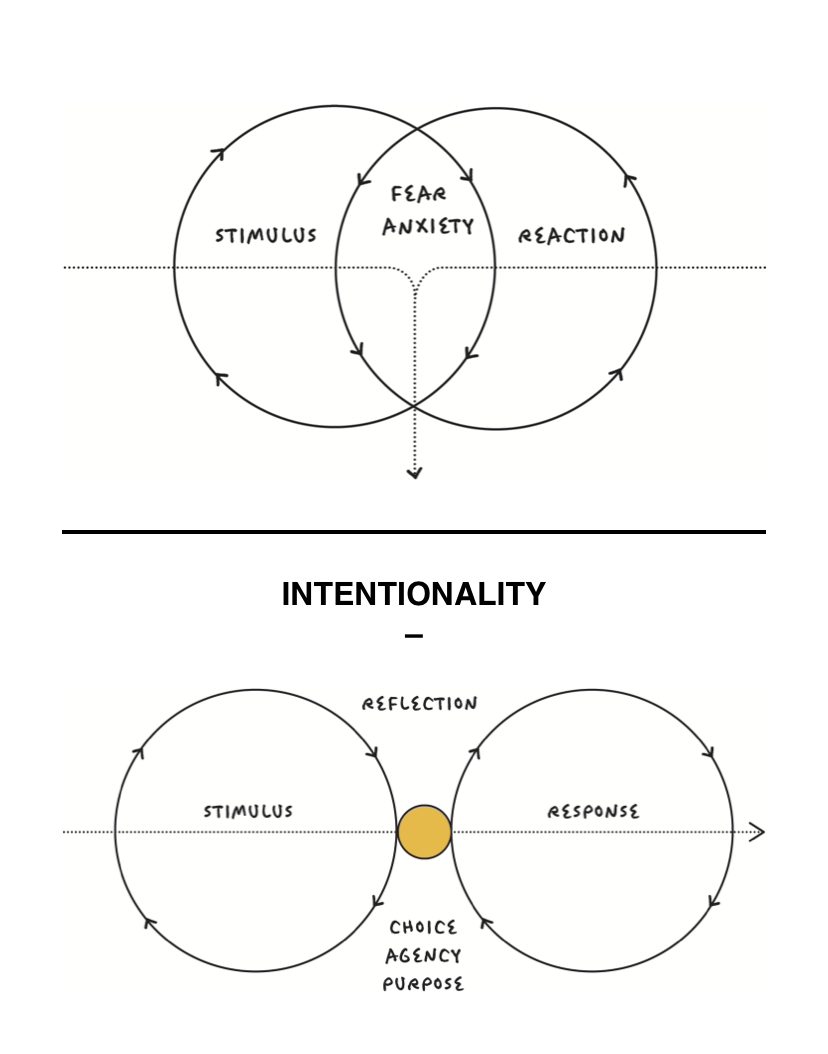
I saved one great image from The Bullet Journal Method that illustrates using tools intentionally:

It suggests without space between a stimulus and an action, we’re going to react with snap judgement based on instincts like fear or anxiety.

Inserting a pause allows the chance to come up with a more constructive action.

Responding rather than reacting. Choosing to kick rather than twitching your leg when the doctor’s hammer strikes.

I wrestle with the easy reactions allowed by social media; the buttons where one click signals you’ve seen something or want others to see it.

Or the mental math about a Quote Tweet where you decide if you have anything constructive to add, whether your framing is necessary, or if the thing that you’re sharing deserves more eyeballs (because sometimes you’re reacting negatively to something).

These features ask you “How should I react?” instead of “What should I do?” or “What do I have to say?”

Social media content gets called a feed, as if it were just another blog or a rapidly updating news site, but the tools provided to interact with it treat it like an inbox.

Reply. Reply All (with tagging). Forward (share). Flag.

The design and prompts are there to make it feel like it’s your responsibility to wade through it all.

But there’s too much, because it’s not actually intended just for you.

That’s a thing about social media that’s hard to deal with right now while many of us crave social contact: It’s not all about you.

Your feed isn’t just for you. It’s a bunch of people screaming into the void, and you’ve chosen to stand nearby.

That’s why your email inbox lets you clear things out and social media doesn’t. Email is (supposedly) intended for you. You can’t delete or sort other people’s social media posts because they’re not your job.

It’s never too late for resolutions, and right now seems like a good time to reevaluate how (and if) to use social media.

I don’t intend to chuck it all, but I do want to make sure I remember what is and isn’t my job, and what tools are best for the work I must do.

Hopefully I can spend more time kicking at things that need to be kicked instead of twitching into space.