When it comes to a(my) blogging method for writing longer, more synthetic work, the traditional relationship between research and writing is reversed. Traditionally, a writer identifies a subject of interest and researches it, then writes about it. In the (my) blogging method, the writer blogs about everything that seems interesting, until a subject gels out of all of those disparate, short pieces.
This post got me thinking about sharing more on the blog and less on social media. If I’m interested enough in something to want other people to see it, it makes sense to post it somewhere it will stick around and connect to other ideas.
It also reminds me of two quotes I keep in Highlighted:
“Talking to yourself can be useful. And writing means being overheard.”
Zadie Smith, Intimations
You can’t put a tweet on a shelf. Things stick around for a reason.
Jonathan Safran Foer
It also gets me thinking about Bean Dad (sorry to remind you about that).
How does the tool address the task? What do I accomplish sharing something on social media instead of here?
It’s all got me thinking.
I try to remind myself to always be willing to chuck out what I’ve written, but not refer to my writing as garbage.
Deleting something removes it from view, but it doesn’t erase the work I did or what I learned from it.
Yesterday, someone who just met me answered a question by asking “Have been told you overthink things?” It was a pretty spot-on reading.
This morning, I came across this passage:
From the point of view of Samaya, we could say that looking for alternatives is the only thing that keeps us from realizing that we’re already in a sacred world. Looking for alternatives—better sights than we see, better sounds than we hear, a better mind than we have—keeps us from realizing that we could stand with pride in the middle of our life and realize it’s a sacred mandala. We have such a deep tendency to want to squirm out of it, like a beetle on a pin: we squirm and try to get away from just being on the dot.
Pema Chödrön, When Things Fall Apart
This really clicks when you’re the kind of person who has a setup for managing your to-dos, but keep Googling ways you might optimize or refine it with one more trick.
Or you’ve been stuck trying to finish a draft of something you’re writing, because you think it could be better if you spent a little more time on the thinking about the writing instead of the writing.
That pernicious idea that you must keep looking and contemplating for a better way to do things before the doing, instead of treating the doing as the path to better. That the doing is good enough.
It’s something I remind students of, and have to remind myself of frequently: You can’t revise what you haven’t written. Searching for better and ruminating is like trying to write the third draft of a blank page.
Some work, especially creative work, acts like a gas: It fills up whatever amount of space you give it.
I’ve looked at timers, Pomodoro setups, and different apps and devices to signal to my brain “This is the time. Use just this time.” But most of them wind up feeling arbitrary and unhelpful.
If I can adjust the timer after I’ve started it, it takes additional willpower to maintain that sense of containing the work.
It got me thinking about something my wife said to our daughter when she was a baby: “You’re an adorable little alarm clock, but you don’t have a snooze button.”
Natural timers
Instead of looking for just the right artificial timer, I started thinking about where I see hard edges and clear boundaries within a day.
If I get up before sunrise to work on things, I know I can’t press snooze on The Sun.
If I start a task with a warm cup of coffee, I can tell myself it needs to be done before that coffee gets cold (or drank) and needs a warm up.
Or, and this is a little TMI, if it’s a full pot of coffee sized task, I have to check off that to-do by the time I need to head to the bathroom.
I can look at the calendar and see what events can’t be moved, and tell myself I need to finish something before that next thing starts. I can’t just say “ten more minutes, please” to a class I need to go teach, or picking my daughter up from school.
When and how I spend my willpower
It takes that little extra bit of intention to find the right time to start, but the benefit for me comes in knowing there’s a clear, definite place to end. There are consequences for going beyond that boundary.
It’s especially helpful for some creative tasks that can easily drag on into procrastination, like perfecting an outline or fiddling with proofreading a document.
Instead of needing to spend willpower deciding on the start and end point of a task, I’m only picking one.
Let’s assume that one of the main goals of telling a story is to reveal some deeper truth about its characters to the audience.
What we know about a character, what we can believe to be true about them, comes from watching what they say and do. Their actions reveal their character.
But people do plenty of things throughout their day that don’t tell us much of any importance about them. They sleep, cough, use the bathroom, stare out the window, put gas in the car, and so on.
So, in writing to expose a deeper truth about a character, we need a way to push them toward meaningful action.
Which is what makes conflict important.
If your car skids off a bridge into a lake and starts filling with water, you’re not going to spend time changing the radio station or calling in a carryout order.
Conflict forces characters to take action to resolve that conflict to their benefit.
We learn what’s important to them, and what they think are the best strategies and tactics to protect what they have or gain what they desire.
If these things are true, a scene without a clear conflict is a scene that’s not revealing something meaningful about the characters to the audience.
Meaningful Conflict
Conflict is about unresolved, impeded desire: Somebody wants something badly, but they’re having difficulty getting it.
A character arguing with a cashier to accept an expired coupon is a conflict, but that conflict isn’t meaningful unless it’s tied to some larger goal.
If they want the coupon honored because they don’t want to spend an extra 75 cents on avocados, that reveals something about their character, but that conflict may not be an essential part of their story. It’s an anecdote that reveals part of their values, but if they begrudgingly buy the avocados anyway, it may be wasted time for them and the audience.
If they can’t afford what they think is the perfect birthday gift for their estranged daughter without this coupon, that argument becomes more meaningful. That’s fueled by some larger desire worth focusing on.
A meaningful conflict applies pressure to a character to act, because if they refuse to take action, their story ends.
I like to think about the scene in The Muppets where Kermit initially refuses to even try to get The Muppets back together and Mary (Amy Adams) breaks the fourth wall and says “This is going to be a really short movie.”
If you have a clear idea of your character’s desire, and you have reasons to put that goal in jeopardy, you need to think about the terms of that conflict.
And that’s where Mike Nichols comes in.
Three Kinds of Scenes
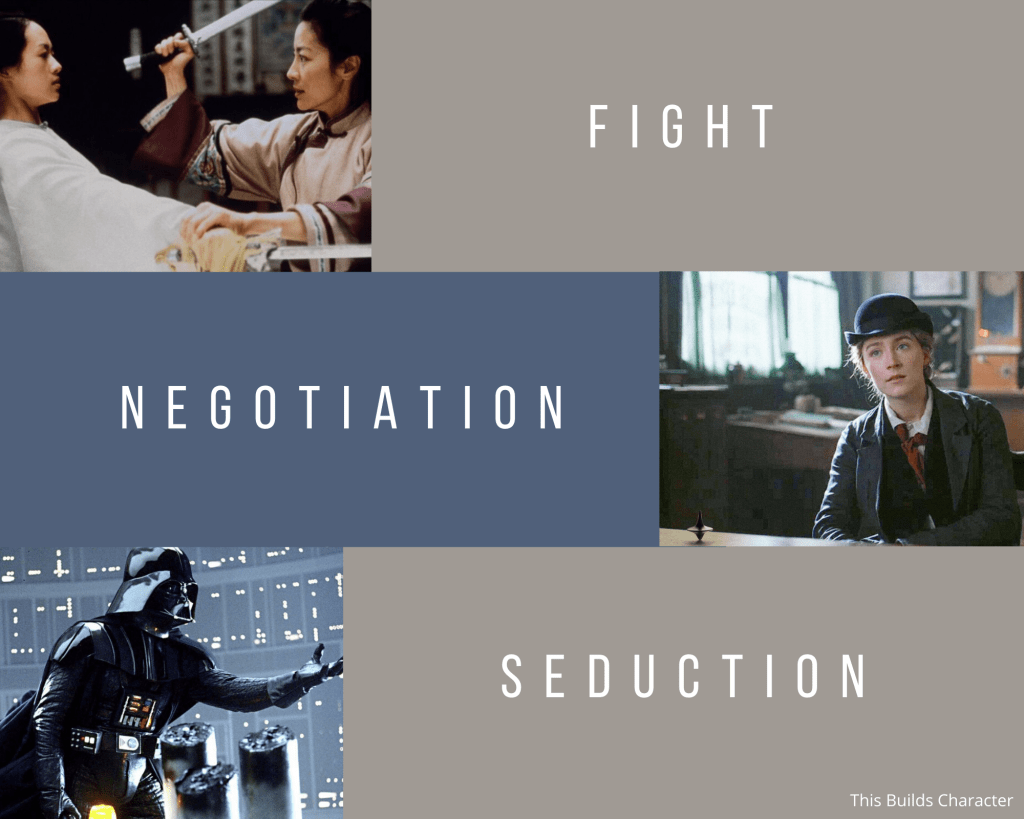
“There are only three kinds of scenes: negotiations, seductions and fights. I’ve finished. That’s all. All scenes come in one of those three categories. […] How often have you rehearsed a scene for two weeks, and said ‘Oh my God, it’s a fight!’… And you can do the same with seduction, and, most of all, with negotiations, because that’s mostly what we do in life, especially at home.”
A fight is a test of strength or willpower. The winner of the scene is the one who can endure for the longest, or who can overpower their opponent.
This is about physical and mental toughness, as well as presence. Think about Captain America getting back up every time he’s knocked down and saying “I can do this all day.” John MacLaine walking barefoot over broken glass. Jen and Shu Lien dueling in a room full of weapons, continuing the fight even as weapon after weapon breaks. Dr. Ryan Stone climbing her way out of an escape pod and fighting her way back on to land.
A negotiation is a test of a person’s ability to craft compromise or display logical arguments. The winner is the person who is most capable of offering a logical solution in a way that makes their correctness obvious to everyone involved.
Think about Jo March crafting the terms of her publishing agreement. Michael Corleone convincing his brother and their associates that they can get away with killing a police officer as part of settling the score between two families. Stacker Pentecost showing up at a construction site to convince Raleigh Becket to stop hiding from who he is and get back in a giant robot to go punch monsters.
A seduction is about understanding and manipulating someone else’s desires. The winner in this kind of scene is the one who can best read someone else and understand their deepest desires.
This kind of scene always makes me think of Darth Vader in The Empire Strikes Back. When he tries to convince Luke to stop fighting and join the dark side, Vader offers Luke the two things he wants most: A place of consequence in a larger story, and a sense of belonging. Luke starts the Star Wars trilogy feeling powerless and alone, far from where important things are happening. Vader offers him a place not only as his son, but as the heir apparent to dominion over an entire galaxy. Luke refuses, but he knows the temptation is there.
The Choice Isn’t Always Obvious
You need to think about what kind of story you’re telling. It’s not just about the genre you’re working with, but also what’s most important to your characters.
As an example, I took a fairly trope-y scene (a bank holdup) and tried to spin it out as each one of these types of scenes.
Note: Because I’ve used these scenes before in the classroom, and it’s easier in that environment to shorthand some things by talking about actors instead of one-shot characters, I cast these scenes. For our purposes, Michael Keaton is the bank robber and Awkwafina is the bank teller he confronts.
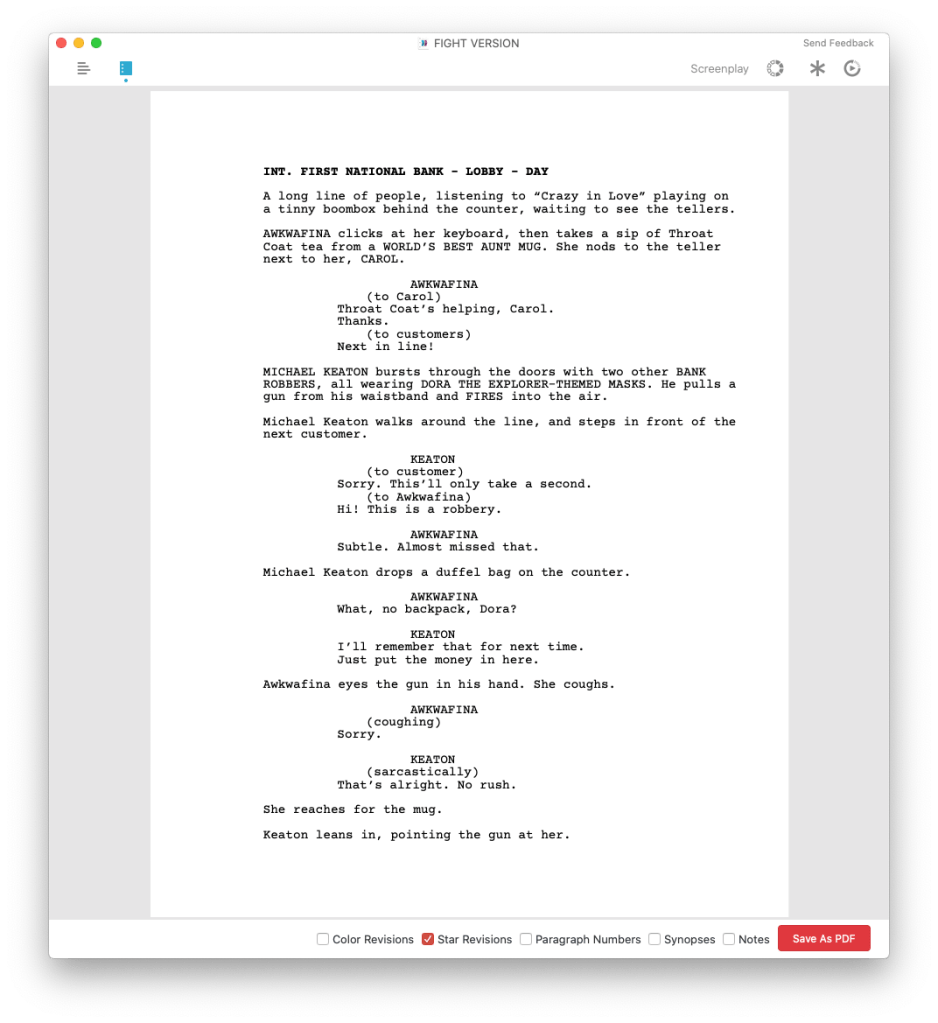
First, the Fight Version:
Click/tap to read the PDF of the full scene.
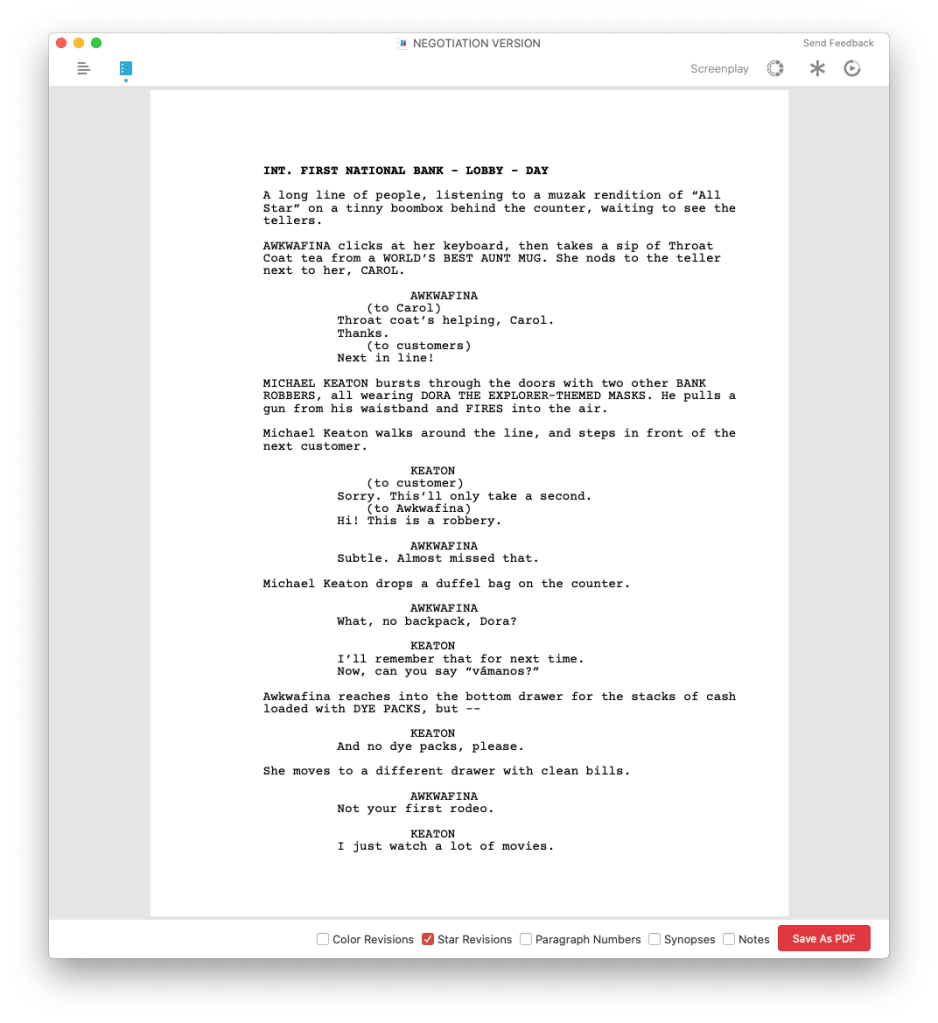
Next, the Negotiation Version:
Click/tap to read the PDF of the full scene.
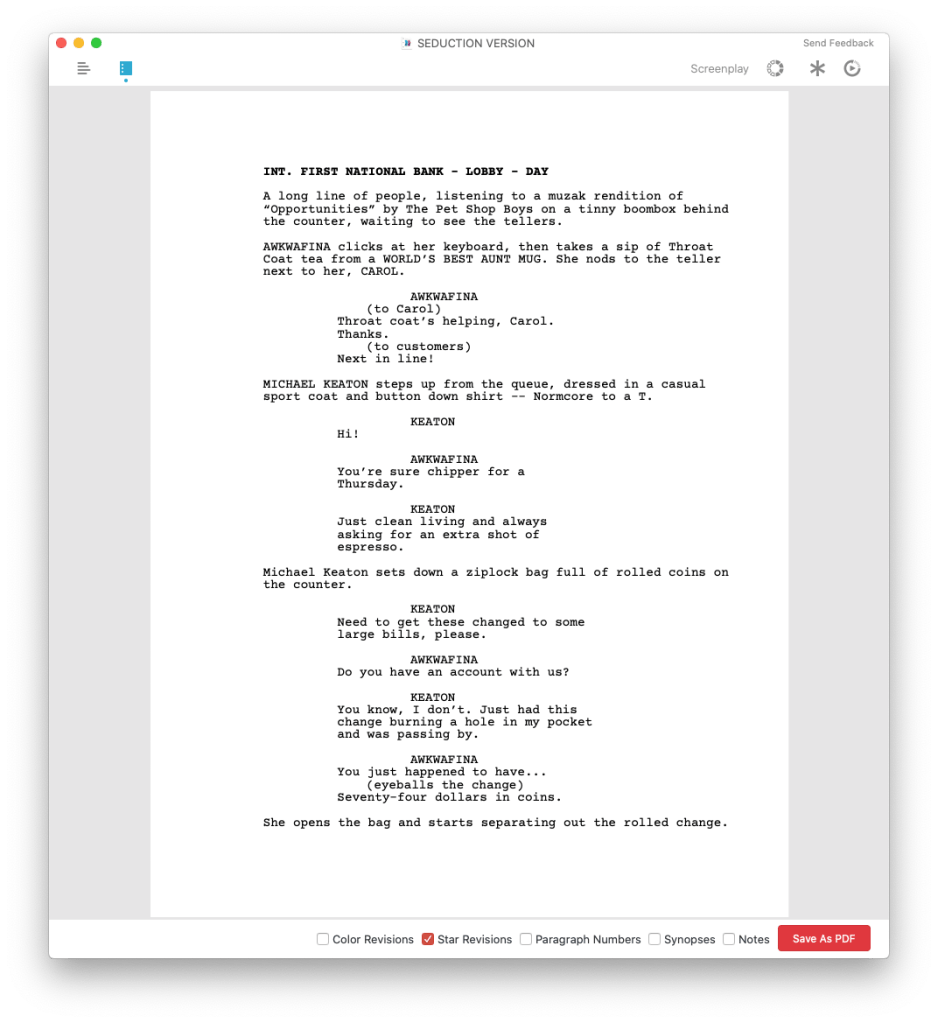
Finally, the Seduction Version:
Click/tap to read the PDF of the full scene.
Each one has its merits, and each one sets a different tone for what type of story you would tell before and after that scene happened.
The Fight version raises specific questions: Why is Awkwafina’s character so ready to take action in a dangerous situation? Is there something about her past that prepared her for this moment? Is she going to face more fights as the consequences of foiling this robbery chase after her?
With the Negotiation version, we’re asking different questions: How did she stay so cool under pressure? How will her savvy handling of this situation help her in the future? Could it be used against her? How will standing up in a life or death situation like this change her perception of herself and how others see her?
And with the Seduction version, there’s one big question: Can she get away with helping to rob the bank she works for?
But in each version, it starts with the same basic premise.
I’m just a boy, standing in front of a girl, asking her to give me all the money in this bank.
Choosing which style of conflict works best depends on the story you want to tell before and after.
 This Builds Character
You must be logged in to post a comment.