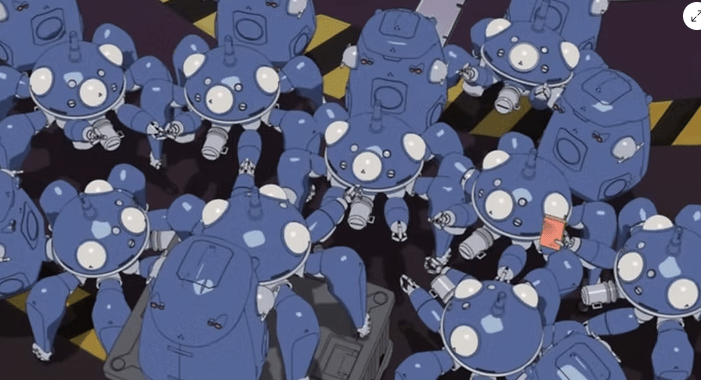
This summer has been a real cyberpunk buffet for me. Finally finishing the story in Cyberpunk 2077, reading Neuromancer and Snow Crash, and diving in to Ghost in the Shell: Stand-Alone Complex courtesy of the Criterion Channel.
And there’s one episode of Stand-Alone Complex that sums up for me both why I’m enjoying the show and what has been lost with sub-20 episode seasons of television shows: Episode 15: Afternoon of the Machines
The majority of the episode isn’t spent on Section 9 trying to solve a new case or following up on the season’s big bad, The Laughing Man. It’s a Rosencrantz & Guildenstern Are Dead-like peek into what the Tachikoma robots do when they’re not on a mission.
The Major has been watching their behavior change over the previous episodes and has growing concerns that they’re developing distinct personalities more quickly than expected. They were designed to download each of their experiences each night so they could be shared collectively, making sure that each one had the same set of knowledge and they could be used interchangeably.
But they started acting hungry for new knowledge. Getting giddy when one of them came back with new data to share with the others. Arguing over which one of them was the actual Tachikoma that supplied certain pieces of information.
When they start asking about what it means to die, or if they even can die because they’re AI and don’t have a “ghost” (the way the show describes a human essence/soul/consciousness). It reminds me of when my seven-year-old asked me during lunch, “Where was I before I was born? And before you and Mom were born?”
Throughout this episode, the fleet of chirpy-voiced blue robot tanks come up with a plan to try and fool The Major into liking them: If they act and speak more like robots, she won’t have a problem with their personalities.
Let me rephrase this for emphasis: A bunch of AI robots decide to act performatively robotic in order to meet the expectations of their boss (who is herself a human consciousness implanted into a mostly synthetic body).
It’s bizarre. It’s hilarious. It’s a seven-layer-dip of discourse on what constitutes the self and intelligence.
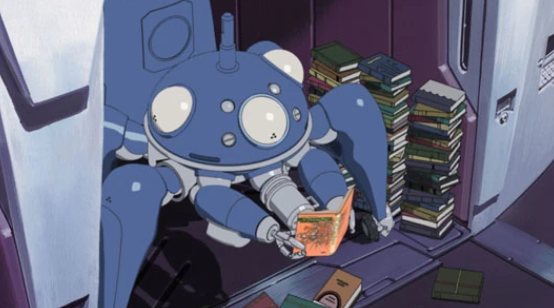
There’s two particular conversations from it I want to highlight. First, one of the Tachikomas spends most of the episode in their berth/storage unit reading a huge stack of hardcover books. Another Tachikoma questions why they’re dealing with the hassle of reading actual physical books, and gets the response that there’s an importance in experiencing the work in the manner it was originally intended to be experienced instead of just downloading the text itself.
There’s another where three Tachikomas waiting in a hallway have a conversation about whether or not the terms used for humans who have had cybernetic implants and prosthetics installed are seen as offensive by those humans. It’s like seeing a million monkeys at a million typewriters suddenly generating the transcript of an HR meeting.
This is exactly the kind of episode that is lost with the highly concentrated storytelling of streaming-era mini-seasons.
It has stakes (because in the end The Major decides to send the Tachikomas back to the lab to have their memories wiped and their base software reinstalled), but it’s mostly a side quest. It’s the kind of episode that’s both out of place and likely to grab some people as their favorite episode because of how off-kilter it is in a particular direction.
Writers are allowed to take chances, be weird, and showcase underused characters when they have more episodes to work with.


You must be logged in to post a comment.