Clean Your Plate

Picture yourself in a restaurant.

The server hands you a menu and lets you know they’ll check back in a few minutes to see if you’ve decided on what to eat. You look over the available options and make a choice.

When the server returns to your table, they ask if you think you’re ready to order, but then offer you an additional menu. Specials the chef thought you might enjoy, they say.

Do you stick with what you picked from that first menu, or would you rather take a moment to see if there’s something better available on this new list?

Now imagine that server returning every few minutes with another supplemental menu. Each one unique. Each one with at least a few options you might enjoy.

You start thinking about if you need to come back to this restaurant again soon, because you can only eat one thing tonight, and you’d better make a decision soon, because you’re only getting hungrier.

But there are just so many choices, and the server refuses to stop providing you with more options.

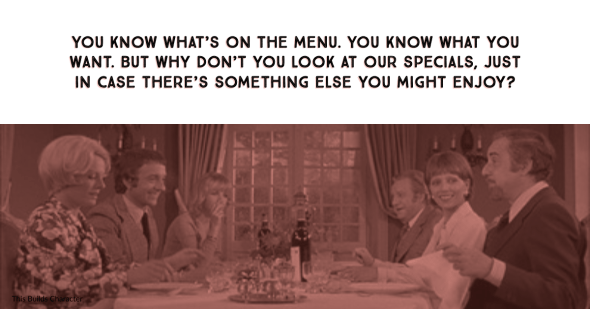
Picture from The Discreet Charm of the Bourgeoisie with quote from the blog post

It’s absurd, right? Total Buñuelian nightmare. You’d never go to that restaurant willingly.

But you might be doing just that, except it’s not with what you eat. It’s with the other things you consume.

What is your intention with your attention?

You make choices, moment to moment, about how to spend the finite amount of attention you have. When you choose to act based on your intention, you need to navigate the pathway between that intention and satisfying the desire that lead to that intention.

Let’s say you want to watch a movie, the movie is on Netflix, and you have a Netflix subscription. What greets you when you load Netflix?

First, you get an ad for whatever movie or tv series their algorithm thinks you’re likely to enjoy right at the top, filling most of your screen. Then you get a set of similarly-formatted lists; rows and rows of colorful pictures to entice the eye.

While the top one is most likely the list you populated with choices you intend to watch, you’re also presented with an array of options aside from what you told Netflix you have an interest in.

This is a design choice. Your interaction with Netflix is not crafted with the purpose of helping you follow through on your intention. It’s designed to lead you toward discovery.

You know what’s on the menu. You know what you want. But why don’t you look at our specials, just in case there’s something else you might enjoy?

Compare this to the actions that went with watching a movie on DVD. The advertising, selection, and viewing processes had more distinct separations.

Maybe you went to the store, or to a video rental outlet, and made your choice about what to watch. When it was time to watch the movie, you put the disc in the machine, and only that movie was available to watch.

When the disc would first load, you’d see trailers. Sometimes you could skip them. Sometimes you couldn’t. But one thing you were never able to do was switch what movie was about to play. The advertisement wasn’t linked to the immediate act of consumption.

You were still going to watch the movie you intended, even though you had to see trailers and commercials first (just like at a movie theater, where you lock in your intent with the purchase of a ticket).

Think about the goal of each distribution mechanism. A movie theater wants you to pay for one movie and stay for its duration (and maybe buy some snacks and drinks). A video rental store wants you to pay per movie you watch and bring them back in a timely fashion (which encourages you to watch the movies promptly).

Most streaming services don’t charge you based on how much you watch, and there’s no physical media to return. Their interest is in keeping you paying a regular subscription fee, and the best way to ensure that you want to stay subscribed is to create the feeling that you will continue to find new content worth watching.

A digital service has more interest in helping you discover new menu items, than it does in making sure you clean your plate because you loved what you ordered.

This push toward discovery over intention also holds true with the shift from physical media to streaming media in music.

Open up a music app and check to see if the first screen is your saved library, what you last played, or if you see suggestions of other artists or playlists you might like.

Sidebar: This also relates to the promotion of The Playlist over The Album, because it’s a way of rapidly introducing you to more artists instead of focusing you on any particular musician or group.

Now look at a news site. Individual articles still have a prominent place, but there’s often a sidebar with popular links, or links to additional articles interspersed with the text. You may read your way through a single article, or you might wind up with 18 open tabs and no time to scan them all.

There are tools to combat this, like Reader View in Safari or services like Instapaper and Pocket, that remove extraneous links to aid you in focusing on what you intended to read.

But these are additional tools on top of what was designed and presented to you by the news source. These are workarounds to assert your intention instead of the default.

These design decisions are about fostering hunger instead of enabling satisfaction.

This is not to say “DIGITAL BAD!”

There are some amazing things that have happened due to the proliferation of new distribution methods and channels. In particular with video streaming services, there are new outlets for a more diverse set of storytellers and types of storytelling.

And the ability to access this material easily, quickly, and (relatively) cheaply is a boon for many reasons.

But the design decisions behind how we interact with these services are antagonistic toward user intention. These interfaces can easily turn you into a digital hoarder, always hungry, and rarely satisfied.

On not passing on your fears and failures

My daughter loves getting in the pool, except for one thing: Getting water in her face. I know this problem well.

When I was a kid, I hated being in the water. Hated it with a passion. Needed to be bribed, heavily, in order to even attempt the most basic aspects of swimming, like going underwater. And even then I still hated it.

When I was younger, there was a PSA that ran all the time on television about how little water it could take for a child to drown. It was intended to make sure parents didn’t leave a baby alone in a bathtub, but my brain catalogued it as evidence that drowning should be a constant fear when in the water.

So I recognized that level of fear and anxiety when Sprout was asked to put her face all the way in the water to blow bubbles (called Submarine Bubbles by her swim class instructor, as opposed to Motorboat Bubbles, which just involve putting up to your nose in the water).

“But what if it hurts?” she would repeat on a loop, with different levels of anxiety and tears.

That fear of potential pain would lead to stalling. To crying. To building up a wall of anxiety around something that she could actually do when she pushed through that initial moment of fear.

And I thought about all the years I spent, afraid of the water. Afraid of getting stuck underwater and drowning. Scared witless by a moment as a tween when I got the courage to swim in the ocean with some friends, only to fall behind and get pulled under by wave after wave as I struggled back to shore.

I didn’t want that for her. I wanted her to face this fear down.

We had an opportunity: A family trip to a lodge in Ohio, where four generations of my family were spending the weekend. The lodge had a pool in the back yard, and the weather would be warm enough for plenty of opportunities for Sprout to practice.

But we needed to bribe her to do Submarine Bubbles.

At first, it was one dollar if she did five of them. Then my dad offered a matching gift for the second set of five, so two dollars for that set. And the last set, the one where she threw herself into them with gusto, involved matching gifts (as a limited time offer) from a bunch of other family members, which brought her $10.

She was practicing. She was getting better. My wife and I were both feeling more confident she could keep this up.

But the night before her final swim class, when executing submarine bubbles for her teacher would determine if she moved on from Mini Fish 1 to Mini Fish 2, she went back into her stubborn, fearful refrain. I asked her to do one Submarine Bubble in the bath tub, and —

“But what if it hurts?”

There’s a frustration and a futility to arguing against an irrational fear. You can’t out-reason it. The only thing that we could do, in trying to help Sprout break through, was normalize the thing she was afraid of: Water in her face.

At one point, during her bath, I asked her if it would be worse to get hit in the face with water or a ham sandwich. We agreed that the ham sandwich was worse (especially if it had mayo on it). Then we made other comparisons, and I asked her if I could dump water from a pitcher onto her face while we joked about it.

With every comparison, she picked water in her face as being the better of the two options. With every splash, she laughed a little harder about the water in her face.

We had to get through this. We had to, because I was not going to pass on this fear. Whenever I’ve gone swimming with Sprout, I’ve always tried to be conscious of not showing any hesitance toward what she was doing, or signal any anxiety that she might pick up on. And I wanted to feel like my failures wouldn’t become hers.

When it’s your own child, it’s sometimes hard to remember that teaching isn’t always about successes. The Last Jedi put it pretty succinctly:

'The greatest teacher, failure is.' —Jedi Master Yoda

Because I know the fear, I can share with her what I know about facing it. Because I know the cost of letting this fear overwhelm your common sense and your courage, I can remind her of what she’ll miss out on if she forgets how brave she is.

One pathway to success isn’t going to work for all people, but passing on which roads point toward failure can help other people narrow their choices and find the way that works for them.

Let’s cut to the end: She passed the class.

As soon as she was in the water with her teacher, Sprout was eager to talk about how much she had practiced her Submarine Bubbles and showed her teacher what she could do.

After finding out she had passed her class, Sprout was full of boundless enthusiasm for swimming, and wanted to show us all the things she’d learned in her class, without the aid of floaties.

We had to reel her back in when she said that she wanted to jump off the diving board like some older kids she saw, but it was great to see her get past the fear, to feel pride in what she’d done, and to show courage when facing down something that only days before was still paralyzing to her.

At one point we had to start calming her down to get ready to leave, and my wife, commenting on Sprout’s newfound excitement for swimming, asked her “Where did you come from?”

And like the Pawnee Goddess she is, Sprout shouted back:

“I came from your belly, and I’m made of Spicy Chicken Sandwiches!”

Why I grade writing students on respect and empathy

Years ago, when I was still teaching writing classes with training wheels, I had a student turn in a short film script that I wanted to refuse to workshop in class.

It involved a fashion model with no interior life, treated with disdain and ridicule by the dialogue she was given and the way the action and description lines of the script referred to her. There was a lecherous, controlling photographer who the script treated as a virtuous character, even as he sexually assaulted and murdered her.

I met with this student before showing the script to the class and tried to suss out his intent. We spoke for over a half hour as I tried to get across the numerous reasons I had for believing this script wasn’t appropriate for our class.

But he was set in his belief that there was nothing wrong with what was in his script. His said it was honest: That all women just want to be famous, and this woman that he depicted being gaslit, sexually harassed, and murdered deserved what she got.

I had to repeat this back to him to make sure I had heard him right: He wanted to write a script where the audience felt that the model deserved to be murdered for being a model.

As I was trying to explain the many problems with all of this, he interrupted me to ask a question: Was he going to be graded on any of this?

I hadn’t anticipated that a student would be willing to share something so toxic with a room full of their peers, and be willing to be graded on it.

The truth was, I didn’t have anything in writing that directly and specifically addressed the issues we were discussing. He would lose points for flawed characterization and an exploitative and non-sensical plot, but those didn’t get to the heart of the issue.

That was a big problem. A student could turn in an absolutely abhorrent story, and I hadn’t given myself a way to check their impulses with the most powerful leverage I had in the classroom.

I needed better grading tools

After that semester, I evaluated all of my grading criteria and lectures. Something was missing, and it needed to be front and center.

From that point forward, every writing assignment I have given to students involves some variation on the same grading rubric. If they want to get all the points available for this rubric, they need to demonstrate respect & empathy in their writing.

All characters on the page treated as fully-dimensional humans. No stock types, straw men, or derogatory stereotypes used. Every role gives an actor someone specific and realistic to inhabit.

I don’t get as much time as I’d like with each student. I don’t get as much time as I’d like with each of their assignments. So I find a way to make them sit up and take notice of a real problem for writers by making their grade depend on them taking stock of how their writing could have an impact on others.

There’s no clear way to look inside the hearts and minds of every student to see if their default is to look at other people with dignity, respect, and affirming their basic humanity. When we talk about developing characters in class, one of the main points I always make is that we can never truly know anyone. We only know what we see from what we see them say and do.

So that’s what I tell them I’m looking at — What did you write, and what does that show me?

Because narrative choices are moral choices.

No fiction is objective

The defense of saying “That’s just how things were back then!” or “That’s just how people are!” doesn’t work with me.

Any time you tell a story, you’re telling a specific story, loaded with the choices you’ve made as one person, from your perspective.

You can never be objective.

To be truly objective, you would have to know everything and also not have any stakes in the story you’re trying to tell. The first one is impossible, and the second is improbable.

  • You’re not going to spend the time writing a story that doesn’t mean something to you.
  • You’re not going to tell a story that doesn’t have some kind of personal point of reference somewhere in the narrative.
  • You’re going to create characters and situations based on your individual knowledge and experience. Even ways you use to expand your knowledge and experience are still filtered through your individual perceptions of what’s important, meaningful, or useful.

You will always be one little person.

And that’s okay…

So long as you acknowledge that in your writing and as you’re writing.

You need to think about how the stories you choose to tell put the audience in the perspective of certain characters, and what it means to prioritize the perspective of those characters over others.

You need to think about how the resolution of your story gives the victorious perspective moral weight, even if you don’t believe your story has an Aesop-style moral.

You need to think about how, if you’re writing a dramatic work, every single role will be performed by a living, breathing, feeling human being. What are you asking them to do? To think? To feel?

Are you asking an actor to choose between paying their rent and portraying something that reinforces negative stereotypes? Are you going to make an actor feel guilty for taking their paycheck?

And you need to consider how, even if it’s abundantly clear that what you’re writing is fiction, some people may use what you’ve written to further a very real agenda.

Act like your words matter

Because it’s the only way that they will.

If you want people to take your writing seriously, write in a way that shows you give serious consideration to what your words could do if shared with the widest possible audience.

Don’t treat something you’re writing as beneath you, or look at your characters with contempt.

Any story has the potential to carry deep meaning for another person.

People have the opportunity to see themselves reflected in stories in ways that their life may deny them, or in ways that they didn’t anticipate. But a story can’t take hold of a person’s hopes, fears, and sense of self if the writer doesn’t consider it possible.

Give them a mirror worth looking into.

The kind of person who owns grapefruit spoons

One day, my wife and I made the decision in a Crate & Barrel to buy grapefruit spoons. We even went and bought several grapefruits and ate them with those grapefruit spoons.

But it never became a habit.

We moved several times after that, and the grapefruit spoons always came with us, but they mostly stayed in the drawer.

It’s a minor thing. A pair of small, serrated spoons that take up an almost unnoticeable amount of space.

But that’s just it — almost.

I know the spoons are there. I know they’re not being used. I know we intended to use them, and now we hang on to them long after the seriousness of the intention has passed.

Buying the spoon wasn’t just about the utility of the thing, but the identity it created.

I’m the person who makes a healthy choice and eats a grapefruit in the morning regularly enough to require specialized flatware.

The purchase came ahead of the identity. The desired identity came ahead of the work of becoming that person.

And it leaves me with three options:

  1. Do nothing constructive. Keep the spoons and feel annoyed every time you notice them. Regret the purchase and the desire to have that identity.
  2. Abandon the spoons. Chuck them out, and decide that either the identity wasn’t that important or grapefruits (as an object) aren’t that important.
  3. Do the work to own that identity. Buy some grapefruit. Eat the grapefruit.

Lately I feel aware of the other things in my life that feel like grapefruit spoons, and that it’s time to make some choices.

Option one doesn’t feel healthy or wise. Option two has its merits, since reducing attachments and commitments allows for more focus on what’s left behind. But option three has its merits, as well.

There’s no one-size-fits-all answer for everything, but sometimes you need to confront where choices have to be made.

Because it feels better to see yourself as the sum total of what you choose to do, rather than to just feel the accumulated weight of the things you held onto and left unused.

Professionalism and Style

While listening to the latest episode of The West Wing Weekly, there was a great comment from presidential candidate and mayor of South Bend, Indiana Pete Buttigieg that

“Your job is to decide how much you’re willing to conform to [what’s expected of you]. It’s often ocurred to me that all the ways in which you — in any profession, not just politics — but all the ways in which you conform to what’s expected of you, the sum total of that becomes your professionalism. And then all the ways in which you decide not to conform, the sum total of that becomes your style.”

(You can listen to the full interview here.)

This comment encapsulates a lot of the things I try to get across when talking to writing students.

You learn the rules, tactics, and techniques of writing not so that you can follow them religiously, but so that you know what’s expected of you.

What do people who consume a lot of material see frequently, and what conforms to their expectations? What has worked for other writers in the past? What can you draw from the past that applies to your work in the present?

But you also have to find ways to make something your own. To differentiate yourself in a crowded marketplace of ideas.

A thousand other people could be writing a story just like yours right now, so what is it that you’re going to do that subverts the expectations of the audience? What bends (or breaks) the tropes and rules and traditions of the kind of story you’re trying to tell?

And this quote makes a case for thinking on a continuum, where every choice moves your position just a little bit between one end where you’re all professionalism (but no individuality) and one end where you’re all style (but with no sense of accountability or being responsive to expectations and norms).

It suggests a mentality where skill comes from learning to serve expectations where it makes sense, and carve your own path when necessary. And that seems like a pretty healthy mindset to aim for.