39. The Producers

Gene Wilder holds his comfort object, a blue blankie, while talking to a stunned Zero Mostel.

I always enjoy a narrative setup where a charlatan seduces a generally upstanding person (often wealthy, but not necessarily) into pursuing a big score. See also, GLOW, The Greatest Showman, and Ed Wood.

The whole notion of intentionally creating a flop in order to defraud the show’s investors is clever, and the path toward their goal seems assured. From the moment they decide to produce Springtime for Hitler, a musical tribute to Nazi Germany, it seems like nothing could possibly go right.

Until the audience decides it’s a parody/satire, and that it’s intended to be hilariously bad. It’s a perfect comedic setup and payoff. It also has some phenomenal comedic performances from Gene Wilder and Zero Mostel.

I know there’s criticism about comedies that “you couldn’t make today” (and I’m not going to address that broader discussion here)… but there’s one part of this film that I don’t believe would work today. It feels like producing Springtime for Hitler would become a “culture war” flashpoint with people attacking and defending their idea of the show starting well before it debuts. In the film, the author of the show is furious about what they’ve done to his earnest ode to Hitler. In a modern version, it’s not hard to imagine a wave of “go woke and go broke” mockery along with a wider range of dangerous threats by neo-nazi groups.

That’s not to say that the original isn’t still effective and funny. It’s a time capsule of the cultural climate and a sense of where the boundaries were for comedy at that time.

38. Contempt

Shot from Contempt. Paul and Camille look at each other as Camille prepares to get in the red convertible of Jeremy Prokosch.

From the opening credits of this film, it’s clear you’re in for something different. Instead of seeing text, the credits are narrated to the audience as we watch a cinemascope camera perform a tracking shot. This film will continue to play with our expectations, and it doesn’t waste any time announcing it.

When I was in undergrad, a friend was taking a class on Godard and needed to write a paper comparing a Godard film to a similar US/Hollywood studio film. I remember suggesting comparing this film to Indecent Proposal. There’s some similar tensions, like in the way that a wealthy man inserts himself into a marriage. But there’s no explicit deal being made here. Camille suspects that Paul is allowing American film producer Jeremy Prokosch to spend time with her as a quid pro quo for hiring him to work on the script for a film. That suspicion grows into contempt, ending the marriage.

There’s also a satire of international movie production, with an American producer hiring Fritz Lang and a French writer to adapt The Odyssey. Multiple scenes feature people speaking in different languages with Prokosch’s assistant, Francesca, offering commentary in how she translates between them. The scenes we do see of the work in progress are experimental and off-kilter, suggesting another kind of problem of translation: adapting an over 2,000-year-old work of prose into a film.

But for all its stylistic strangeness and layers of meta-textual commentary, the heart of the film is an extended sequence in Paul and Camille’s apartment where the two argue while moving between rooms. You can see a diagram of the apartment layout and the paths of the characters in this article. It is raw, bitter, and you can’t look away.

That’s one of the things that sticks with me about this film. It’s constantly pointing out the artificiality of making a movie, reminding you you’re watching a movie, and still managing to get you caught up in whether or not these two fictional characters will resolve their conflict, or if their marriage is over.

It’s like a magician teaching you how a trick is done, but still holding on to just enough surprises and mystery to let you hold on to your sense of wonder.

I know this is a trick, but it’s an impressive trick, and it’s performed by someone confident in their abilities.

37. The Sound of Music

Julie Andrews and Christopher Plummer stare into each other's eyes in a gazebo during "Something Good."
I know that the bisexual gaze reached its apotheosis in the 1999 cinematic classic The Mummy, but how do you solve a problem like making THIS a throuple?

This is the kind of movie that just didn’t click when I was younger. It was too long, the songs seemed silly, and it didn’t seem to have a lot going on.

I was so wrong.

It’s a story about finding your convictions at a time when so many are just going with the flow (see also: Casablanca and The Rules of the Game). It’s a story where people give up on accepted paths for their life and take a dangerous chance on something that brings them joy.

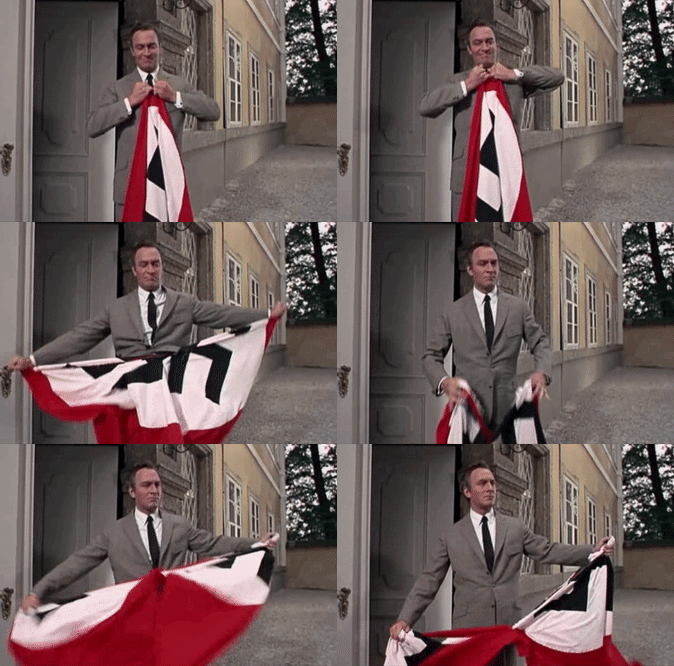
And it provides great online shorthand for the proper response to Nazi bullshit:

Captain Von Trapp rips a Nazi flag in half, because Nazis should fuck right off.
Nazi Punks Fuck Off (Von Trapp Club Remix)

When I see parodies of the love story, I feel like I’m laughing with the movie instead of at it. It really is one of those well done instances where you understand why these two characters fall in love (and the relationship’s believability isn’t just riding on the fact that they cast two actors who can definitely get it).

36. Mary Poppins

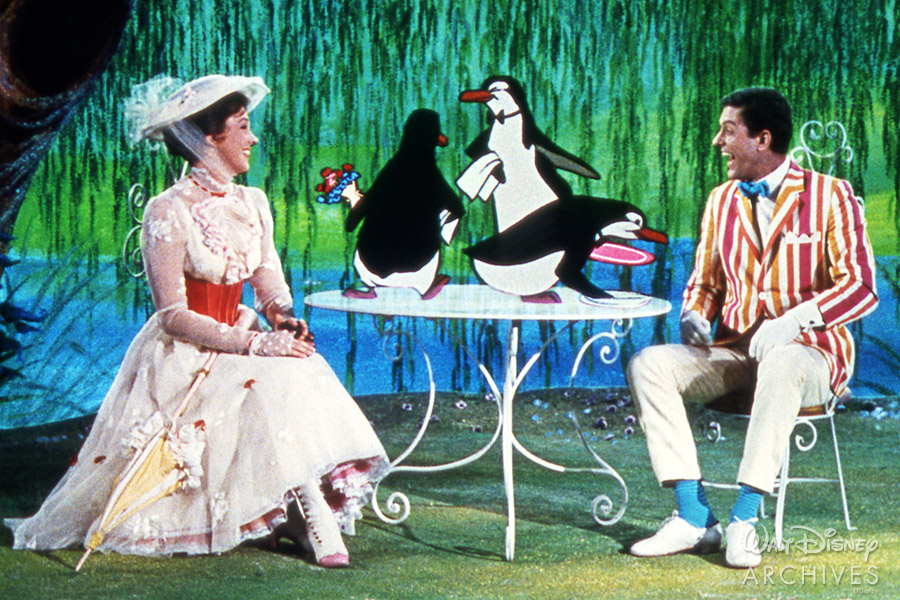
Mary Poppins and Burt on a Jolly Holiday, sitting at a table with penguin waiters milling about on the tabletop.

I liked this film well enough as a kid. It kind of blurred together for me with Chitty Chitty Bang Bang and Bedknobs and Broomsticks. But then came Saving Mr. Banks.

Going back and watching this film with new eyes after considering what went into the making of it gave me a whole new respect for the craft, and a new window into the story. It was a real Joni Mitchell moment, because looking at Mary Poppins from both sides (once as child, and again as a parent), I feel like I somehow know more and less about it.

Because it’s not really just a movie. It’s the moment you walk through Disneyland and see a performer dressed as Mary Poppins leading a group of children from the audience in a dance while musicians play behind them, and she’s graceful and practically perfect in every way. It’s watching your almost-four-year-old see the movie for a first time, dance along, and demand the movie start over as soon as Disney+ suggests what to watch next. It’s getting any of the songs from the soundtrack stuck in your head at a random moment, because it lives there, too.

When we think about companies like Disney, or characters that become cultural touchstones with staying power, I don’t feel like any of the animated characters in Disney’s IP roster can hold a candle to Mary Poppins. Maybe it has something to do with avoiding overexposure and revision. There have been exactly two films with the character, and those depictions kept crucial characteristics aligned.

Mickey Mouse can be everything from a wizard to a race car driver to a croissant delivery boy. But Mary Poppins will always be the one who gets you to pick up your bedroom or convince Dad to stop working and go fly a kite.

You get to watch Mickey’s magical life. Mary Poppins shows there’s already magic in your own.

35. A Woman is A Woman

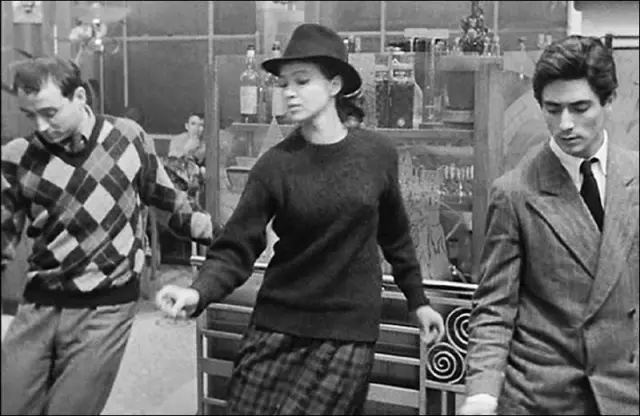
Still from A Woman is A Woman with a triangular composition in an apartment hallway with Jean-Claude Brialy and Jean-Paul Belmondo on either side of Anna Karina. They look at her, she looks somewhere just above the line of the camera.

It’s sort of a musical. It’s kind of a love triangle. It’s definitely a reason to find yourself deeply infatuated with Anna Karina (or at the very least, anyone in your circle who reminds you of 2 or 3 things you know about her).

It felt back in school like Godard and Truffaut were the Beatles and The Rolling Stones of French New Wave. Or if you prefer Mia Wallace’s framework, you’re an Elvis man or a Beatles man. You had to take a side for some arbitrary reason, and your choice supposedly said something about you. I definitely came down on the side of Godard.

He was cheeky. Playful. He had absorbed a lot about movies and wanted to make jokes for an audience that had also watched a lot of movies. There’s a fine line in some of his films between what works in general and what works best if you get the reference.

Put something like this toward one end of the spectrum, and toward the other end you might see something like Schmigadoon. Both know a lot about musicals and what audiences expect from them, but while Schmigadoon gives the audience a knowing wink and some twists with the content, A Woman is A Woman twists the form and the expectations of what a musical is supposed to look and sound like.

Also contains one of my favorite arguments ever on film: Two characters who don’t want to talk to each other, so they use the titles of books on the shelf behind them to insult each other.