This fits in the same box as Mr. Smith Goes to Washington. A single incorruptible man stands up for what’s morally right and is able to gradually turn the opinion of the other jurors and prevent a miscarriage of justice through a filibuster.
It’s the kind of story where the end upholds the idea that the system works, while also showing us how perilously close it came to condemning an innocent young man. At the same time, it’s a story about the importance of strength in the face of mob mentality, and how refusing to forget your convictions to smooth things over by going along with the group.
It’s a real powder keg of a film, too. Not a wasted moment, and a contained thriller that makes the most of every inch of that jury room.
Also, some context. This film was released in 1957, based on a teleplay written in 1954. Via the Associated Press, “The Civil Rights Act of 1957 gave women the right to serve on federal juries, but it wasn’t until 1973 that all 50 states passed similar legislation.” Court cases arguing the legality of impaneling an all-white jury have been tried as recently as 2016. When we consider writing off the makeup of the jury depicted here as “of its time,” it’s worth considering what that means, and if that time has truly ended.
Men will literally force their new girlfriend to get a makeover to match their dead ex instead of getting therapy.
When I first saw Vertigo, it was after knowing Jimmy Stewart almost completely as a comedic actor, but always as a moral, upstanding figure. Mr. Smith Goes to Washington. It’s a Wonderful Life. Harvey. The Philadelphia Story. You Can’t Take it With You.
The only thing those performances have in common with this one is that James Stewart never looks like he quite understands what kissing looks like.
I know that sounds like a joke, but I’m very serious. He looks like a cross between a nervous lifeguard attempting CPR and Mr. Peepers. But it kind of works in this role?
It’s this strange scenario where the protagonist doesn’t seem to know what kind of story he’s in. He thinks this is a melodrama or romance, but the further he goes, the deeper he gets pulled into a noir.
It’s a neatly twisty plot. Stewart’s Scottie is a detective hired by an acquaintance to track his wife after she starts exhibiting odd behavior. There’s just one catch: The woman he’s told to track is already dead, and the person he’s following is an impersonator. Scottie falls in love with the impersonation, but then she needs to fake her death in order to cover up the actual woman’s murder.
The idea of a man being tricked into falling in love with a woman so he can form an alibi for a murder is one thing, but for him to meet the same woman again and attempt to get her to return to the performance by forcing a makeover on her is sociopathic. Like Norma Desmond, this is someone clinging to an obsession with the past and an inability to see the potential for moving on.
I took a course in undergrad about Color in Cinema and used this film as the basis of an obsessive paper on the use of color as a tool for narrative. Drawing on the writings of Natalie Kalmus from Technicolor and repeated viewings of the film, I mapped out the ways that different colors were traded between characters and played with in costuming and set design.
The professor for the class asked me to present it to the rest of the class, which was my first taste of giving a film lecture. I had a clip list and everything, and wound up giving something like a 25+ minute lecture on Vertigo.
I don’t think I would’ve even considered spending any time teaching if it hadn’t been for that experience. I felt so comfortable up there directing the class and moderating questions, even though I still had a lot of learning to do.
It was satisfying to feel that sense of approval and attention, but I think it was a time when I got the most joy out of the actual work of putting the paper together. Combing through the film again and again, trying to reverse engineer the decisions for why this color of lighting or this pattern on a dress could mean something. It gave me a real appreciation for the subtleties of craft that go into every frame of a film.
This is one of the films that got me into French cinema from this time. The deep focus on Antoine Doinel and piecing together a picture of a life made more difficult by every authority in his life finding ways to fail him. There is no sufficient figure in his life to model himself on, or to provide him any kind of direction for his energy and passion.
I think two about the sequence where he steals a typewriter from his stepfather’s office, tries and fails to sell it, and then gets caught when giving up and attempting to return the typewriter. Is it ironic that he only gets in trouble after finally deciding to do the right thing, or is it a fulfillment of the axiom that it’s not the crime that gets you in trouble, but the cover up?
This also fits into a specific subgenre I enjoy, which I like to call “It sucks to be a schoolboy in postwar Europe.”
Also: Jean-Pierre Léaud as Antoine. What a performance. Honest, heartfelt, and heartbreaking.
The flip side to Singin’ in the Rain. Instead of some plucky silent film stars finding a way to whether the storm of talking picture disruption, here we see what happens to a performer who didn’t make the transition.
Honestly, what a great double feature those two would make.
Whereas Singin’ is a sweaty, try hard musical, Blvd. is an ominous noir that starts with the narrator informing us that he’s the corpse face down in the pool that we’re looking at. Thinking about them side-by-side presents industry shifts as a zero sum game where the only way for some to ascend is climbing over the still-warm corpses of others.
But it’s also worth considering the way that Norma Desmond resists change, both in her art and her conception of herself. She still wants to be a silent ingenue, still wants the same car, the same friends, the same lifestyle.
She clings to an ideal of the past, and refuses to accept that there’s anything worthwhile about the present or future unless it feels like a carbon copy.
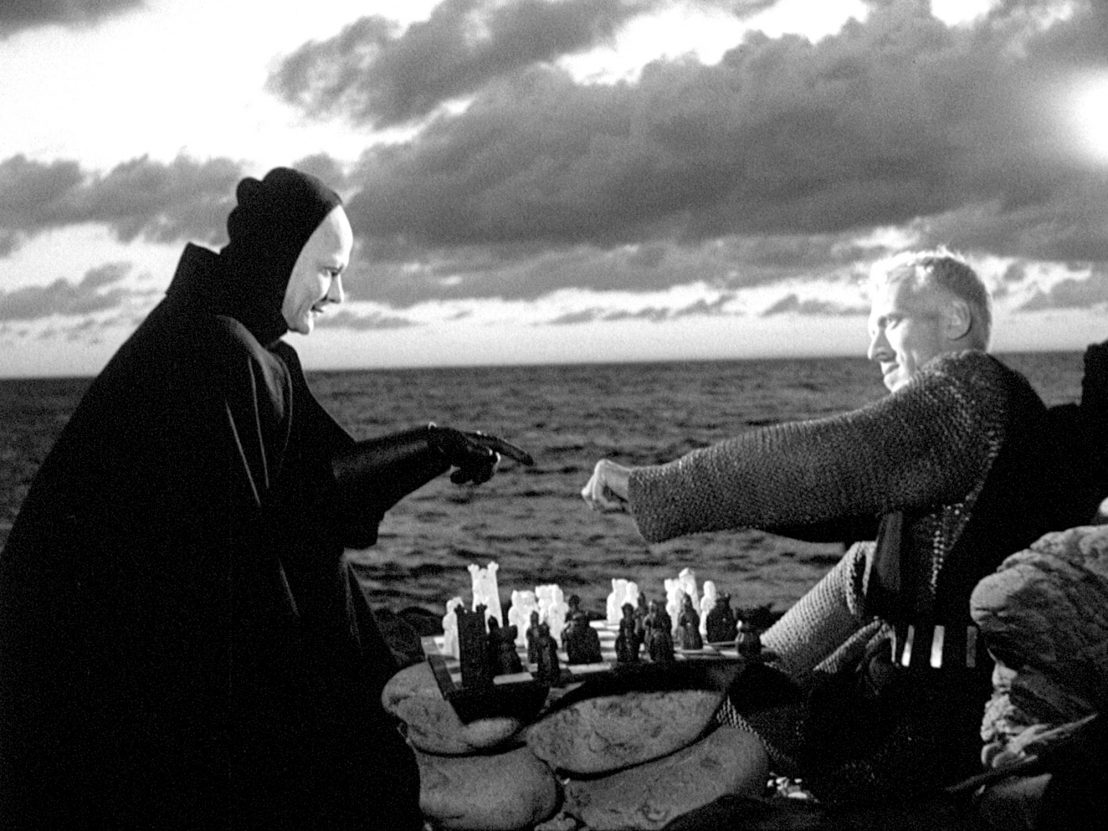
It’s a game of wits against Death himself. And it’s surprisingly funny. That’s the part that always surprises me.
Maybe it has to be, given the heightened premise of a knight returned from the crusades playing a lengthy game of chess against Death himself during the Black Plague. As serious and dire as the stakes are throughout the film, if there isn’t humor, then the entire concept of the story would seem silly on its own.
There was a line I got via some trickle-down teaching about writing dramatic stories: You need to find places to add some humor, or your audience will find the wrong places and add it themselves.




You must be logged in to post a comment.