36. Mary Poppins

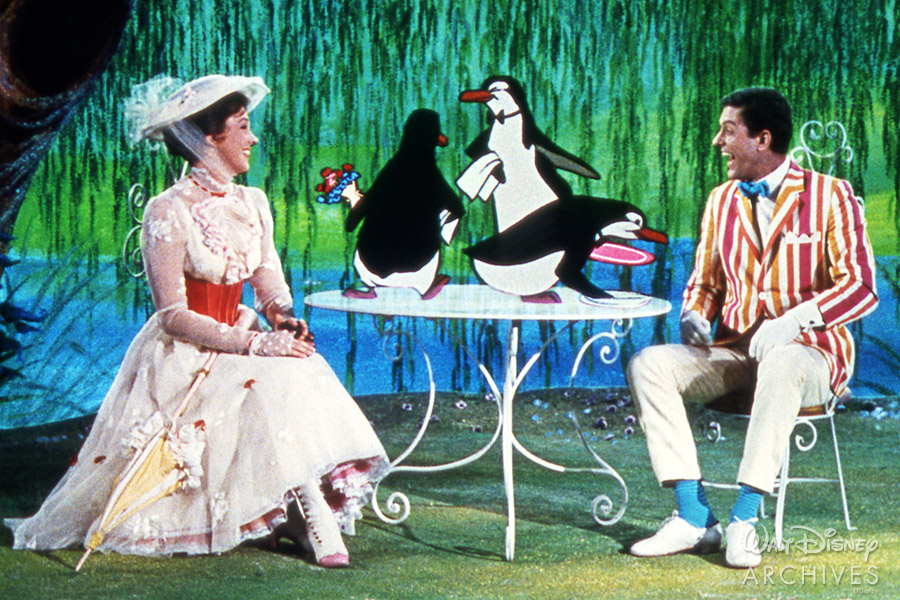
Mary Poppins and Burt on a Jolly Holiday, sitting at a table with penguin waiters milling about on the tabletop.

I liked this film well enough as a kid. It kind of blurred together for me with Chitty Chitty Bang Bang and Bedknobs and Broomsticks. But then came Saving Mr. Banks.

Going back and watching this film with new eyes after considering what went into the making of it gave me a whole new respect for the craft, and a new window into the story. It was a real Joni Mitchell moment, because looking at Mary Poppins from both sides (once as child, and again as a parent), I feel like I somehow know more and less about it.

Because it’s not really just a movie. It’s the moment you walk through Disneyland and see a performer dressed as Mary Poppins leading a group of children from the audience in a dance while musicians play behind them, and she’s graceful and practically perfect in every way. It’s watching your almost-four-year-old see the movie for a first time, dance along, and demand the movie start over as soon as Disney+ suggests what to watch next. It’s getting any of the songs from the soundtrack stuck in your head at a random moment, because it lives there, too.

When we think about companies like Disney, or characters that become cultural touchstones with staying power, I don’t feel like any of the animated characters in Disney’s IP roster can hold a candle to Mary Poppins. Maybe it has something to do with avoiding overexposure and revision. There have been exactly two films with the character, and those depictions kept crucial characteristics aligned.

Mickey Mouse can be everything from a wizard to a race car driver to a croissant delivery boy. But Mary Poppins will always be the one who gets you to pick up your bedroom or convince Dad to stop working and go fly a kite.

You get to watch Mickey’s magical life. Mary Poppins shows there’s already magic in your own.

35. A Woman is A Woman

Still from A Woman is A Woman with a triangular composition in an apartment hallway with Jean-Claude Brialy and Jean-Paul Belmondo on either side of Anna Karina. They look at her, she looks somewhere just above the line of the camera.

It’s sort of a musical. It’s kind of a love triangle. It’s definitely a reason to find yourself deeply infatuated with Anna Karina (or at the very least, anyone in your circle who reminds you of 2 or 3 things you know about her).

It felt back in school like Godard and Truffaut were the Beatles and The Rolling Stones of French New Wave. Or if you prefer Mia Wallace’s framework, you’re an Elvis man or a Beatles man. You had to take a side for some arbitrary reason, and your choice supposedly said something about you. I definitely came down on the side of Godard.

He was cheeky. Playful. He had absorbed a lot about movies and wanted to make jokes for an audience that had also watched a lot of movies. There’s a fine line in some of his films between what works in general and what works best if you get the reference.

Put something like this toward one end of the spectrum, and toward the other end you might see something like Schmigadoon. Both know a lot about musicals and what audiences expect from them, but while Schmigadoon gives the audience a knowing wink and some twists with the content, A Woman is A Woman twists the form and the expectations of what a musical is supposed to look and sound like.

Also contains one of my favorite arguments ever on film: Two characters who don’t want to talk to each other, so they use the titles of books on the shelf behind them to insult each other.

34. Targets

Peter Bogdanovich and Boris Karloff argue while seated in a hotel room.

Targets was made in part because Boris Karloff owed Roger Corman two days’ work. Corman gave Bogdanovich a chance to write and direct based on him burning off the rest of Karloff’s contract, and that he re-used some footage shot for another Karloff film. That gives us half the story, where aging horror icon Byron Orlok declares his retirement will start after a personal appearance at the drive-in premiere of his most recent film. Meanwhile, a fanboy director tries to convince him to make one more picture.

But if you only have two days of Karloff, how are you going to turn that into a full feature? That’s where you bring in a story about a mass shooter (inspired by the Tower shooting at the University of Texas), and send this killer on a cross-city rampage headed toward the very drive-in Orlok’s movie premieres at.

It’s a confrontation between an older, gothic horror and a modern, seemingly random violence erupting in everyday spaces. Karloff is a perfect embodiment of that creeping horror of cinema’s past where you never needed any clues as to who the monster was. His counterpart, gunman Bobby Thompson, is a clean-cut young man who could blend in just about anywhere. It’s his lack of defining physical characteristics that make his actions all the more frightening.

The final sequence at the drive-in is complex and layered, with moments of people isolated from one another in their cars, unable to realize that a man is picking them off from behind the screen. It’s the cultural equivalent of if someone in the present day was shown doomscrolling on their phone and missing out on the person next to them getting stabbed.

I saw this film for the first time in a class about Road Movies, and there’s plenty of driving even if they don’t cover much ground. The people in their cars at the drive-in. The drivers picked off from the tower overlooking the highway. People are constantly on the move and isolated from each other, but not insulated from the violence around them.

The thing that keeps me coming back is how deftly this film acts as a meta-commentary on what scares us as humans and as a moviegoing audience. When there are so many possible ways that real life horror could intrude on our lives, why do we seek out scares? What is it about witnessing fictional acts of violence and terror that gets us reaching for the popcorn?

There was also something about Peter Bogdanovich that was inspiring to me when I first saw it, as well. He was a student of film, and apprentice and acolyte of many iconic names of cinema. Like the Cahiers du Cinema to French New Wave director pipeline, I saw the potential for what I was interested in being something worth putting on screen because of how much I was pulled in by this film nerd B-movie. It gave me a feeling of permission to be as nerdy as I wanted to be.

33. The Seven Samurai

The titular seven samurai stand together on a hill, looking out into the distance with clouds behind them.

Rare is the three hour film that flies by and makes you wish for more.

It’s a film that inspired westerns, and with good reason. It’s an elegy for the time of samurai as the age of guns comes into focus. A technological shift in the weapons of war that disrupts society, giving a group of bandits an edge against the team of (mostly) battle hardened samurai hired by the village to defend it. Much like The Searchers, it ends on a note that some people are allowed to stay and live out their lives in peace, but others are warriors forced to wander until their help is asked for.

It’s a film with tremendous heart, and an electric performance by Toshiro Mifune as Kikuchiyo. He begins as an annoying samurai wannabe, but develops over the course of the film into a trusted ally and protector of the oppressed.

The fight scenes are also staged to be as brutal as possible, in the sense that they avoid the balletic sword play of some samurai tales and feature swift, violent, scrambling combat. There’s one scene in particular with rain and mud and chaos that plays to the notion that these samurai are strong warriors, but they’re not superhuman.

They can bleed. They can fall. They can die. Their victories come at a cost. They don’t get shawarma—they stand over the graves of their comrades.

32. North by Northwest

Cary Grant as Roger Thornhill, holding the knife used to murder a UN Ambassador after pulling it out of the ambassador's back. A crowd of people stares at him, convinced he's the killer.
“Would you believe it’s not what it looks like?”

I do enjoy a Wrong Man Thriller, but this one has that extra sauce on it because Cary Grant’s Roger Thornhill is misidentified as a man who doesn’t even exist! Thornhill is confused for George Kaplan, an alias created by a US intelligence agency to frustrate and confuse a target of their investigation.

Now it suits them to let Thornhill run around, giving credence to their lie about Kaplan existing, and helping them draw their target out into the open. Oddly enough, I see connective tissue with Miracle on 34th Street and Mr. Smith Goes to Washington, where a primary character in the story is a pawn in other peoples’ game.

Whether or not people agree on if it’s the best Hitchcock thriller, it’s certainly the Most Hitchcock one. If you watched this playing Hitchcock Trope bingo, everyone would be a winner. And it’s not just ticking off boxes, but creating iconic moments:

  • The murder in the UN (see the photo above)
  • Thornhill waiting for a bus, then being chased by a low flying crop duster.
  • A final chase on top of Mount Rushmore.
  • The wholly unsubtle, single entendre final shot of a train entering a tunnel.

Another thing to think about: Even though his life is in danger throughout, Thornhill never becomes a nigh-indestructible action hero. He’s an advertising executive who you believe is in danger throughout. He’s not going to get out of this scrape by suddenly leveling up his physical stats, but by being just clever enough and just persistent enough to play the angles that get him to safety.