A student came up to me after class and asked about impostor syndrome. I had mentioned in class that one of the main causes of things like plagiarism or bloated writing is insecurity: People are afraid that their writing will be found lacking, and that they will seem lesser because of it.
And this student wanted to know what they should do to fight back.
Impostor Syndrome comes from the idea that people will see you as a fraud. That you are less than what you claim to be. But it’s also the feeling that we don’t measure up to our own projection of who we are, or who we should be.
You don’t need an audience to feel like a fraud.
But somebody was looking to me for an answer, so I warned them that this feeling never really goes away. The insecurity and uncertainty just become more manageable over time, given the right effort.
This is not a life hack. This will not cure you. This isn’t even a tactic that works 100% of the time. But you can try it, and it might help.
Focus on the work, not what you think the work means.
If you’re writing something, focus on the story beat. If you’re revising something, focus on the sentence in front of you. Then the next one. If you’re offering advice to another writer, don’t worry about what they’re going to think about you based on your advice. Just do your best to tell them what you see in their work, and help them realize their goals.
And if you feel yourself thinking about what you’re going to say in your awards acceptance speeches, or how you’re going to spend all that money you’re destined to be making, or how you’re going to get to start name-dropping all your fancy new friends… If you find yourself dreaming about the rewards for work you haven’t done yet, that’s the other side of the Impostor Syndrome coin.
It’s ego, flowing in more than one direction. It can build you up or pull you down, but when you let that untamed sense of self take the wheel, you’re not doing the work.
And if you can only focus on one thing at a time, it’s better to train yourself to focus on the work, and not worry about shame, praise, or imagined distant futures. Like Andy Warhol said:
”Don’t think about making art, just get it done. Let everyone else decide whether it’s good or bad, whether they love it or hate it. While they’re deciding, make even more art.”
The same can be said about yourself. Focus on whether or not you enjoy the work that you’re doing, and whether you can joyfully give your attention to the work. Spend your effort on making the work the best it can be.
You’re a person who has value outside of your work. To the people who care about you, you can never be an impostor. Try your best not to confuse your assessment of your work with a measurement of your worth.
A few weeks back I went to put a load of laundry in the dryer, and the machine refused to cooperate. The motor started up, but as soon as I released the start button, it cut off.
I did what I do most of the time there’s an appliance failure in the house: I went to YouTube.
One video suggested I try turning the dryer on with the door open to see if the drum moved. If it didn’t spin, it likely meant that the only problem was a broken belt (aka, something the video said anyone could fix). After confirming the broken belt, I felt pretty comfortable with the next steps. I don’t consider myself handy, but it seemed like an easy enough thing to fix.
Keep both of those things in mind:
I don’t consider myself handy.
This seemed like an easy problem to fix.
I ordered the replacement belt from a local appliance store and picked it up the next day. The video demonstrating how to replace the belt was ten minutes long, so I estimated that I could accomplish the same task in 30 minutes (adding time based on what was trimmed out in editing the video, and adding some padding due to my lack of experience with dryer repair).
An hour later I was covered in lint, sweat, and desperation.
There’s one part of the whole operation that’s a particular challenge.
To get the belt in place, you need to thread it around a spindle on the motor, and then around a pulley that keeps the belt tight against the drum. The pulley is connected to a switch. If the belt snaps, the pulley pops out of alignment and turns off the motor.
In order to get the belt in position, you have to reach your arm inside the bottom of the dryer, underneath the drum, and stick it behind the motor in a part of the dryer that you can’t see. So you’re lying down on the floor, your whole arm where you can’t see clearly, lining up a thin rubber belt over a pulley that you have to pull into place at the same time. One-handed.
Somehow, I’d managed to do this. Probably. I called Dena down to check on the results. I plugged the dryer back in and pressed power.
The Good News – The dryer started and stayed on! The drum turned!
The Bad News – The dryer was making a truly awful metallic scraping sound and smelled like maybe something was burning.
I decided it was time to scream into the void and start over again, but we agreed that I’d be better off just cutting my losses for now, taking a shower, and calling my dad over to help me take a look the next day. It’s a universally agreed upon notion that my dad is handy.
And this is where it got more complicated.
The next day, he and I struggled with the dryer for another hour, assembling and disassembling it over and over. We watched dueling YouTube instructional videos to figure out what we were doing wrong. We drew diagrams. We tried alternate methods of threading the belt.
At one point we yanked the pulley clean out of the dryer and tried to get it back in place.
And all of this was done with the time limit of tickets to go see Ralph Wrecks The Internet that afternoon. Another day, another attempt at fixing the dryer failed.
We agreed to come back to it the next day when there weren’t any appointments interfering with the work.
And something happened overnight. Maybe I just looked at the diagram of how the belt was supposed to thread just the right way. Maybe the moral of Ralph Wrecks the Internet and how insecurity is the mind killer had time to sink in. Whatever it was, I had to revisit those two key premises from earlier:
I don’t consider myself handy.
Alright, I’m not somebody who’s ever going to advertise their services as an independent contractor, but I can follow instructions. I can think through a problem. I’ve fixed other appliances and I have solved problems in the past.
So why don’t I consider myself handy?
Is it just that I don’t have a variety of experiences that would allow me to talk shop with hardware store employees? That I sometimes need to ask for help or instructions? Is it because one time a shop teacher yelled at me for showing another student the wrong way to use a band saw and it convinced me to take more drama electives?
None of those seem like very good reasons. Which leads us to…
This seemed like an easy problem to fix.
Why did I think that?
Is it because the person with more experience who narrated the video said it was easy for them? Is it because there were so few steps to the process?
Was thinking that this was supposed to be easy causing me to make mistakes, or get overly frustrated?
And in that moment of the third attempt to install this belt, I had a moment of clarity. It’s not the dryer that’s the problem: I’m the problem.
By not believing I could solve the problem, I was holding myself back from finding a way to solve the problem.
I looked at each individual component of the dryer and how they were supposed to line up. And that’s when I noticed something I had missed before: The metal ring connecting the exhaust hose to the back of the dryer. It was loose.
That was the scraping sound I had heard after the first time, and probably the source of the burning smell. Making sure the exhaust pipe was secure wasn’t part of the process of replacing the belt, so I hadn’t checked it.
Everything came together quickly after that, especially since I’d taken it apart and put it back together several times already. I’ve been enjoying machine-dried clothes ever since.
More importantly, the experience kicked my ass and reminded me that unless you believe you might be able to solve a problem, you have no hope of making it happen.
While listening to a recent episode of The West Wing Weekly, a story that Josh Malina told about a conference he had early during the filming of the show’s fifth season struck a chord with me.
Showrunner John Wells told Josh “Here’s the plan I have to keep you on the show,” going into detail on his reasoning for having Josh’s character, Will Bailey, change jobs and accept an offer to work in the office of the new Vice President.
Josh said he wasn’t used to this kind of explanation from a writer or producer, and that while he appreciated the additional conversation about the reasoning for some dramatic changes for his role in the show, his overall reaction floored me.
“At the time I didn’t dwell on it much, because I don’t think that enhances one’s acting, to obsess about the storyline. Your job is: Here’s the script – act it. I never really gave it two seconds of thought. I never really cared deeply about Will’s decision. That’s not the kind of actor I am… it’s not going to improve my performance to go through the mental gymnastics of whether or not I like the storyline. This is my storyline. This is what I have to say. Go say it.”
– Josh Malina
I want to frame that quote on my wall.
There are a lot of times in life where the unexpected changes our plans, or we get straight-up served a shit sandwich.
But no amount of thinking about the situation is going to essentially change it.
While we don’t all have the convenience of a script to feed us our lines, there’s still the option to train ourselves to not get caught up in the emotional side of the response and focus on the task at hand.
We can shut down the response to procrastinate, to fume, to come up with any number of alternate scenarios that would be better. Or we can live with what’s presented to us and move forward.
This is what’s happening. It’s your story. Do what you have to do.
I get it. People buy in, hook, line, and sinker to this craze the way marketing used to tell kids shoes would make you run faster and jump higher.
But it’s genuinely pleasant.
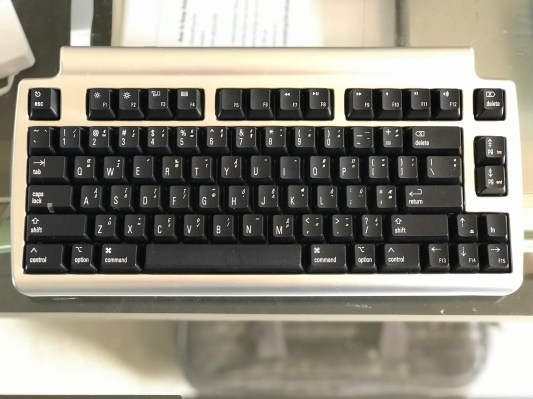
Does having a nice keyboard make me a better writer? Not in and of itself.
But does having a nice keyboard make me feel like my time spent writing is more enjoyable, encouraging me to favor this activity over other ways to spend my time? You bet!
The only thing that helps a person work on their craft is time and deliberate practice. You could argue any tool that helps create those conditions has some degree of positive impact.
But there’s also the nostalgia.
It reminds me of that feeling of the first time I learned how to type, working on a Commodore 64 in my parents’ living room. The chunkiness of the keys. The orange glow of the text when I fired up the word processor to do a research paper on Mars. The satisfying click as I made things happen on screen while following along with one of the library books that said they would teach me how to program in BASIC (Ron Howard Voice: “They did not.”)
It’s not that I wish that the computer I was using had the same limited capabilities as that old machine. What I wanted from purchasing a mechanical keyboard was comfort and joy.
There’s a strong sensory connection between the tactile experience of the keyboard and the sensation of enthusiastically discovering something new. An attempt to trigger those beginner’s mind feelings, even after years and years of using a computer.
Because there’s still so much to learn.
But even without any guarantee of that, I can say for certain that sitting down to type feels more joyful. It’s no longer just the pleasure of actually taking time to write something down and work out my ideas. There’s a rhythm to the keys that keeps me motivated just as much as any well-crafted writing playlist.
Because he got a clicky mechanical keyboard, of course.
It’s a healthy reminder that we’re not just content-creation algorithms, trying to spit out data for dopamine rewards. There should be joy in the process. An awareness and appreciation for not just our ideas, but the tools we use to make them tangible.
Little touches can make a world of difference, like the right coffee mug.
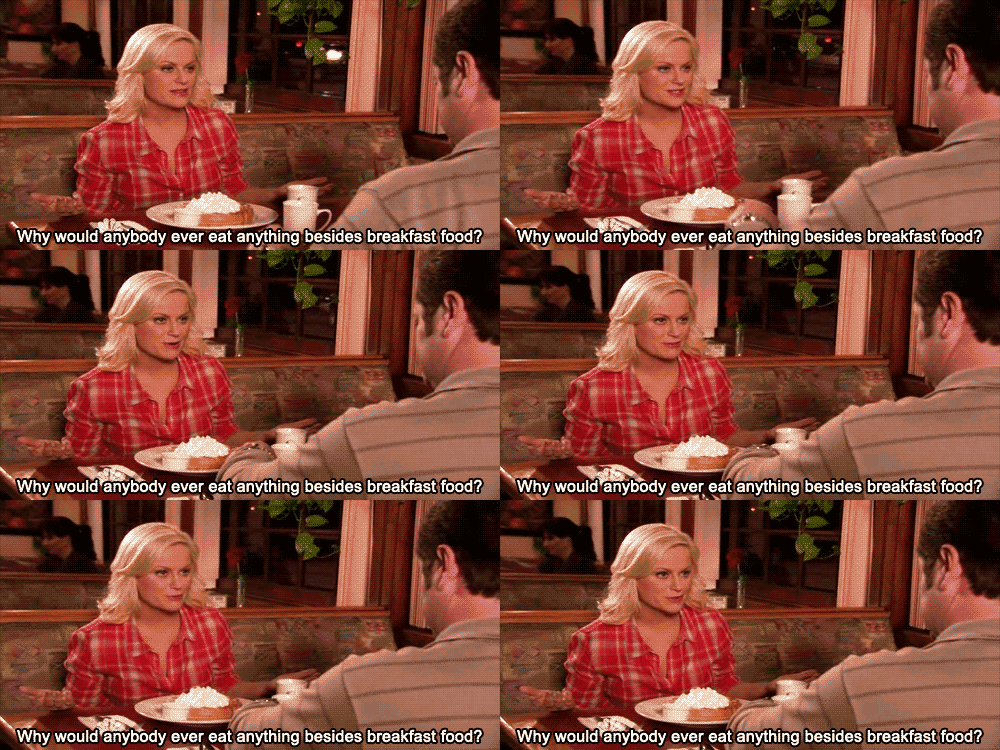
My favorite breakfast place in the entire United States is the Deluxe Town Diner in Watertown, MA. If you’re familiar with the love Leslie Knope has for J.J.’s Diner, you have a general idea of how much I rave about this place.
On my family’s most recent trip out to the east coast, I made sure that I took home a mug from Deluxe Town, because it is the perfect mug.
This isn’t just nostalgia for the countless brunches over sour cream waffles or their perfectly tender and juicy in-house corned beef hash.
There’s a satisfying weight to the mug. It doesn’t make coffee taste better, but it makes the act of lifting the mug up to my lips feel substantial. You pay attention to the feeling in your hand and your arm as you raise it up.
You can’t ignore this mug. It’s not a paper cup. It’s not a cheap ceramic nothing. You are aware that you are drinking a good cup of coffee (so long as you put some good coffee in it).
If I appreciate my tools, the objects I surround myself with, they help me to remain present in time and space with them.
It’s not about the price tag. This isn’t a call for unchecked consumption, or for an endless deep dive into the world of The Best X You Can Buy listicles.
It’s a call to look for those objects and moments you interact with that matter. To consider how best to appreciate the tools of your trade.
What do you touch every day? Do you pay attention to it? Does it matter? Should it matter more?
When you are asked to give more and more of your mental energy and presence to things happening away from where you are, what things help anchor you? What objects can you use to keep yourself from drifting too far away, or getting lost down rabbit holes?
I am drinking this coffee. I am typing these words. I am here.
Now picture that cat in your home, somewhere near you.
What do you imagine that cat doing?
Don’t overthink it. Whatever immediately came to mind when I said to imagine a cat in the room with you works fine.
Got it?
So, what did you imagine?
Was it something you’ve seen a cat do before? Chase a laser pointer? Stare out a window at some birds? Knock something off a table? Curl up and purr in your lap?
Remember that. Keep your imaginary cat in the back of your mind for a few minutes.
Recently, my daughter looked down at our lazy, 13-year-old cat lounging on the carpet.
“When’s Luna gonna get bigger?”
I paused. “She’s already fully grown. That’s as big as she gets.”
Sprout started to pout. “So I’m never gonna get to ride her‽”
I didn’t see that one coming.
What Sprout did just then? That was beginner’s mind in action.
You see a cat, or you imagine a cat, and your experiences tell you about things that cats do. They tell you purposes cats have. You catalog and categorize the things you see in the world around you.
This thing is a cat. This thing is like a cat. This thing is not a cat.
Time passes. More things make their way into the matrix of your memory. All thoroughly cross-referenced and orderly.
And that’s why you didn’t consider riding your imaginary cat.
You have your reasons, and they’re good reasons. They’re true. It would be foolish to try and actually ride a housecat.
But that doesn’t mean it shouldn’t be an imaginary possibility.
I want to try to break down how Sprout came to this moment. My guess is she had some combination of these thoughts (not necessarily in this order):
There’s Luna.
I love my cat so much, I can’t handle it.
I am small, and so is Luna.
I am growing.
Is Luna growing? Ask a grown up.
I can ride animals, like that time I rode Oreo the pony.
If Luna was bigger, I could ride her!
When will Luna be big enough for me to ride? Ask a grown up!
Her creative process for this idea probably involved memories, established facts, and questions about the unknown.
It’s unlikely she’s seen anyone riding a cat, so that’s a novel element. It’s an aspect of the unknown.
I am absolutely certain Sprout has never watched He-Man in any form, so I’m ruling out this as an influence.
However, that element of the unknown is an extension of the known. She’s not just creating this possibility out of nowhere.
So why am I doing a deep dive on two sentences from my daughter, besides the fact that they made me laugh really hard?
What I saw in her in that moment was a piece of the larger creative process: The desire to create something that does not currently exist, except in the mind.
“In the beginner’s mind there are many possibilities, but in the expert’s there are few.”
The more we learn about an idea, or a process, or an art form, the more it can constrict our thinking. That which has already been proven, or has already been done, suggests boundaries for what can still be learned or done.
It limits the questions you ask, or the solutions you attempt.
While I can’t deny there is value to be had in deep study of anything you want to work with, be it a creative medium, a scientific field, or any job with its set of processes and requirements, adhering to strongly to “the way things are done” can stifle novel solutions.
The best cinematic expression I’ve seen of this comes from Star Wars Episode V: The Empire Strikes Back. While training on Dagobah, Luke whines to Yoda about how he couldn’t possibly lift an X-Wing using the Force. He says that even though he can lift rocks with it, an X-Wing is much heavier.
Luke knows the weight of objects, and he knows his capacity to physically lift objects. He applies these rules to how he thinks the Force works.
And Yoda attempts to convince him that his strict adherence to just these facts isn’t helping him.
In this example, Yoda lifts the X-Wing out of the swamp using the Force to make a point: This is something new to you that you don’t yet understand. It isn’t a muscle. It doesn’t use your body. You can’t hold onto the same rules you learned from interacting with heavy objects using your body.
There’s a method to test and explore ideas. To not feel like everything is already decided for you, or that what you already know is an impenetrable wall, halting your progress.
Anchor your ideas in what you know, but test those boundaries of possibility. Ask questions, the way Sprout did.
Think about what happens if something you see as a hard rule could bend, just a little.
Then chase that notion.
It’s mental jujitsu. Use the weight of the knowledge you already have against itself, and try to swing it to the side to see if it will make way for something unexpected.
To be clear: I do not have all the answers to this, or a simple, listicle-friendly process for people to follow. It’s something I wrestle with regularly, too.
What I do know is that some ideas are less solid and impenetrable than they seem, and it’s important to be able to test your ideas to understand them as they truly are.
It does you no favors to look at a suggestion and see it as a rule, or vice-versa, like the difference between a stop sign and a yield.
One caveat: This doesn’t mean that all ideas formed in this Beginner’s Mind state are great ideas.
I can’t tell you how many times since having this conversation with Sprout that I’ve had to stop her from straddling Luna in preparation to actually try to ride the cat.






 This Builds Character
You must be logged in to post a comment.