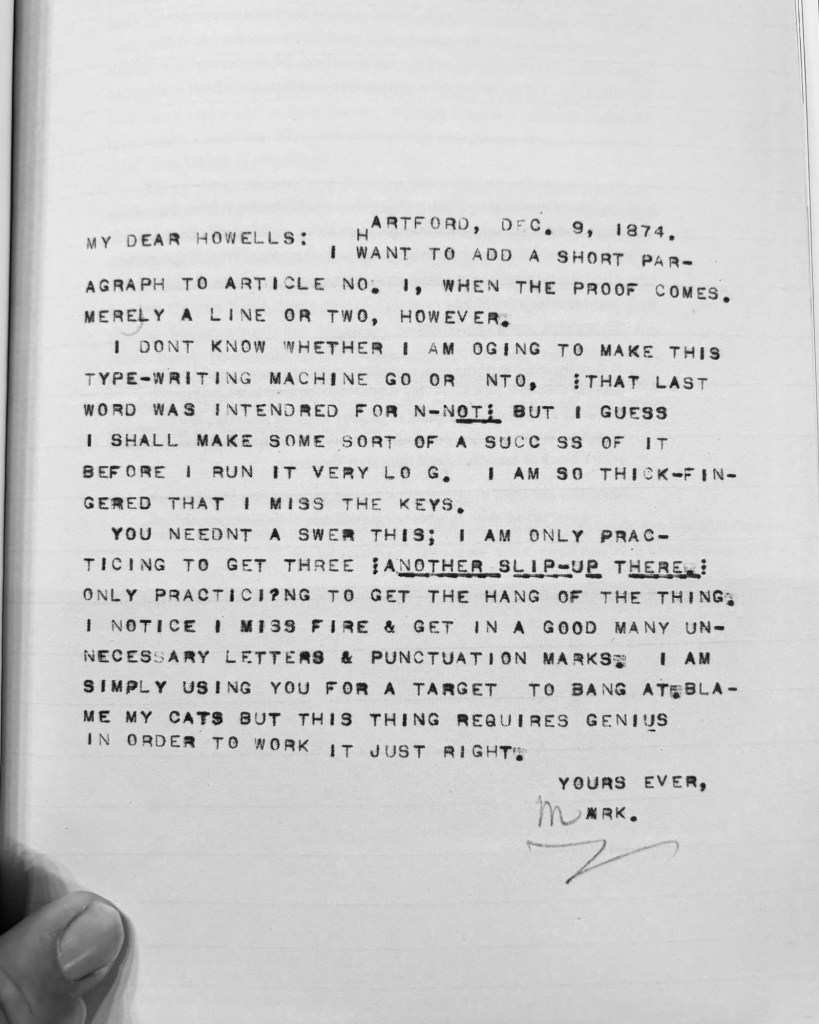
This was Mark Twain’s version of the Sent from my iPhone typo excuse.
Becoming a better writer and Homo sapien.
This was Mark Twain’s version of the Sent from my iPhone typo excuse.
Trying something other than resolutions in the new year (Yes, I know it’s February. Pope Gregory XIII isn’t the boss of me.) and instead focusing on three key words.
Your attention is one of the most valuable things you possess, which is why everyone wants to steal it from you. First you must protect it, and then you must point it in the right direction.
Austin Kleon, Keep Going
Working on a newsletter a few weeks back, I came across a paper on Critical Ignoring as a required skill for digital information literacy.
Critical ignoring is a type of deliberate ignorance used to filter and block information so a person can reduce their exposure to irrelevant or inaccurate information. It involves redesigning the choice architecture used to engage with the internet, using outside references to validate the quality of information by a source (instead of looking only at the source itself), and disengaging from bad actors.
Why work on intentionally ignoring information? Cited in the paper:
When the world comes to people filtered through digital devices, there is no longer a need to decide what information to seek. Instead, the relentless stream of information has turned human attention into a scarce resource to be seized and exploited by advertisers and content providers. Investing effortful and conscious critical thinking in sources that should have been ignored in the first place means that one’s attention has already been expropriated.
M. Caulfield, Recalibrating our approach to misinformation.
There aren’t any easy answers to how to avoid falling down useless rabbit holes on the internet, especially when lead down them by emotional manipulation. But this paper does connect with a lot of other best practices and puts into focus the idea that the goal shouldn’t be to optimize your information consumption, but to make choices that support the things you already want to do so that you can avoid being redirected from what you value.
I read this post from Chris Wilson, and one part clicked for me:
On those wildly busy days, my ego tries to convince me that I don’t have time to stick to my keystone habits of hydration, elevation, meditation, and contemplation. And that’s my signal amongst the noise that it’s time to double down on the habits that “I don’t have time to do.”
When I worked at the Ann Arbor Film Festival I started a habit. I was the first one into the office each morning, so I took a few minutes to put together a quick meme to tape to the front door.
I called it the Physical Blog.
It set the tone for the day. Sometimes it was about pumping people up. Sometimes we needed a good laugh. Whatever it was, I was giving people something to look at each time they came through the door.
And then there was a point I just stopped doing it.
It wasn’t until it hadn’t showed up for a while that someone asked me why. And the realization came: I was feeling stressed about work, and decided I didn’t have time for this little fun thing at the start of the day.
But that was when I needed it the most.
It was a warning signal that other things were going to start falling through the cracks. Tunnel vision was setting in, and instead of prioritizing I was scrambling.
The things you do for yourself, be it making the bed, meditating, exercising, or posting dumb little jokes for your friends… When you cut those out, you’re acting like those things don’t matter.
That other things are more important.
Maybe it’s other people’s needs.
Maybe things you do to get paid.
Whatever it is, if it’s something that brings you joy and helps give you a little boost and feels like an important part of who you are…
Making sure those things get done asserts that you value yourself. It’s putting on your own mask first. Filling up your pitcher before you start pouring it out.
It’s something I’m working re-learning now.
In looking for simple ways to help stay more mindful, I made an iOS shortcut for when I catch myself doomscrolling.
The problem I have comes when I realizing I’m just doomscrolling, but can’t move myself away. So I gave myself a clear next thing to do whenever I find myself in that spot.
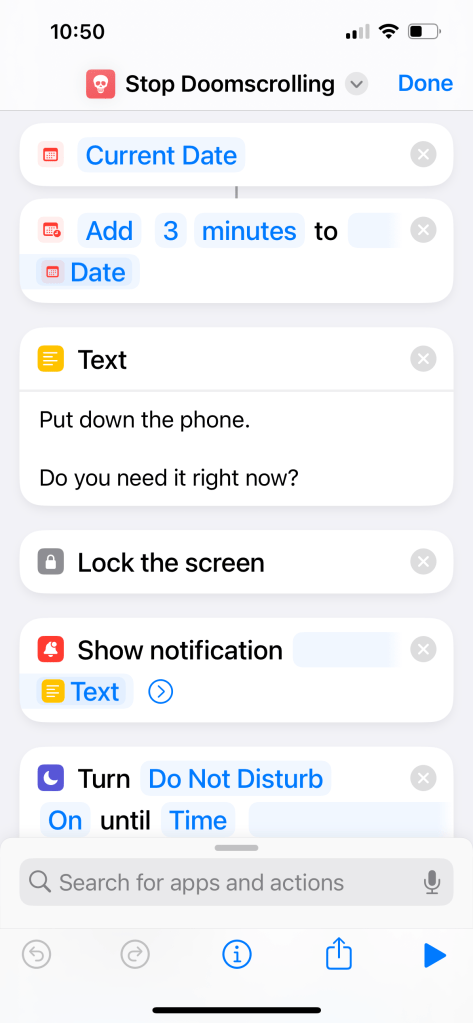
The part about it that makes it simple for me: I can just tell Siri the thing I want to do.
Then, I get this:

Three things happen to disrupt the doomscrolling paralysis:
Maybe this will be an effective countermeasure for me?
 This Builds Character
You must be logged in to post a comment.