Context switching and parenting

Every day when both kids are home from school, I have two small humans competing for my attention.

One has homework questions they need help with, occasional anxieties to be confronted and calmed, and a desire to know what the plan is for the rest of the night. The other needs a snack (but doesn’t know what kind), wants to watch something (but doesn’t know what), and either wants to pretend to be a Star Wars character or ask me 50,000 rapid fire questions about Star Wars.

And I started thinking about how, exactly, I wind up so tired right before dinner every weekday. Which lead me to remembering about partial attention and context switching.

In the case of continuous partial attention, we’re motivated by a desire not to miss anything.  We’re engaged in two activities that both demand cognition.  We’re talking on the phone and driving.  We’re writing an email and participating in a conference call.  We’re carrying on a conversation at dinner and texting under the table on the Blackberry or iPhone.

Continuous partial attention also describes a state in which attention is on a priority or primary task, while, at the same time, scanning for other people, activities, or opportunities, and replacing the primary task with something that seems, in this next moment, more important.  When we do this, we may have the feeling that our brains process multiple activities in parallel.  Researchers say that while we can rapidly shift between activities, our brains process serially.

Continuous partial attention is an always on, anywhere, anytime, any place behavior that creates an artificial sense of crisis. We are always in high alert.  We are demanding multiple cognitively complex actions from ourselves.  We are reaching to keep a top priority in focus, while, at the same time, scanning the periphery to see if we are missing other opportunities.  If we are, our very fickle attention shifts focus.  What’s ringing? Who is it?  How many emails? What’s on my list?  What time is it in Bangalore?

In this state of always-on crisis, our adrenalized “fight or flight” mechanism kicks in.  This is great when we’re being chased by tigers. How many of those 500 emails a day is a TIGER?  How many are flies? Is everything an emergency?

Linda Stone, Beyond Simple Multi-Tasking: Continuous Partial Attention

Something that came up again and again when I was researching my book on this topic, is that switching your attention — even if only for a minute or two — can significantly impede your cognitive function for a long time to follow.

More bluntly: context switches gunk up your brain.

Cal Newport, Deep Habits: The Danger of Pseudo-Depth

I want to be there for my kids, and actively engaged with them in the moment. But they also both want 100% of my attention at the same time right after school.

It’s a concentrated burst of continuous partial attention that may not last long, but definitely triggers that fight or flight response in me. I usually need a few minutes at some point to clear the brain fog.

But maybe by putting a name to it and looking more closely at how it’s happening, I can start to navigate better solutions.
Three quotes about attention

Joy and happiness are born of concentration. When you are having a cup of tea, the value of that experience depends on your concentration. You have to drink the tea with 100 percent of your being. The true pleasure is experienced in the concentration. When you walk and you are 100 percent concentrated, the joy you get from the steps you are taking is much greater than the joy you would get without concentration. You have to invest 100 percent of your body and mind in the act of walking. Then you will experience that being alive and taking steps on this planet are miraculous things.

The Zen master Linji (also known as Rinzai) said, “The miracle is walking on the earth, not walking on water or fire. The real miracle is walking on this earth.”

Thich Nhat Hanh, You Are Here

Who made the world?
Who made the swan, and the black bear?
Who made the grasshopper?
This grasshopper, I mean—
the one who has flung herself out of the grass,
the one who is eating sugar out of my hand,
who is moving her jaws back and forth instead of up and down—
who is gazing around with her enormous and complicated eyes.
Now she lifts her pale forearms and thoroughly washes her face.
Now she snaps her wings open, and floats away.
I don’t know exactly what a prayer is.
I do know how to pay attention, how to fall down
into the grass, how to kneel down in the grass,
how to be idle and blessed, how to stroll through the fields,
which is what I have been doing all day.
Tell me, what else should I have done?
Doesn’t everything die at last, and too soon?
Tell me, what is it you plan to do
with your one wild and precious life?

Mary Oliver, Poem 133: The Summer Day

So what is noticing?
A pinpoint of awareness,
The detail that stands out amid all the details.
It’s catching your sleeve on the thorn of the thing you notice
And paying attention as you free yourself.

Verlyn Klinkenborg, Several Short Sentences about Writing

Negative noise machine

Paul Jun loaded his post Twitter Brain with plenty of quotable moments, but this stood out to me:

Twitter, I realized, is a stationary bicycle to self-generate chaos. It is a buffet of madness. It is a marketplace for anyone who wants a desire for any desire—and most of the time what you’ll get is anger, outrage, and stupidity. No one leaves Twitter feeling better. But what’s sickening is how hooked we can get.

What I learned from my burnout—and trying to reorganize my life—made me face the reality that being comfortable in chaos can be an excuse. It can be a form of trauma response. It is easy to find identity in trauma and pain, to make that the background music of your life. When we crave chaos, and life is actually good, oddly we want things to be bad again. It’s a vicious cycle. It’s a profound realization. 

When I pull up Tweetbot, it’s a filtered experience. I check in on people I know with their tweets in chronological order, check my replies, and can’t do a lot of interaction with trending topics unless the people I follow participate.

If I go to the website, though, I’m choosing chaos.

This bothers me as much about my behavior as it does about the platform itself.

It may not be true of everything, but plenty of aspects of my life are much better than they were two, four, or six years ago. There’s still a lot of work to be done, but the volume on the ambient daily outrage and confusion isn’t what it used to be.

The fact that I’m even interested in talking about Twitter to talk about Twitter feels like a weird negative feedback loop. A conversational Groundhog Day.

Back in undergrad, my friend Sam and I were talking about drawing from negative memories when writing fiction, and he said “You don’t have to feel it now in order to remember it and use it.”

I understand now that part of what was going on was undiagnosed depression, but there’s also something going on with that back-asswards craving for the stability of knowing things are terrible and on fire.

That compulsion to wallow in the negative used to only have a home inside my own head. Now I can take on other people’s misery, and there’s always something wrong.


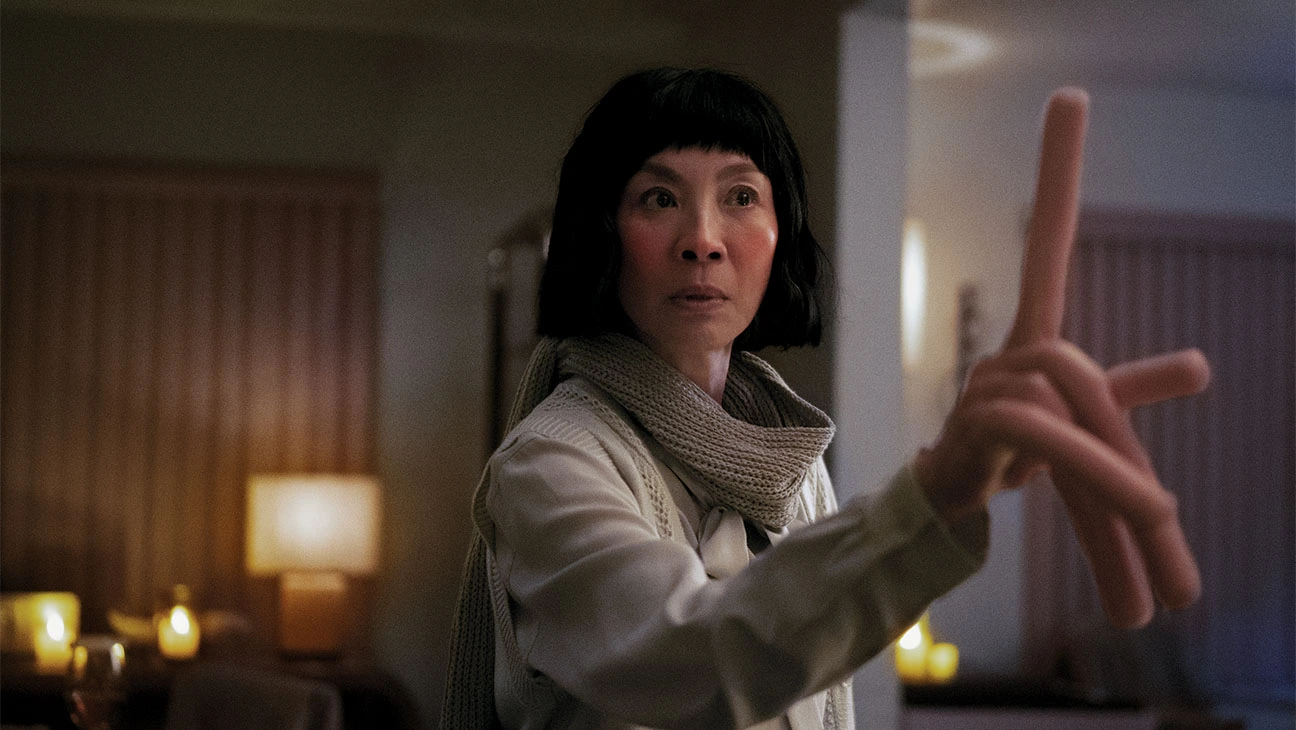
Michelle Yeoh with hot dog fingers in Everything Everywhere All at Once
Seriously, this movie deserves all the awards.

Last night I finally watched Everything Everywhere All At Once. What an explosion of joyous creativity! A heartfelt story about breaking the cycle of generational trauma, an action film, an absurd existential comedy, and a pitch perfect parody of a dozen genres at different points.

Enjoying something like that requires disconnecting. Giving yourself over to the whirlwind.

And when I think about how I feel after watching something like that versus how I feel after a check in on social media, I know the difference. I know what gives me energy and creativity and ideas, and what makes me want to roll over and have a good wallow in the muck.

But change doesn’t come from acknowledgement alone. It’s a step.

Considering who benefits from my attention

“Wondering how to decide what to read? Here’s a simple but effective heuristic to cut down the choices significantly. Ask yourself one question: Does this writer make bank when we hate one another? And if the answer is yes, don’t read that writer.”

Alan Jacobs, “a friendly reminder”

Jacobs makes a good, high-altitude argument. If the goal is to keep you engaged by making you angry, giving it your attention doesn’t benefit you.

It’s not that anger can’t be a useful motivating tool. But anger as the end goal isn’t worth pursuing.

I came back to this post after all the changes with Twitter’s new main character. Maybe he’s the Final Boss, but that’s not clear yet. Anecdotally I’ve noticed a lot more garbage in trending topics that make it less useful, and a lot of time spent by people trying to dunk on the Chief Twit (whether or not they name him in their post).

I don’t need an app whose primary purpose is to tell me what dumb thing Elon Musk said or did today.

But it’s not just about Twitter, either:

Betchik is one of TikTok’s premiere rage-bait chefs: influencers who make videos of gruesome and often disgusting recipes, which they then consume in front of a camera. Most creators in the space claim to be driven by curiosity rather than fame, but their reliance on outrage to fuel their online presence is undeniable. On TikTok and other platforms, algorithms favor engagement — and nothing inspired engagement quite as reliably as disgust. 

Jessica Lucas, Why the worst recipes imaginable are blowing up on TikTok

It used to feel harder to pull myself away from some of this stuff. I’m not sure what’s changed. Maybe there’s just a tipping point. When the problems with an app or a type of content outweigh any potential benefits.

Sure, I can get sucked down a rabbit hole like anybody else. But a thing that can help to pull me out is asking, “Are they just trying to annoy me? Are they just playing a game to get me angry so their metrics look good?”

I don’t want to be a little rage button that can be pushed to juice somebody’s numbers.

It’s the illusion of control for me

With a new bullet journal notebook, a day fits neatly between straight lines guided by a ruler and dot grid. It has form. Order.

It doesn’t make the day itself conform to this shape, but the map is realistic enough to represent the country.

Each event logged takes up no more space than it’s allowed. The moment transfers to the page without the emotion.

This is what I planned and this is what I did. No judgement. No regrets.

When it feels like all I can control is my reaction to events, putting a name to every reaction and giving it a place to live outside myself helps me find balance.

I can’t just doomscroll. I have to pause and write down that I’m doomscrolling.

If I’m going to have any chance at getting back to navigating my own path, I need to find my bearings first.