Intentionally Slowing Down Text Messaging

Messages routinely get forgotten and go unanswered. The missing “Mark Unread” button has no doubt caused countless accidental ghostings, avoidable arguments, and missed opportunities. And its lack has likely made life more difficult for users with conditions that affect memory or follow-through, like ADHD and depression, who may not be able to respond in the moment and have no easy way to record their intention to do so.

Matthew Bischoff, “The Case for ‘Mark as Unread’ in Messages”

I know I’ve let text messages slip through the cracks because I didn’t feel able to commit the bandwidth to a response in the moment I received the initial message. This isn’t as much of a problem with other communication apps because there are ways to flag items to respond to later.

One thing Mark as Read can’t fix: What happens when I’m ready to respond, but it’s the wrong time for the other person?

Slack has that problem figured out. I can save a message and have it delivered at a later time. It’s a solution that fits with Slack as a work tool, but the Deliver Later option could be helpful for lots of communication apps.

Imagine you could save a draft text message to be delivered to someone later. At the time you set, you could get a quick prompt showing you your message and asking “Is now the right time?”

Apple does have options with Focus modes where you can block delivery of message notifications, or batch your notifications to be delivered at a later time, but these are based on a system where you have to play defense. People aren’t given the option to be more considerate senders.

Take it a step further: Send When They Have Time as an option.

A person toggles an option that creates a window/windows when they can receive text messages that might require action or a more thoughtful response.

The person sending it is given the option to let the app coordinate with the other person’s settings to determine when this notification shows up.

It could be messy — creating a scenario where a person gets deluged with messages during their best time to respond.

But it would be nice if there were more options like it that allowed for both sender and recipient to acknowledge that while our devices can consistently process instant communication, we’re made of chemicals, meat, and feelings.
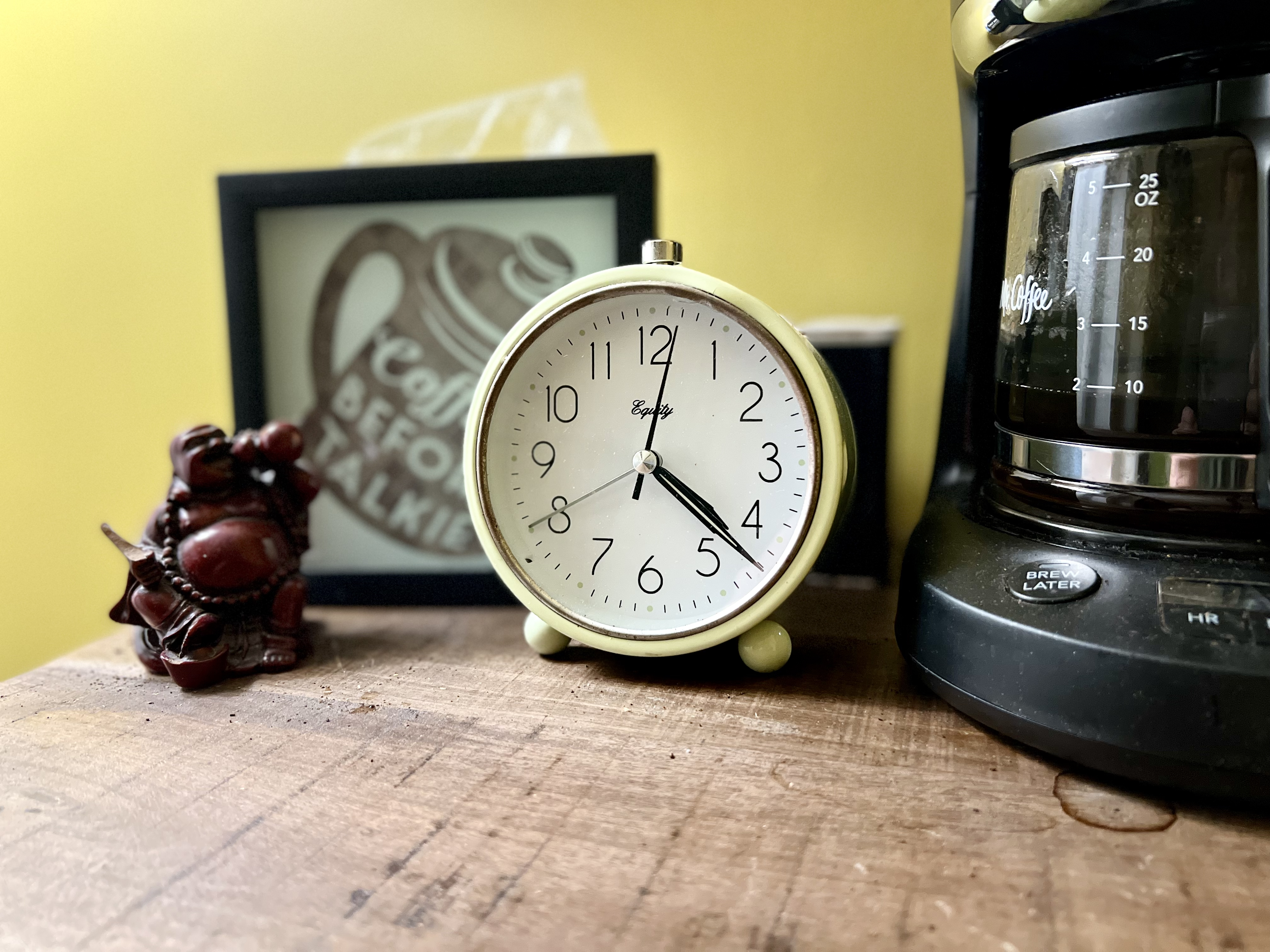
I keep a clock in my office near the coffee maker.

A picture of an analog alarm clock next to a coffee maker, a Buddha, and a sign from Target that says "Coffee Before Talkie."

It ticks away the seconds.

It could sound like a bomb, nearing detonation.

Or a roller coaster, pulling its passengers up toward a drop.

Or it could be a small voice whispering “Now.”

Over and over.

A reminder that every moment passes, giving way to something else.

Whether I believe it or not, I’m always moving forward.

Each new beginning isn’t even a moment away.

I’m already there.

Nownownownownownownownownownownownownownownownownownownownow

Do or do not. There is not GTD.

In the years since high school and undergrad, I learned a lot about different systems for managing work, but I don’t know how much of that translated into knowing more about managing myself.

Lately I’m craving simple solutions.

We’re in year three of a pandemic. I’ve got two young kids. A heap of responsibilities in different buckets to juggle. I don’t have time to learn calligraphy to make an attractive bullet journal or craft a set of 57 nested tags for a perfect GTD machine.

The other day I tried to remember what my system was to manage my task list when I was in school… and I couldn’t.

Part of that was privilege. With few external pressures or obligations, I kept focused on schoolwork.

There was also the clarity of being a student.

At every level, school had small blocks of work that added up to a coherent whole:

Do these assignments by these deadlines to pass these classes and earn this degree.

Stepping out of that environment left a vacuum.

I wasn’t submitting to someone else’s syllabus. Making your own choices about what to focus on requires a leap of faith.

Maybe the most direct answer, though not the easiest one, is to focus less on organizing to-do lists or articulating methods, and more on developing trust in my ability to set priorities.

What is important? What is important right now?

If I can learn to answer those questions quickly and confidently, shutting out everything else in order to focus might be easier.

Update: The Sans Case Experiment

It’s been about three weeks since I took the case off my phone.

I’m still treating my phone gingerly and making choices about when it’s worthwhile and safe to take it out.

My average daily phone use dropped around 25%.

The biggest decline in individual app usage: social media apps. I haven’t stopped using them, but I’m using them less as a pause between other things.

It may seem silly to buy an expensive tool and then work to use it less, but it’s also silly to try to use a drill as a hammer.

Am I paying for the quantity of tasks the phone can do, or should I judge its value based on the quality of the tasks it can perform?

I could trade in my iPhone for a retro Nokia, but this phone gives me valuable features—turn-by-turn navigation, a great camera for pictures of my family (and easy ways to share those photos), quick access to email, and contactless payment.

In a small way, directly feeling its design under my fingers reminds me my phone was built as a tool, not a toy.

500(ish) Meditation Sessions

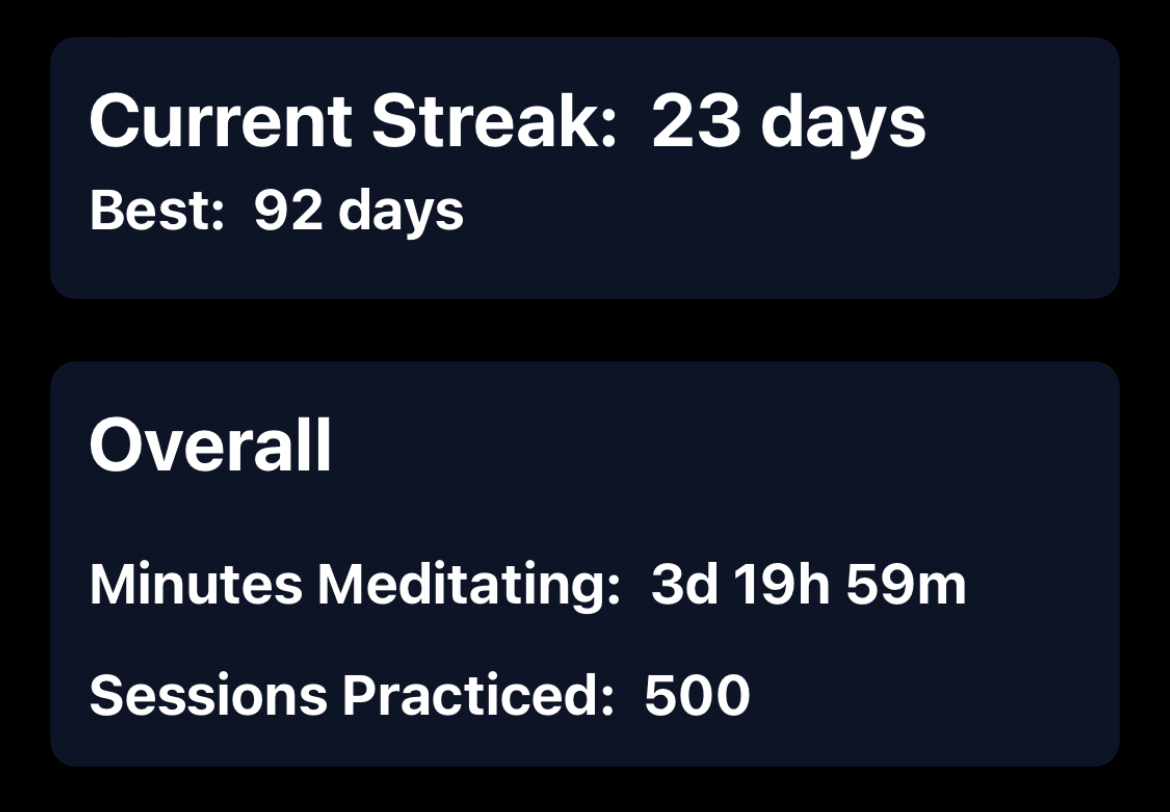
This morning I sat for my 500th meditation session since starting to use the Timeless app.

Screen grab from Timeless meditation app on iOS. Current Streak: 23 Days. Best 92 Days. Sessions: 500
Yes, I am mildly peeved that I didn’t sit for one more minute today to make it an even 3 days and 20 hours.

I’ve been meditating at least semi-regularly for around ten years. I’ve cycled through multiple apps in that time, so I don’t really know how much total time I’ve spent sitting.

But I know I started this some time ago, and I still do it. Almost every morning I wake up ahead of everyone else in the house to make time for it.

I know the day feels different if I don’t make time for it. Not necessarily worse, but different.

I know that it’s something I’m comfortable doing even though I’m not sure I’m doing it “right.”

The effort itself helps.

It’s a steady presence. Even though no session is the same as any other, the act of sitting, breathing, and not trying to restlessly chase some kind of input to fill the time… It’s a reminder that when I need to, I have tools to help me step back and find my balance.

Seeing the numbers used to make me feel like I was doing something wrong. That breaking the chain was a failure of character.

But the timeline is longer now. I can see I don’t need to be perfect at it to get value from it.

Every session is practice, even after ten years.