Re-starting the chain

I try to meditate every day. Sometimes I don’t. The other day I had reasons for why it just didn’t happen, and I broke a 90 day streak.

I’m supposed to feel bad, right? That’s what a lot of people tell you — That if something is important to you and you don’t do it every day, without fail, then maybe it’s not actually important to you and you’re bad at it.

But look at what one missed day really means.
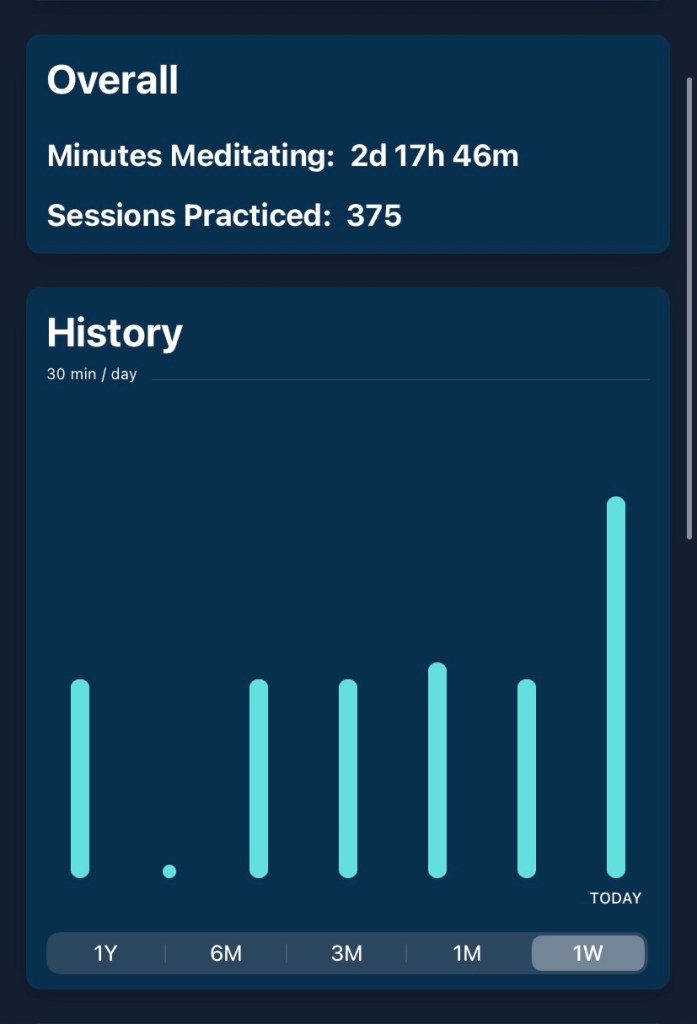
Here’s one week.

You see the missing day, and that 1/7 (or 14%) looks meaningful.

It’s not a majority. It’s not even a plurality of my week.

But it looks like something to take note of.

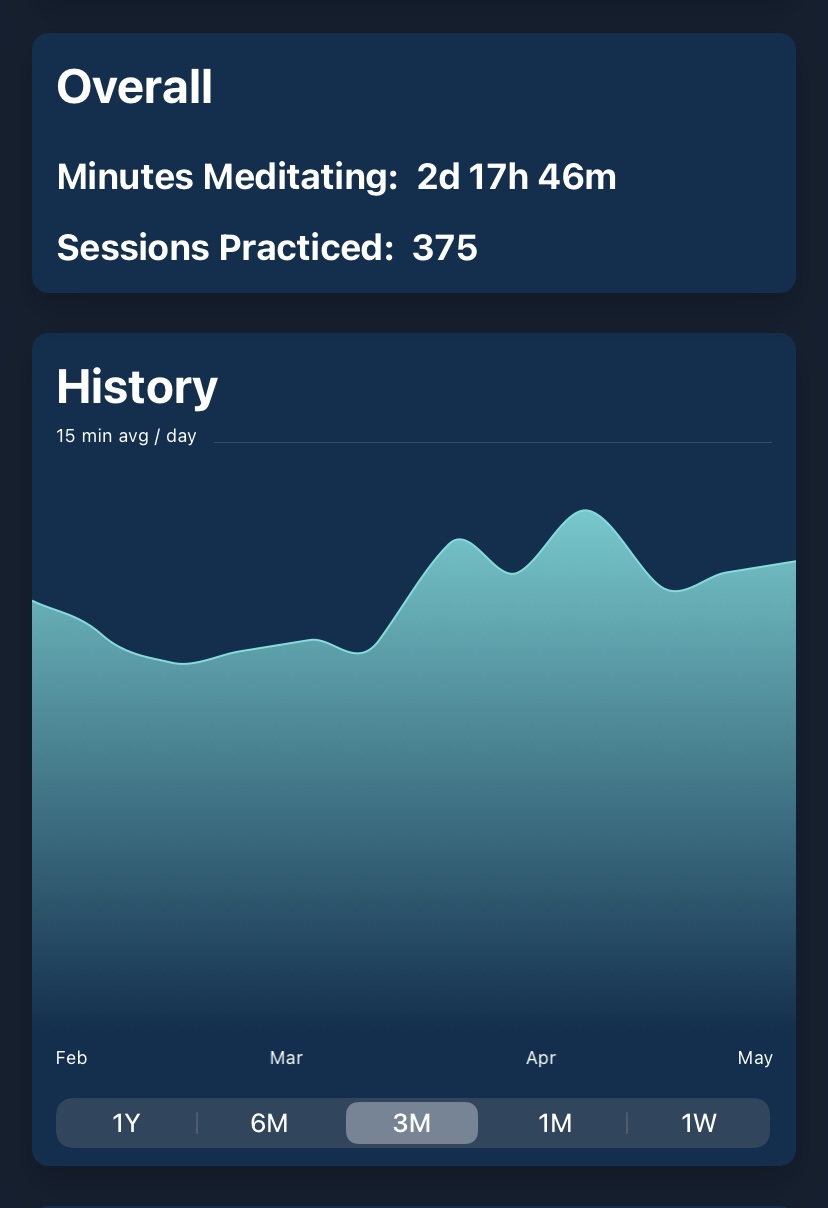
Until you look at the view from one month and three months back.

At one month, it looks like a big dip. Remember how I said I had a 90 day chain going?

Now pull back to three months, and you can barely tell where the dip is. It’s just one small curve on a fairly smooth line.
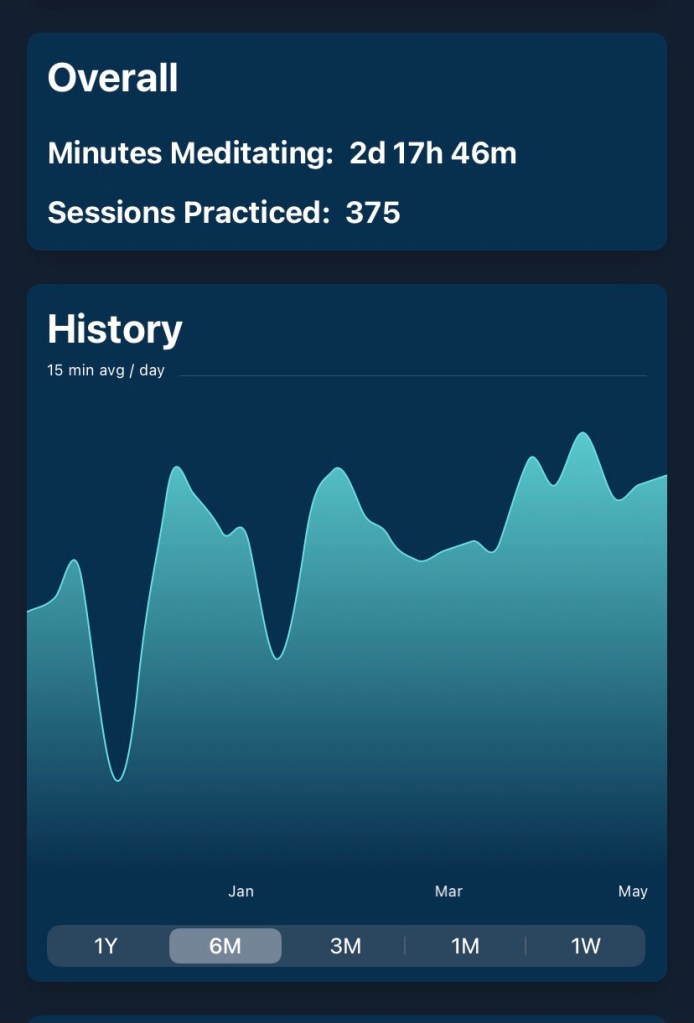
Then look at six months of records.

That dip furthest to the right? That’s the missing day.

It’s nowhere near the biggest dip on this chart. It’s not significant in any real way.

Now look at a full year of keeping track of my meditation:
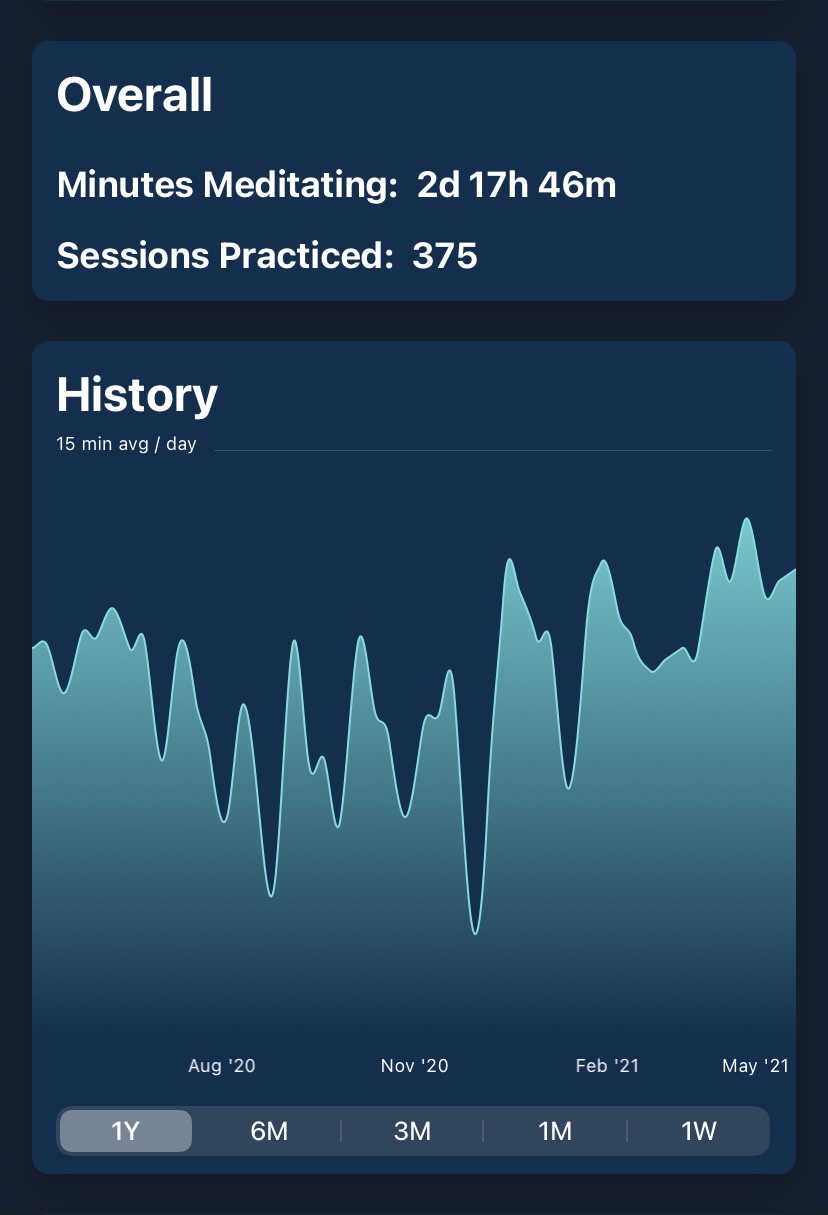
That single missed day? That’s nothing. Barely worth noticing.

Thinking back to how even the best professional baseball players have “low” batting averages, this looks like further evidence toward the point that there’s value in being gentle to yourself and setting realistic expectations.

Discipline for the sake of discipline isn’t a virtue.

A single bad day or bad portion of a day comes out in the wash.

Executing on the purpose of the habit can be just as meaningful on executing on the habit itself. I don’t meditate to unlock a trophy in my meditation app. I do it because it helps ground me, and it’s part of how I do the work of surviving with depression. The product of the habit is a better version of me.

There’s a world of difference between giving up on a habit and its benefits versus letting go of the compulsion to keep up a habit at any cost when you have a need to give yourself space for other things.

It’s part of why I like James Clear’s take on missing days from a habit:

Whenever this happens to me, I try to remind myself of a simple rule: never miss twice.

The first mistake is never the one that ruins you. It is the spiral of repeated mistakes that follows. Missing once is an accident. Missing twice is the start of a new habit.

Atomic Habits

Calculating Intention Debt

I’d love a to-do list app that totals up the estimated time for the tasks I have planned for the day so I know if I’m overextending myself. Even better: It tracks my time and suggests better estimates based on previous work.

I’d like a podcast app that tallies how much listening I’ve committed to with the episodes I’ve downloaded. Or to have streaming services tell me, based on the data they have about my viewing habits, how long it will take me to watch everything in my queue.

Or a toolbar widget in my browser that calculates how long it would take to read my open tabs. A Read Later app that shows the estimated reading time for my saved articles.

Tools like this would make it easier to stop creating Intention Debt, that long list of things that I think I’ll get to, but that just creates digital clutter.

A Netflix queue that you only sometimes see in the app isn’t the same as a stack of unread books on a table. One is tangible and the other can be ignored with a quick tap or click.

Knowing where I’m setting the finish line could be helpful. A concrete number could change my decisions about how to spend time in ways a vague sense of “I don’t have the bandwidth for this” won’t.

I woke up feeling congested. When I sat down to meditate, my nostril whistled like a kettle begging for attention.

I sat with it for a minute, thinking about Pema Chödrön’s words on removing discomfort:

“Scrambling for security has never brought anything but momentary joy. It’s like changing the position of our legs in meditation. Our legs hurt from sitting cross-legged, so we move them. And then we feel, “Phew! What a relief!” But two and a half minutes later, we want to move them again. We keep moving around seeking pleasure, seeking comfort, and the satisfaction that we get is very short-lived.”
― Pema Chodron, When Things Fall Apart

I tried to focus on the air getting through instead of the force required; the air in my lungs and not the blockage in my nostril.

Then I asked the question: “How is blowing my nose not the dharma?” How is removing this impediment any different than labeling a thought as “thinking” and letting it pass?

I got up, blew my nose, and sat back on the cushion.

I’m not sure if it was the correct response, but I made the decision and moved on.

And isn’t a point of mindful attention to not dwell on things, but to try and see them as they are?

Sometimes a booger is an invitation to practice patience, and sometimes it’s snot.

Looking for better instead of making better

Yesterday, someone who just met me answered a question by asking “Have been told you overthink things?” It was a pretty spot-on reading.

This morning, I came across this passage:

From the point of view of Samaya, we could say that looking for alternatives is the only thing that keeps us from realizing that we’re already in a sacred world. Looking for alternatives—better sights than we see, better sounds than we hear, a better mind than we have—keeps us from realizing that we could stand with pride in the middle of our life and realize it’s a sacred mandala. We have such a deep tendency to want to squirm out of it, like a beetle on a pin: we squirm and try to get away from just being on the dot.

Pema Chödrön, When Things Fall Apart

This really clicks when you’re the kind of person who has a setup for managing your to-dos, but keep Googling ways you might optimize or refine it with one more trick.

Or you’ve been stuck trying to finish a draft of something you’re writing, because you think it could be better if you spent a little more time on the thinking about the writing instead of the writing.

That pernicious idea that you must keep looking and contemplating for a better way to do things before the doing, instead of treating the doing as the path to better. That the doing is good enough.

It’s something I remind students of, and have to remind myself of frequently: You can’t revise what you haven’t written. Searching for better and ruminating is like trying to write the third draft of a blank page.

I must remind myself of this more often.

I want to be useful, not a user

I still like Twitter. I don’t like subtweets and trending topics.

It’s not hard to add context to a tweet. But, particularly with trending topics, you wind up searching out why people are bothering to talk about The Thing or The Person in the first place. All the tweets complaining about not knowing why x is trending become part of the noise to sort through.

It makes me think about the difference between being heard and being seen.

To be seen talking about something is to want others to know you’re aware of something that’s going on.

Being heard is about wanting people to care about the substance of what you have to add to the conversation.

If you only care about being seen talking about something, you’re only speaking to the audience that already understands the context.

If you value being heard, you also value being understood. That means including context, links, or other helpful cues to fill people in.

Some ways I like to add context.

  • Link to a primary source: It’s direct and simple. And links don’t count against how many characters you have left.
  • Use something like Linky: This is an iOS app that lets you highlight relevant text from a link and attach it as a screenshot.
  • Action over reaction: To take a page from Mister Rogers, be a helper. When it makes sense, show people something they can do about the issue. Push for the solution to trend instead of just the problem.
  • Share somewhere else: Do you want to briefly scream into the void, or do you want more room? Is it a blog post? A text to someone who wants to know? A letter to an elected official?

Right speech and respecting time

I try to think about the consequences of jumping on the bandwagon and adding my voice to the already noisy chorus.

If I tweet something vague and snarky about something, I’ve not only wasted time, but other people’s.

I took time to share something with limited value on its own that may direct others to use their time to search for what I was referring to in the first place.

Time and attention are precious resources.

If I want to use Twitter to spend time connecting with others , I need to respect the time and attention of others.

If I respect people’s support, I should also respect their time.

And if I respect my time, I need to make choices about what I must have an opinion about, and what isn’t worth my attention.