When writing feels like cutting teeth

My son is teething hard. I had a dream that he suddenly went from no teeth to eight teeth overnight, and some days it seems like he’s determined to make that a reality.

“nom nom nom”

It’s a hard process. Each tooth needs to erupt from the gums, which takes a lot of time, force, and pain.

And when it’s all done, and they get those baby teeth in, that’s not the end of the story. There’s a second draft of that mouthful of teeth, waiting on deck.

If you’ve never seen an image of a child’s skull with both sets of teeth inside, it’s… something else.

I’m a little sorry if this makes you horrified of small children.

I’ve been focused on new projects lately. First drafts and new collaborations. Ideas pushing hard, trying to break through and emerge.

And there are times when it feels painful. Like things aren’t moving fast enough, and you just wish you could force things along faster, (like how I imagine Button feels when he’s gnawing on a teether).

Yes, it looks like a coffee cup. I am relentlessly #onbrand, even when picking out baby stuff.

Or when you know that you need to choose to put your butt in the seat and get some ideas out onto the page, but you have to choose that over other things that might also be be fun or important.

But I have to remind myself that the work can continue, and the pages will come, and then… well that’s when it’s time for the next draft.

Which brings me back to that baby skull full of teeth.

Because getting the idea out into the world isn’t the final act. Those pages and ideas fall out and get cast off to make way for bigger, stronger ideas.

But trust that even before that first idea has broken through, the full shape of what’s to come is there, in your head. And it just takes time, and force, and pain.

Dance Like Nobody Is Watching (You Outline)

I needed to figure out some alternative solutions to a mystery in a story I’m working on.

A lot of the work I’ve been doing on this project has happened sitting and typing out ideas that I’ve solidified while either in conversation on the phone with a collaborator, or talking to myself while driving. But this time, I needed to generate those ideas in that moment, and I didn’t have anywhere to drive.

So I started by standing up. I have a whiteboard in my office, and it’s useful for thinking through ideas. But just standing there wasn’t helping me let my guard down and look past the couple pre-conceived solutions I came into the office with.

I recently finished reading Twyla Tharp’s The Creative Habit. Sparked by some ideas in that book, and the fact that I also have a subwoofer in my office, I thought about how adding some movement to the moment might help.

I want this to be clear: I am not a dancer.

I’m not a professional dancer. I’m not a good dancer. But I love music, and sometimes the groove gets in my heart.

Enter Daft Punk’s Alive 2007:

I’m not going to stop you if you want to start playing this album right now.

I can’t guarantee that any of my ideas were better because I was dancing while I was mind mapping. But it was more fun.

And there’s an aspect of breaking down your guard. Sitting down with as proper posture as I can muster, fingers on the home row, clacking away… It can feel rigid.

So getting less self-conscious about that movement and feeling the beat of the music cuts through that mental filter that makes you want to focus on perfection. Move to the rhythm. Turn off sense of self.

It’s like with meditation: If your mind is irritated or too energetic, calm the body. Take a few deep, slow breaths, and your mind will start to follow your body’s lead.

In this case, I was using my body to signal to my mind that it’s time to loosen up and throw whatever ideas it has up on the board. I broke down the mental walls separating the movements that were part of dancing from the movements that were part of writing on the whiteboard.

Change Your Environment and Change Your Mind

What I was doing by adding wasn’t just a change with my body: This was an attempt to alter my working environment.

It’s not just that I spend a lot of time sitting and typing or scribbling notes, but that when I sit and work in the same space that I check Twitter, grade papers, and track Amazon packages, there’s a sense that I have other things I should be doing besides writing.

That sense of everything sharing a space frustrates and confuses willpower.

In Keep Going Austin Kleon writes about the importance of creating a bliss station, so that there’s a specific time and/or place where you can put yourself in the headspace to work.

It’s the idea that signaling to your brain that here and now is where a certain type of work gets done helps that work get done in a better way.

He goes further to suggest that you can break down that space by certain jobs, like if you have one space where you work on your computer, and a separate space where you draw or write things out on paper. Even if they’re spaces in a single room, a small shift in where you sit or which way you face can send different cues to your brain.

It also might be about timing. Setting a timer, using a calendar to make appointments for certain tasks, or treating certain days of the week as having a specific focus are other ways to cue the brain and put it in the right mindset for the task at hand.

You are not just a brain in a jar, firing out ideas

You receive input from your environment. You receive cues from the rest of your body.

Accept that no matter how much willpower you feel that you have, you can’t exert total control and operate in a state of constant peak productivity.

But there are things you can try to control.

“When?”, “Where?”, and “With What?” are all important questions to answer when thinking about what you have to get done.

And if you’re getting stuck on something, those are the same questions you can examine to see if changing an answer to one might free up a little mental mojo.

Meaningful Work

While heading home from picking up a pizza, another driver sped up and swerved in front of me.

It’s a fairly busy stretch of road with two lanes going each way. I kept watching this driver weave in-between the other cars in front of me, sometimes signaling, other times not. Moments later, they slammed on the brakes at a red light.

I got to that same light about five seconds later, having stayed in one lane, traveling the speed limit, and leaving ample room between myself and the car in front of me.

This isn’t a story about bad drivers or being considerate on the road.

Think about the number of decisions the driver had to make to change lanes five or more times in that stretch of the road we shared.

Each time, they had to judge the distance between themselves and the other cars to avoid an accident. They had to decide if they felt it was necessary to signal, how fast they needed to go, and how soon they would need to change lanes again.

What were they thinking about as they worked to thread themselves up through traffic, trying to get ahead just a little bit faster than everybody else?

Were they annoyed? Nervous? Focused less on the current moment and more about where they were headed?

For all that effort, all they gained was five additional seconds spent waiting at a red light.

Did that satisfy whatever desire motivated them?

When we worry about optimization

Regardless of their exact circumstances, this driver wanted to feel like they were headed toward their destination as fast as possible, even if it didn’t get them there any faster.

They wanted to put their effort into optimizing speed in the moment instead of looking for ways to get tangible benefit.

Sure, you could race between cars to make it to a red light a little faster than everyone else, or you could find a way to get in your car and start driving a few minutes earlier.

We can’t be certain that any one change will definitely result in a better outcome, but we can try to put our behavior in line with better possible outcomes by focusing on actions that are more likely to matter.

Doctor Strange Looks Into The Future
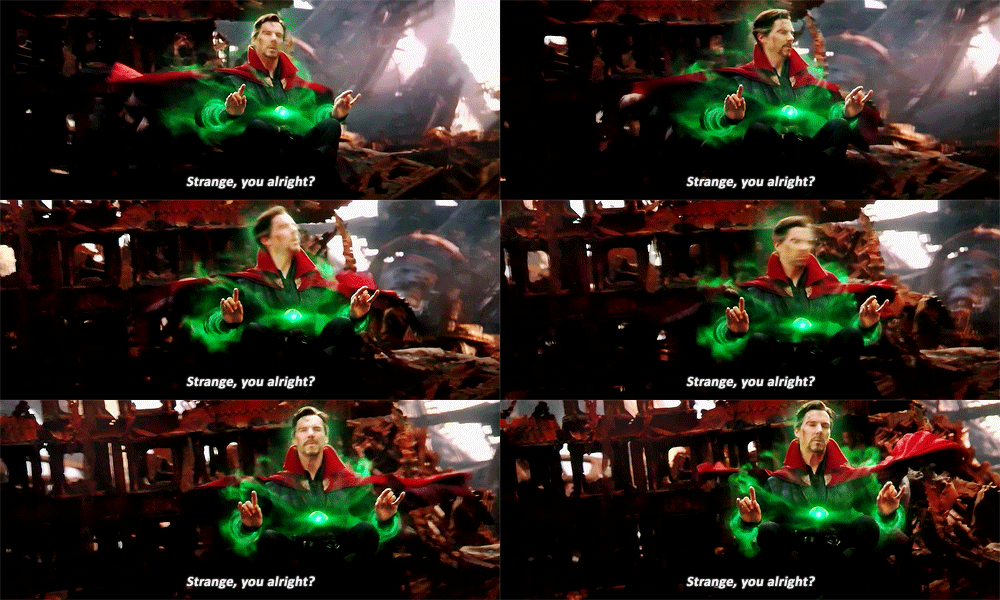
Because we don’t all have an Eye of Agamotto to figure out the best course of action. ¯\_(ツ)_/¯

It’s easy to confuse action with progress

It’s the difference between being busy and getting meaningful work done.

If I spend my time color coding a bullet journal, or arranging a cascading hierarchy of tags in a task manager app, how long will it take for those actions to show substantive improvements in the way I do necessary, rewarding work? Are they a layer of distraction, or a tool for focus?

How many passes and revisions can I make on a set of pages, or a blog post before all I’m doing is making things different instead of making them better?

The siren’s song of optimization is like pressing your foot a little harder on the pedal. You’re feeling acceleration, but you’re not necessarily reaching your destination any earlier.

But how do you tell the difference?

The tasks with meaning aren’t always obvious, but they never lie to you after they’re finished.

Busy tasks always try too hard to assert their importance, like a compulsive liar who peppers their speech with admonishments to “trust me.”

They shout at you that these five life hacks will help you finally clear your inbox…

But the time you spend reading that article could be used to answer two or three of those emails, or asking yourself the question about how necessary is it to reach Inbox Zero.

You could look through a gallery of dozens of great new themes for your website…

Or you could grab a pen and some paper and start coming up with new content to put on that site.

You could read all about how people whose success you wish to emulate schedule their day, or what bullet journal notebook and software they use…

Or you could do work with the tools you have and the time you have, and test things to see what works for you.

Better or Different
Busy work turns time into an I.O.U. where you promise yourself that you’ll eventually get around to what matters.

Meaningful work leaves something behind. It transforms time into something tangible that you can point to.

Shout it from the rooftops: I did this. I made this. It is here now where it wasn’t before.

I did this I made this
Celebrate finishing something, no matter the scale.

Non-Duality (For Writers)


On my flight back from Boston a few weeks back, I was reading my copy of The Mindful Way Through Depression. A man across the aisle from me asked if he could talk to me about my book, and I did something I rarely do on a flight: I struck up a conversation.

It turned out that he was also a survivor of depression, but he said he could never read a book like that in public. “I’d have to be in my bedroom with the door locked.”

For the next 45 minutes in the air, and then for a few more minutes around baggage claim, we talked about depression, our families, finding community in new places (he had recently retired to Israel after living in Canada for most of his adult life).

And there were definitely times when I could tell we could have had a contentious turn in the conversation. Flash points where it would’ve been easy to veer into an argument. But the sparks never landed on kindling.

We found we had something in common that was worth exploring.

A little over a week later, I found myself in the hospital. Long story short: I was losing blood faster than my body could replace it. Doctors needed to find the leak and plug it.

In-between procedures and transfusions, I spent time in a room separated by a curtain from an older man with breathing and mobility issues. My roommate and I had little in common. This could best be summarized by the time he woke me up at 4 AM, watching a televangelist encourage people to “send a donation; plant a seed of $58 to become one of the eleven-hundred and twenty-eight miracles,” or something similar.

I could have dwelled on our differences, or my annoyance with being woken up at such a weird time. I’d had no real food for almost two days, been poked, prodded, and had cameras peering into every corner of my digestive system. I had plenty of reasons to react with anger.

But I thought about the why. I thought about the times he’d spoken to his visitors about how he wished he could get out of the hospital and get home for some real healing. Some “soul healing.”

He was looking for comfort. He wasn’t writing a check. He just wanted something to take his mind off being in that bed, being woken up for his breathing treatments, and not knowing when the Doctors would finally say he was well enough to go home.

And I could relate to the idea that real healing doesn’t necessarily take place in the hospital, where your sleep is interrupted by new tests, new hypotheses for your care, or just the sounds and smells of illness.

There’s a Buddhist concept of non-duality I’ve been thinking about a lot lately.

As best I can explain it, it’s the idea that labelling the differences between yourself and others reinforces false notions of the self.

In Mindfulness in Plain English, Bhante Henepola Gumarantana describes it this way:

“The ego sense itself is essentially a feeling of separation — a perception of distance between that which we call me and that which we call other. This perception is held in place only if it is constantly exercised…”

With these encounters, I could have focused on the differences between myself and each of these men. Differences of age, religion, attitude, political views, and so on. I could have drawn up many lines between us and left it at that.

But both of those times, the value of engaging with the moment came from recognizing that for all the things that separated us, we were all in need of healing. We were all connected to a desire to live and be well.

If I build a wall between you and me, I’m not only establishing a false idea of who you are based on my limited perception, I’m clinging to a potentially false notion of who I am.

This is one of the reasons I stress thinking about empathy with my writing students.
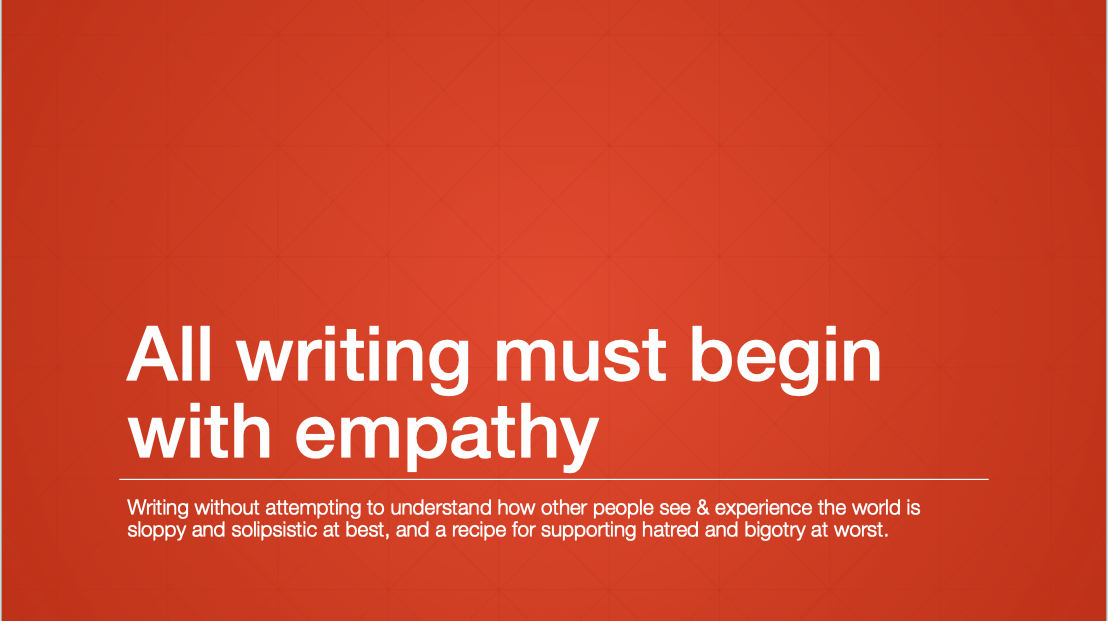
Screen shot from one of my powerpoint slide decks titled All Writing Must Begin With Empathy

When writing, I want my students to remember that every character should be a specific individual, and to remember that not everyone thinks and behaves exactly as they would. In this way, I am teaching them about separating themselves from others.

But at the same time, there is a need to ground your writing with the perspective of that other fictional person in order to make an honest attempt at depicting their actions and reactions.

Part of that process needs to be seeing the center of the Venn Diagram:

How are you not so different from this other person?
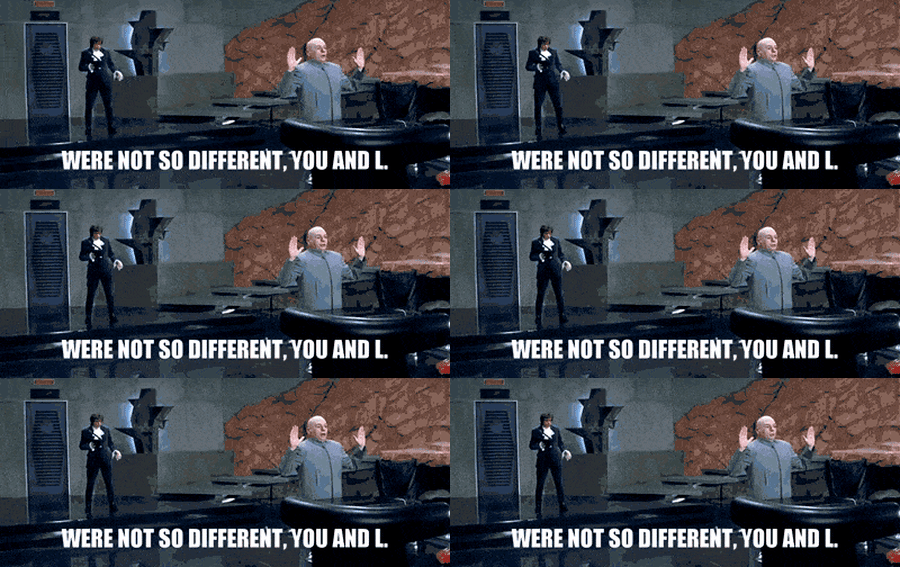
Austin Powers 'We're not so different, you and I.'

If you base their uniqueness only on a representation of their difference, you miss the connections they could have with other characters in the story, or potential points of connection with the audience.

A villain is more engaging if we can see something of ourselves in them. The relationships between characters becomes more complicated if they see there isn’t just difference between them, but common bonds.

The X-Men stories wouldn’t be nearly as engaging without the central friction between Charles Xavier and Magneto: two mutants who both want to protect those like them and help them see their potential, but whose difference emerges from how they view The Other (humans).

Or see the potential for comedy in this play between difference and commonality, like in Home Alone where Kevin’s mom, Kate, rides back to Chicago in a truck with Gus Polinski and his polka band. These characters couldn’t seem more different, until Gus talks about how the whole band needs to spend the holidays away from their families, too. But Gus’s attempt at finding common ground also sparks his story of trying to relate to Kate by telling about the time he left his son behind on accident, just like her… Except that Gus left his kid in a funeral home. For hours. Alone.

All of these things combined take a seemingly one-note polka band gag and use that common ground to give it dimension and resonance with the rest of the story.

But non-dualistic thinking can also help with another bad habit of writers: envy

In Shunryu Suzuki’s Zen Mind, Beginner’s Mind, he writes:

We compare our looks with others, our success, accomplishments, wealth, possessions, or IQ, and all of this leads to the same state—estrangement, barriers between people, and ill feeling.

The meditator’s job is to cancel this unskillful habit by examining it thoroughly, and then replacing it with another. Rather than noticing the differences between oneself and others, the meditator trains him- or herself to notice the similarities. She centers her attention on those factors that are universal to all life, things that will move her closer to others. Then her comparisons, if any, lead to feelings of kinship rather than of estrangement.

A writer looks at someone whose work they appreciate, and get disheartened at their own lack of skill or achievement.

A writer looks at people they consider their peers, and seeing their accomplishments, feels frustration that they don’t see themselves matching up.

A writer looks at their own work in comparison with what they’ve done in the past and sees a failure to recapture who they once were, or a failure to progress beyond who they think they once were.

All of these envious moments focus on difference: There is you and there is me. There is me then and me now.

But what if it were possible to focus on something other than those differences? To find those pedal points in both of your songs that resonate deep within the both of you?

Because if we only focus on the success of others, we erase their struggles, which could show us how alike we may be.

If we only focus on part of our past experience, or on part of our desired future, we skip over any number of valuable moments that inform us, shape us, and give us something worth saying.

When you encounter envy, ask yourself what you have in common with this person. What do you share?

Try not to use this as a springboard for the thought of “If we’re so similar, why are they so better off?” That’s falling back on reinforcing difference.

But seeing what you have in common can remind you of the positive things you see in yourself. If you can focus there, you can turn envy into admiration, and share some of that admiration with yourself.

And, especially when dealing with your peers, envy is the enemy of community.

Anything that can highlight the difference between yourself and others that you wish to work with or share something with will start building that wall between you.

That dualistic thinking and envy can spill out in the workshop session, on social media, in your work with others. And these spills aren’t often easily wiped away.

But your actions and your effort to see what unites you with others can also spread. And if you practice that, you may encourage others around you to practice that same kind of radical empathy.

You’d listen to yourself if you were somebody else

Early on in the semester for my Introductory writing class, I like to bring in motivational and inspirational quotes from other disciplines. I’m looking for examples of strong writing that also offer an opportunity to segue into discussing the work of writing.

For example, when I talk about the process of revision with students, I bring in Max Weber:

“Politics is a strong and slow boring of hard boards. It takes both passion and perspective. Certainly all historical experience confirms the truth—that man would not have attained the possible unless time and again he had reached out for the impossible.”

Writing can feel that slow. It’s hard, focused work, and I tell my students that they need to respect the process and prepare themselves for the slowness of it.

But it’s not always easy to take your own advice

I recently chucked out about 40 pages of a script draft. I was treating a character as a throwaway gag, but I realized there was more dramatic and comedic value in bringing them into the story properly.

Normally it feels a little easier to toss pages aside after an exciting discovery like that. If I kept going without making the changes, I’d only wind up doubling back and starting over again as soon as I typed FADE OUT.

So why not save myself some effort and get going with that new version now?

But I’ve recently started a new semester of teaching. I have a new baby in the house. I have a child starting kindergarten. I’m starting to give some of my bandwidth to the promotional side of the writing project I worked on for the past year. I’m learning to re-wire my brain so I spend less time fighting against it. And so on.

There’s momentum for my writing, but less of it. I have less energy, and I need to spend time learning new ways to adapt.

Take the new baby (Button). Before, I started pushing myself to get up earlier to try and carve out an hour to an hour and a half of solitude for coffee and work before the rest of the house would wake up. Now, Button usually starts stirring mid-way through that time.

At that point, I bring him downstairs so Dena can get some more sleep. Sometimes Button will fall back asleep quickly, but sometimes he just wants to wiggle. Other times he demands to be held.

Austin Kleon offers artists with newborns the advice to “find a one-armed miniature version of what you do.” Not everything I have to do is easily accomplished (or workable) while holding a baby, but most of the time I can shift gears. Re-prioritize, or break something into smaller tasks.

Totally sensible, but my brain says “Nope.”

I fight, resisting the need to change. I deny that I should lower my expectations for myself. I tell myself I need to hustle harder, sleep less, and juggle faster.

In an episode of Jocelyn K. Glei’s Hurry Slowly podcast, she talks about the very kind of impulse I’m fighting against and gives it a name:

When you commit to a schedule or a workload that you intuitively know at the outset is unrealistic and is destined to result in overwhelm. And then later on, you beat yourself up when you are unable to meet that schedule. That’s productivity shame.

When you set an incredibly challenging goal for yourself without creating any structure for emotional support or accountability, and then you blame your failure to meet those goals on a lack of personal willpower. That’s productivity shame.

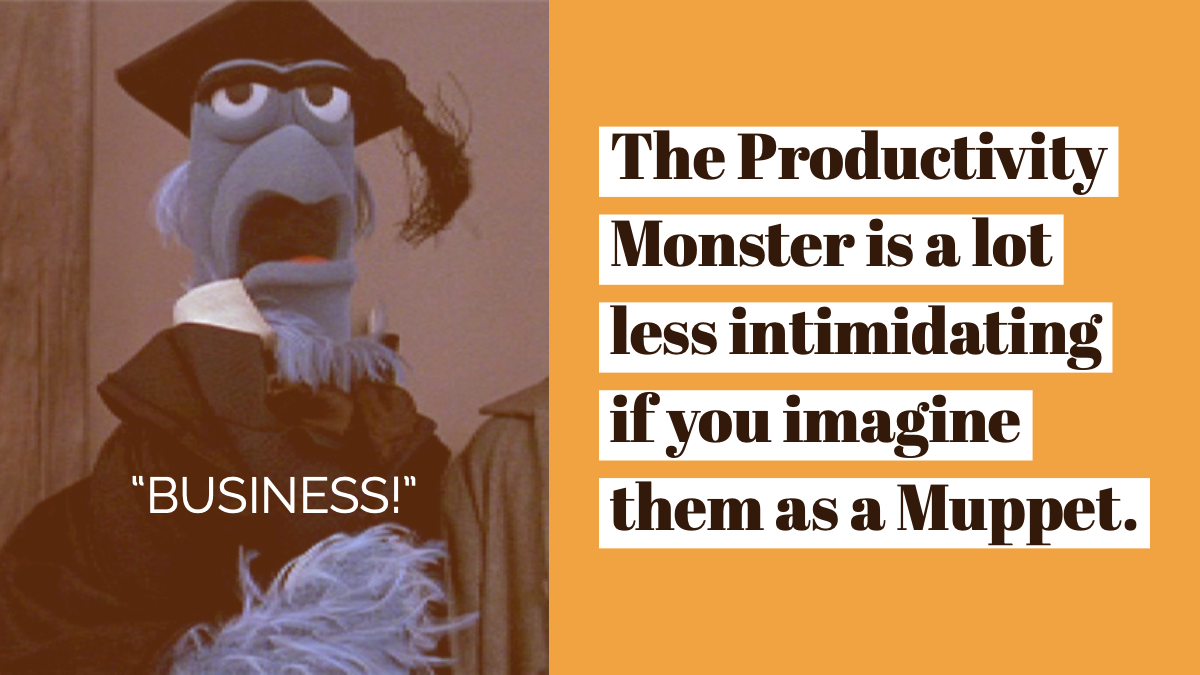
I’ve been trying to introduce some other ideas into my head to populate my brain with counter-arguments against that inner Productivity Monster.

Image of Sam the Eagle with the caption 'The Productivity Monster is a lot less intimidating if you imagine them as a Muppet.'

For example, I read Atomic Habits by James Clear, where he uses a great example to demonstrate the idea that small changes and tiny, consistent actions can still lead to big results:

The impact created by a change in your habits is similar to the effect of shifting the route of an airplane by just a few degrees. Imagine you are flying from Los Angeles to New York City. If a pilot leaving from LAX adjusts the heading just 3.5 degrees south, you will land in Washington, D.C., instead of New York. Such a small change is barely noticeable at takeoff—the nose of the airplane moves just a few feet—but when magnified across the entire United States, you end up hundreds of miles apart.

Small actions can lead to big results if you add enough of them up. It sounds logical enough. So lately, my Write Sprints have gotten shorter, but they’re more consistent than they have been in a while. I’m not having any days where I can knock out 5+ pages, but I’m having more days where I wind up with 1 or 2 new pages of material.

Close up, that effort doesn’t feel like much motion at all. And it can be frustrating to feel like those little drips of writing aren’t connecting into a larger, coherent whole.

But there’s no point in measuring just one day

You can’t write a screenplay or a book in a single day. Anything you can completely finish in a single hour (or less) probably won’t be the thing you hold up as an example of what you’re capable of.

Reading and listening to the work of others reminds me of the idea that you need to take the long view with finishing a larger project or building up a habit.

There’s one quote about writing (and geology) gets used in the second day of the semester. It’s one I like to refer back to throughout the semester as a thematic pedal point for the class:

“When the climbers in 1953 planted their flags on the highest mountain, they set them in snow over the skeletons of creatures that had lived in the warm clear ocean that India, moving north, blanked out. Possibly as much as twenty thousand feet below the seafloor, the skeletal remains had turned into rock. This one fact is a treatise in itself on the movements of the surface of the earth. If by some fiat I had to restrict all this writing to one sentence, this is the one I would choose: The summit of Mt. Everest is marine limestone.”

-John McPhee (from Annals of the Former World)

It’s a reminder to students that great things can come from humble beginnings: That which was once deep in the lowest part of the surface world, through time, pressure, and imperceptible movement, rose high above all else.

That the only constant on this planet is the act of change, and that how any situation looks at the moment is only temporary.

It’s something I use to remind them that no matter where they come from, or how they feel about their ability as a writer, given time and effort, they too can rise up.

Right now, it feels like it would benefit me to look at my work and my efforts as if I were one of my own students.