Battling Impostor Syndrome

A student came up to me after class and asked about impostor syndrome. I had mentioned in class that one of the main causes of things like plagiarism or bloated writing is insecurity: People are afraid that their writing will be found lacking, and that they will seem lesser because of it.

And this student wanted to know what they should do to fight back.

Impostor Syndrome comes from the idea that people will see you as a fraud. That you are less than what you claim to be. But it’s also the feeling that we don’t measure up to our own projection of who we are, or who we should be.

You don’t need an audience to feel like a fraud.

But somebody was looking to me for an answer, so I warned them that this feeling never really goes away. The insecurity and uncertainty just become more manageable over time, given the right effort.

This is not a life hack. This will not cure you. This isn’t even a tactic that works 100% of the time. But you can try it, and it might help.

Focus on the work, not what you think the work means.

If you’re writing something, focus on the story beat. If you’re revising something, focus on the sentence in front of you. Then the next one. If you’re offering advice to another writer, don’t worry about what they’re going to think about you based on your advice. Just do your best to tell them what you see in their work, and help them realize their goals.

And if you feel yourself thinking about what you’re going to say in your awards acceptance speeches, or how you’re going to spend all that money you’re destined to be making, or how you’re going to get to start name-dropping all your fancy new friends… If you find yourself dreaming about the rewards for work you haven’t done yet, that’s the other side of the Impostor Syndrome coin.

It’s ego, flowing in more than one direction. It can build you up or pull you down, but when you let that untamed sense of self take the wheel, you’re not doing the work.

And if you can only focus on one thing at a time, it’s better to train yourself to focus on the work, and not worry about shame, praise, or imagined distant futures. Like Andy Warhol said:

”Don’t think about making art, just get it done. Let everyone else decide whether it’s good or bad, whether they love it or hate it. While they’re deciding, make even more art.”

The same can be said about yourself. Focus on whether or not you enjoy the work that you’re doing, and whether you can joyfully give your attention to the work. Spend your effort on making the work the best it can be.

You’re a person who has value outside of your work. To the people who care about you, you can never be an impostor. Try your best not to confuse your assessment of your work with a measurement of your worth.

Plants and Payoffs in Comedy Writing: Parks and Recreation

Comedy Has Structure

Long form comedy isn’t just a series of jokes. Whether it’s a sitcom, a film, or a stand-up set, there’s a structure to humor that relates to dramatic structure.

Over time, strong comedy builds. New jokes call back to previous jokes. By the end, you haven’t just watched a string of unrelated funny moments, but you’ve seen how one joke leads into a joke later on.

Great comedy builds. It lifts the audience up.

To show you what I’m talking about, I’d like pick apart the inner workings of an episode of Parks & Recreation.

Parks and Recreation Episode 4×11 – “The Comeback Kid”

There are a few key elements of the larger story of this season that help set up this episode:

  • Leslie and Ben are in a relationship, but Chris had a policy forbidding romantic relationships between co-workers.
  • The discovery of this relationship created the scandal that damaged Leslie’s candidacy for city council and lead to Ben resigning his position in the government.

A quick synopsis of the episode:

With Leslie still reeling from her poll numbers plummeting and her campaign staff abandoning her, she recruits her co-workers as a replacement staff to stage a re-launch for her city council campaign at the Pawnee Sports Building. Seeing that Ben has spiraled into a depression brought on by resigning his job, Chris attempts to lift his spirits.

There are three main plot lines to this episode:

  1. Leslie and Ann attempt to convince former Pawnee High School basketball star “Pistol” Pete to appear at the event and endorse Leslie.
  2. Ron leads a group of the rest of the new campaign staff in preparing for the event.
  3. Chris attempts to break Ben out of his funk, which needs to start with getting Ben to recognize he’s depressed.

Plants and Payoffs

A plant is when a writer offers a piece of information to the audience early on in a story ahead of when they absolutely must use it. It’s making sure the audience is thinking about some aspect of the story, be it the stakes, a task some character needs to perform, or even a specific object important to the story.

A payoff is when the writer cashes in on the audience’s memory of that earlier plant, using that information to resolve a story, tell a joke, or throw a twist at the audience.

There are two specific payoffs in this story that weave together the three story lines, and we need to talk about them first to get a better idea of what to look for in their construction.

Payoff One – The Climax

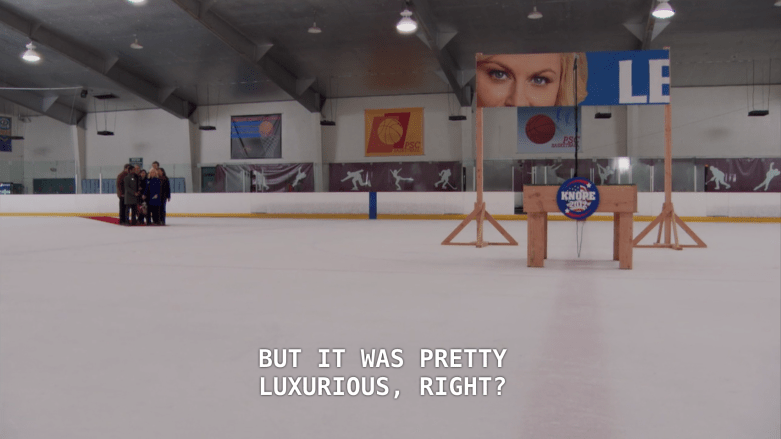
Leslie prepares to walk out into the Pawnee Sports Building believing that she doesn’t have Pistol Pete, her stage is incomplete, the banner she ordered has an error, and to make matters worse, the basketball court she thought she’d be walking out on has been resurfaced as ice for an upcoming hockey game.
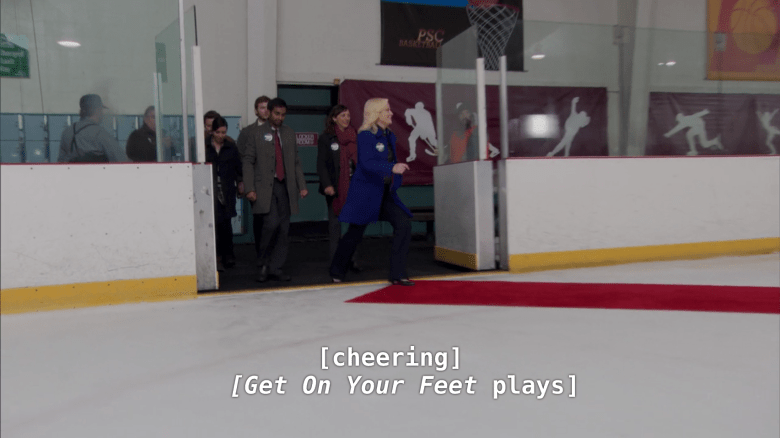
Screen Cap 1.png

Leslie’s campaign staff vows to go out and help her try and save face, only to see that Tom couldn’t order a red carpet that leads all the way to the stage.
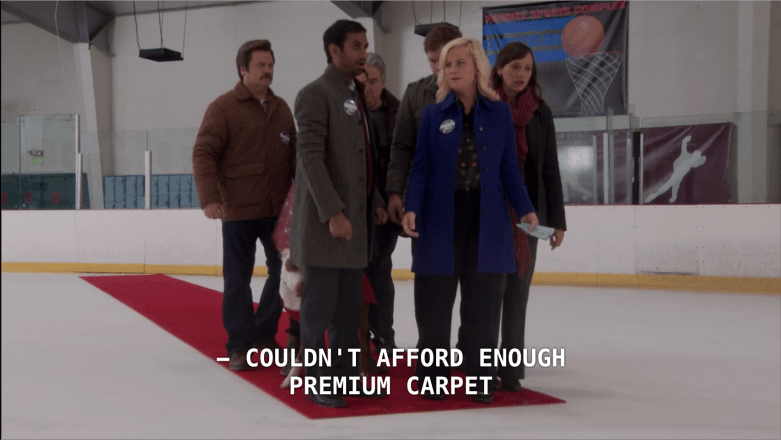
Screen Cap 2.png

Screen Cap 3.png

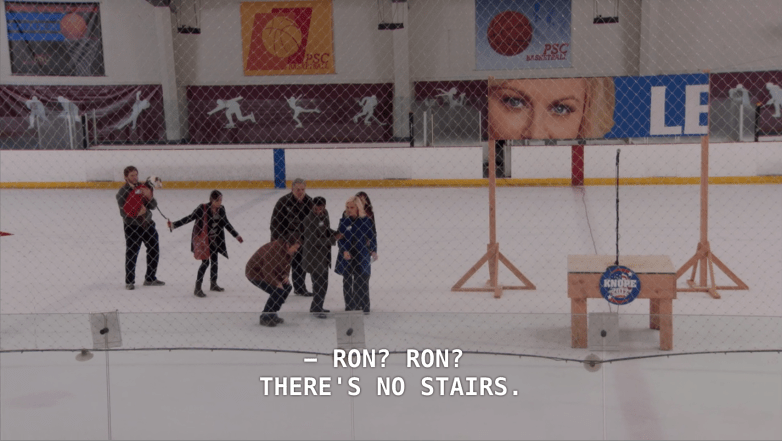
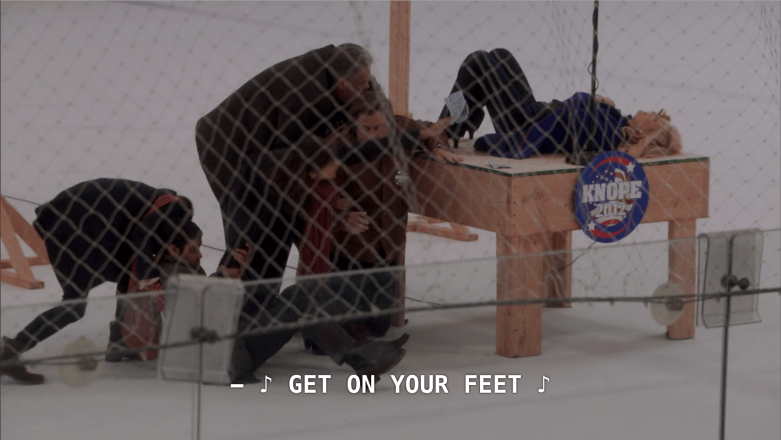
As they shuffle together across the ice, a short clip of Gloria Estefan’s “Get On Your Feet” loops (a clip that would’ve been a perfect duration for a brisk walk across a basketball court).
Screen Cap 5.png

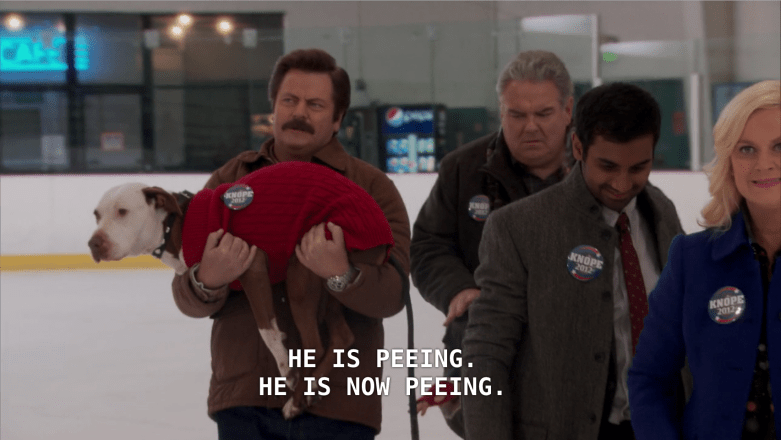
Champion, April and Andy’s new dog, starts peeing on Ron.
Screen Cap 4.png

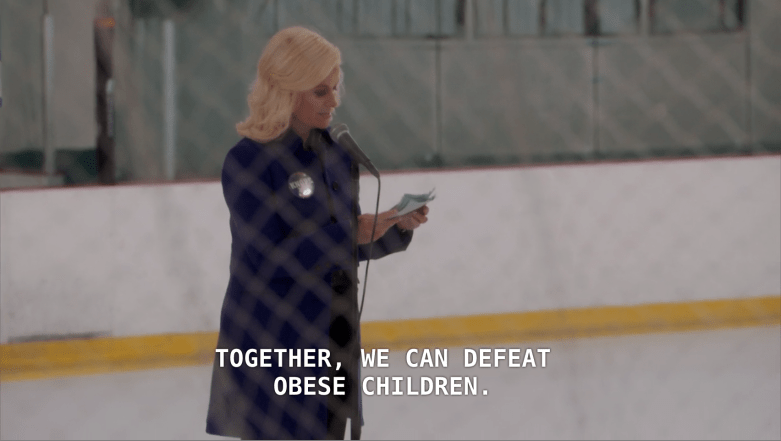
In the scramble to get up on the stage, Leslie’s notecards got out of order, and she starts delivering an incoherent speech.
Screen Cap 6.png

Screen Cap 7.png

At the last moment, when Leslie admits to the crowd that this campaign event was a disaster, Pistol Pete shows up in his old jersey to endorse Leslie. When he attempts to make a slam dunk at the end of his speech, he slips on the ice and injures himself.

Screen Cap 8.png

Even out of context, these moments are funny, but there’s more at work. Each of these jokes has an origin point earlier in the episode, planting these ideas to play with the audience’s expectations.

Because you were taught what to expect by the earlier parts of this episode, you’re rewarded for your attention and your patience with even bigger laughs.

Payoff Two – The New Story Direction

After Chris talks Ben out of his funk and gets him thinking about how to make better use of his time, Leslie and the rest of the campaign team show up, fresh from the disaster at the Pawnee Sports Building.

Leslie approaches Ben and asks him to step in and be her new campaign manager. After seeing what happened without someone with political experience at the helm, she wants Ben there, no matter if his connection to her scandal and polling problems could damage her chances.

This launches a new phase of the story where Ben and Leslie will directly work together on her campaign, but the emotional payoff of this moment requires us to see how much Ben and Leslie need each other (due to seeing the disasters they have to deal with when they intentionally keep themselves apart).

Turn by Turn Directions to Our Destination

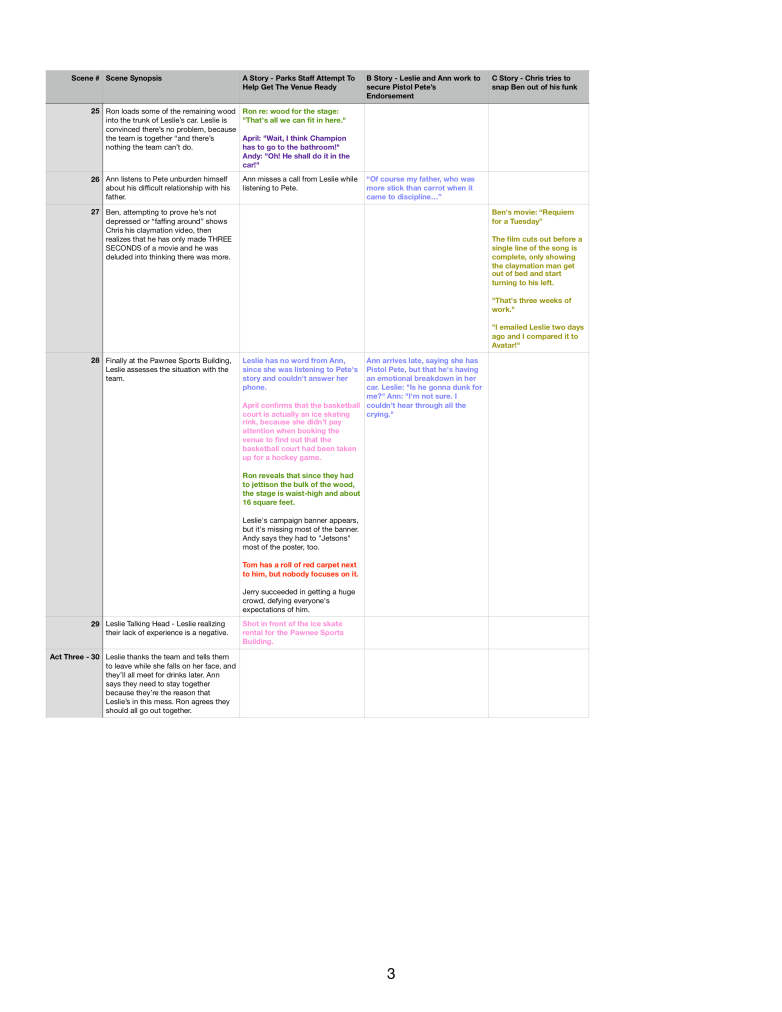
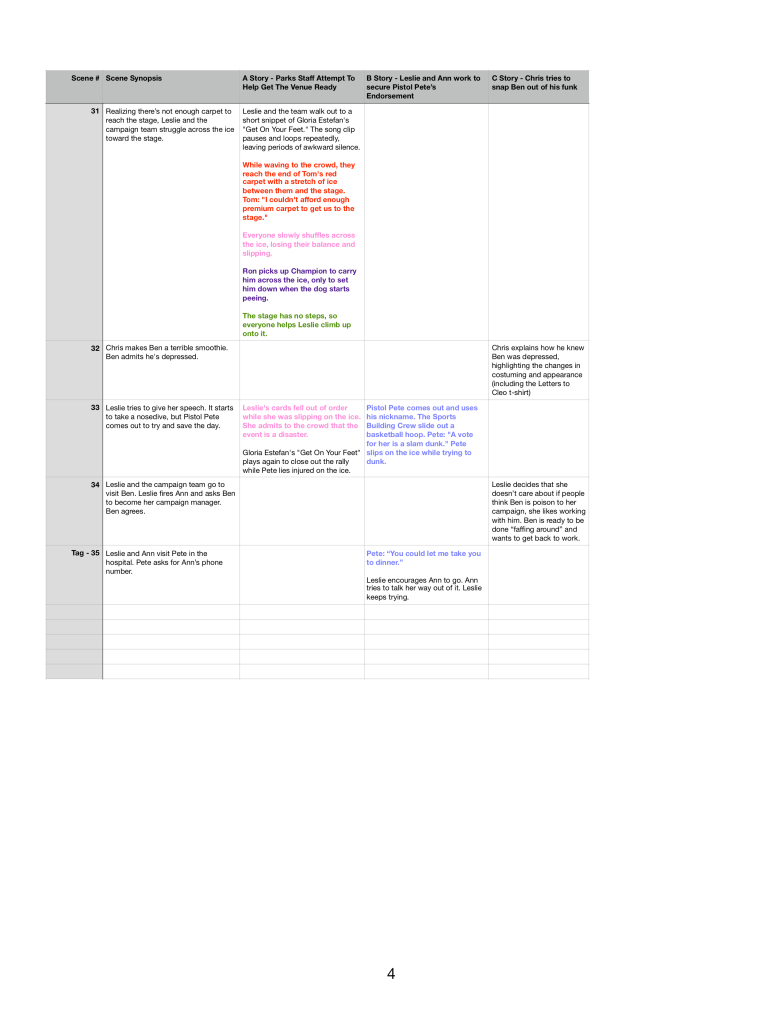
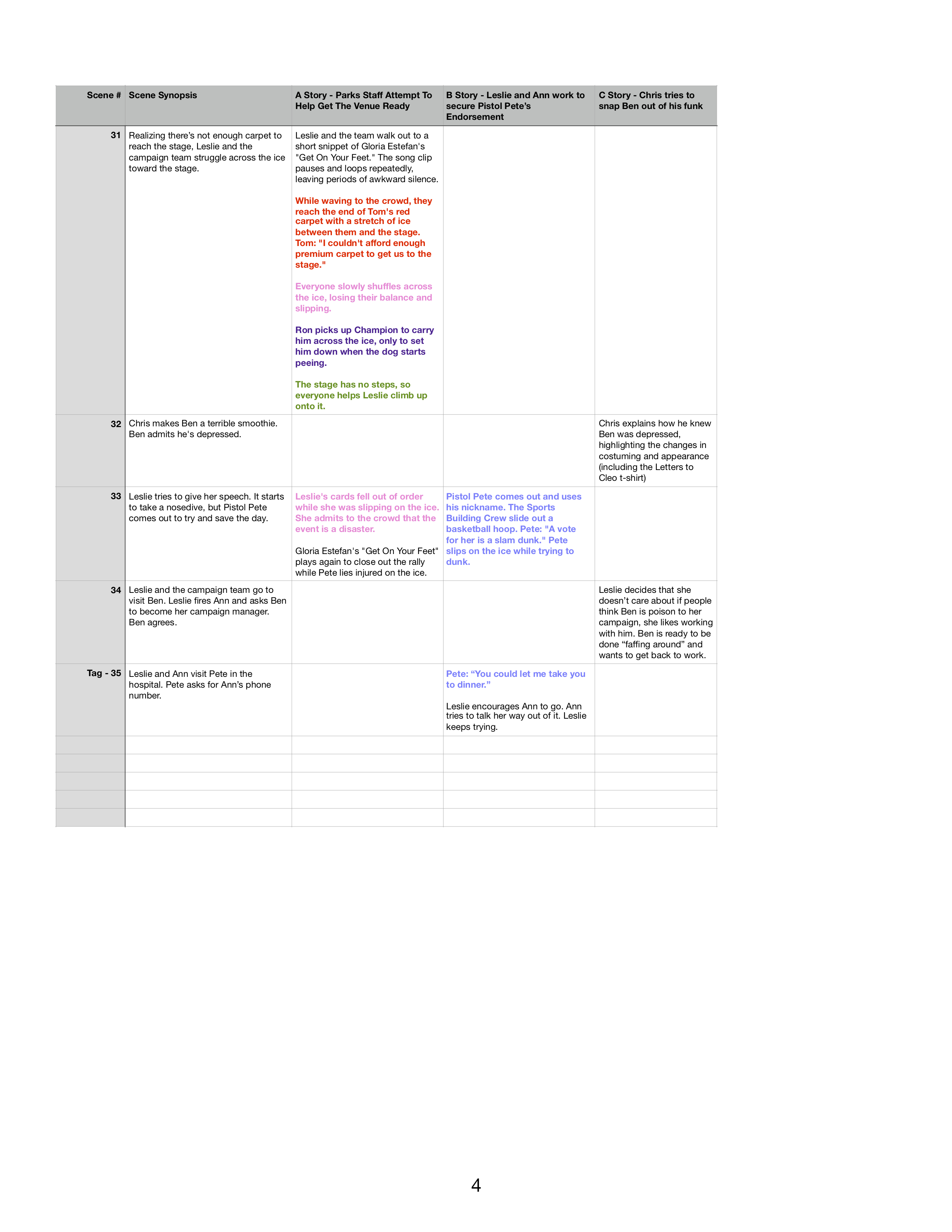
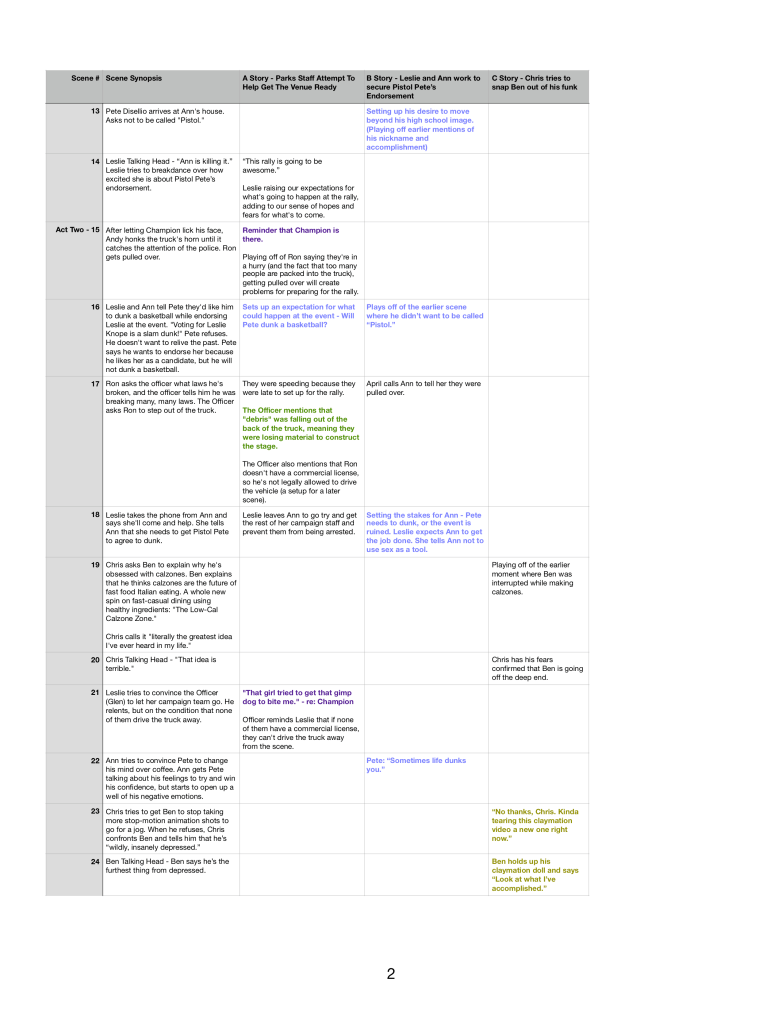
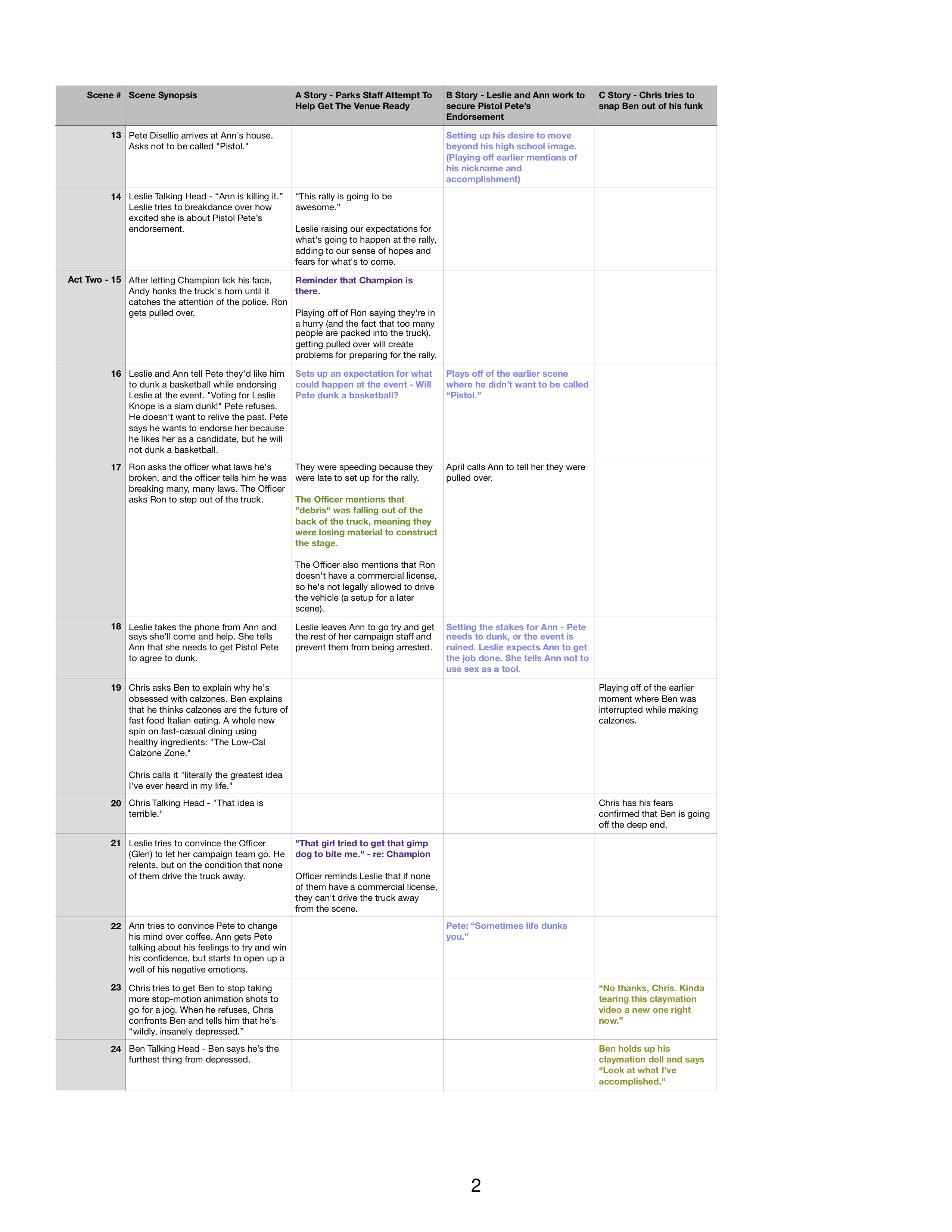
So let’s take a look at the big picture. In the following graphics, I’ve charted out, scene-by-scene, what happens, and what information is used to build the story toward the climactic moments.

Some things to pay attention to:

  • Notice how the writers keep most of these plot threads separate from scene to scene until we get to the final act. These individual threads and stories have a distant connection at first, but they start to interact the deeper we get into the story.
  • Look at the way the narrative moves between the different storylines. We spend a little time with Ben & Chris, then back to a part of the main storylines dealing with the “Comeback Kid” event.
  • The sheer density of this show’s writing. There are moments that barely qualify as having a setup, like how Jerry’s job to pass out flyers to get an audience is a note on a whiteboard, yet it comes back at a crucial moment to raise the stakes for Leslie.

The Comeback Kid - Chart 1.png
The Comeback Kid - Chart 2.png
The Comeback Kid - Chart 3.png
The Comeback Kid - Chart 4.png

Sleight of Hand

But the writers can’t just have the characters look at the audience and say “Hey, here’s a new dog for Andy and April! Pay attention to this dog’s wacky hi-jinks and get ready for it to do something really funny near the end of the episode!”

When planting an element to set up a later joke, it needs to be introduced to the audience so that they’re only mostly paying attention to it.

A successful plant lets the audience know something is there without giving away that the writer wants their attention drawn to it.

Think about a magician. They’ll tell you where they want you to look, and they’ll tell you what they’re going to do, but they’re always conscious about drawing your attention away from the actual work of the trick.

They want you to know you’re being fooled, but they don’t want you to know how.

It’s the same with comedic storytelling. The writer wants the audience to laugh as much as possible, but they know that laughter will be stifled if the audience is too aware of the construction of the jokes and the dramatic storytelling underneath.

Nothing kills a joke like telling somebody that it’s going to be so funny.

So let’s break down one scene as an example.

Anatomy of a scene

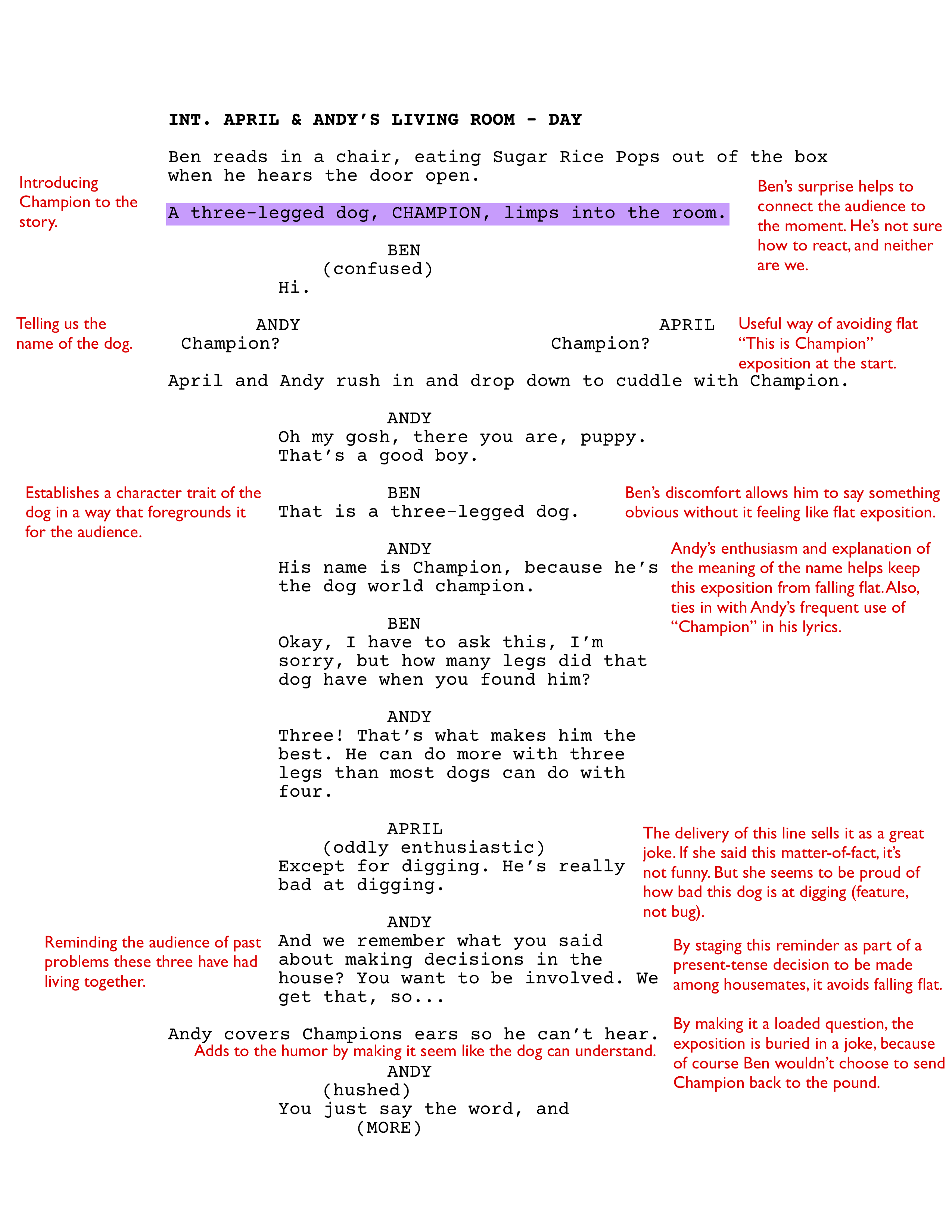
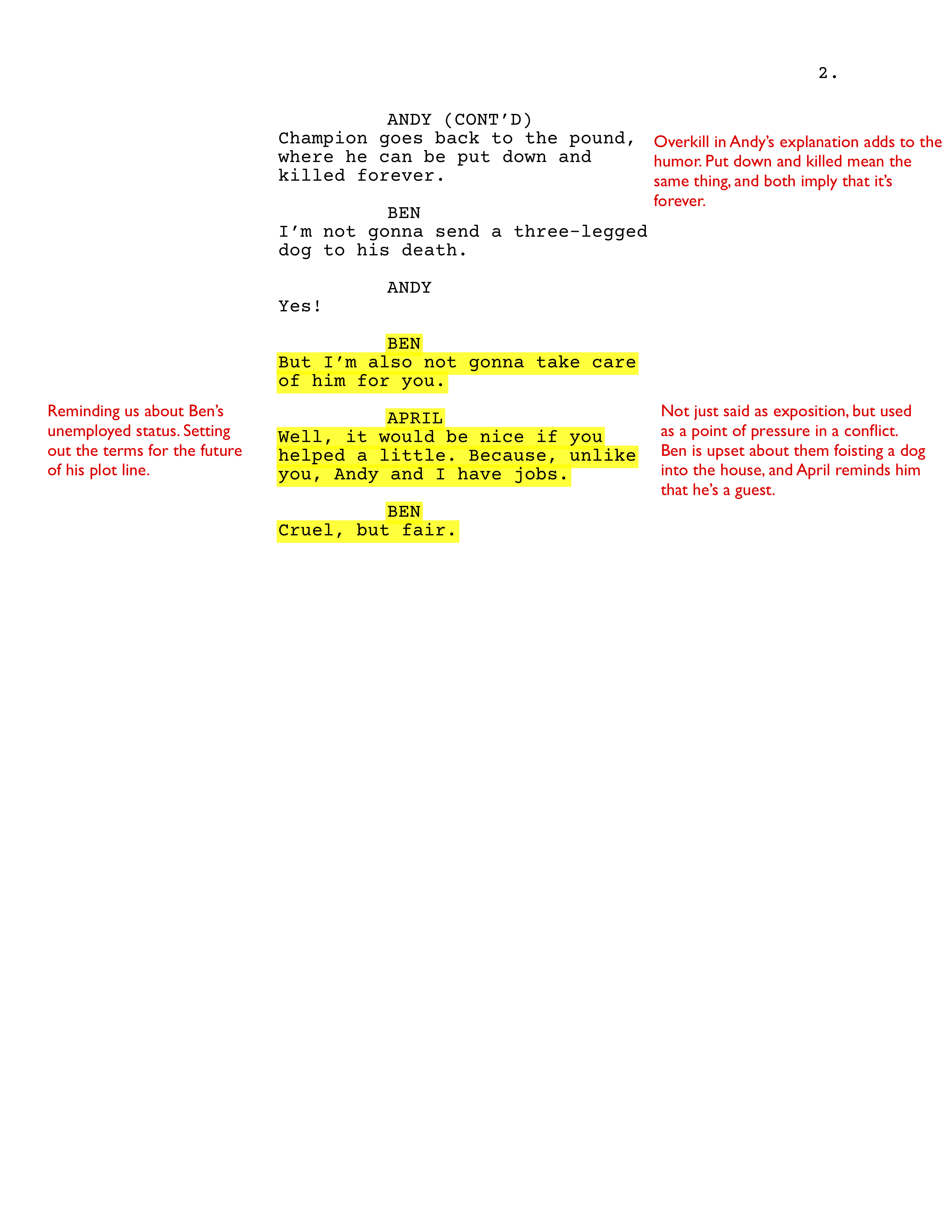
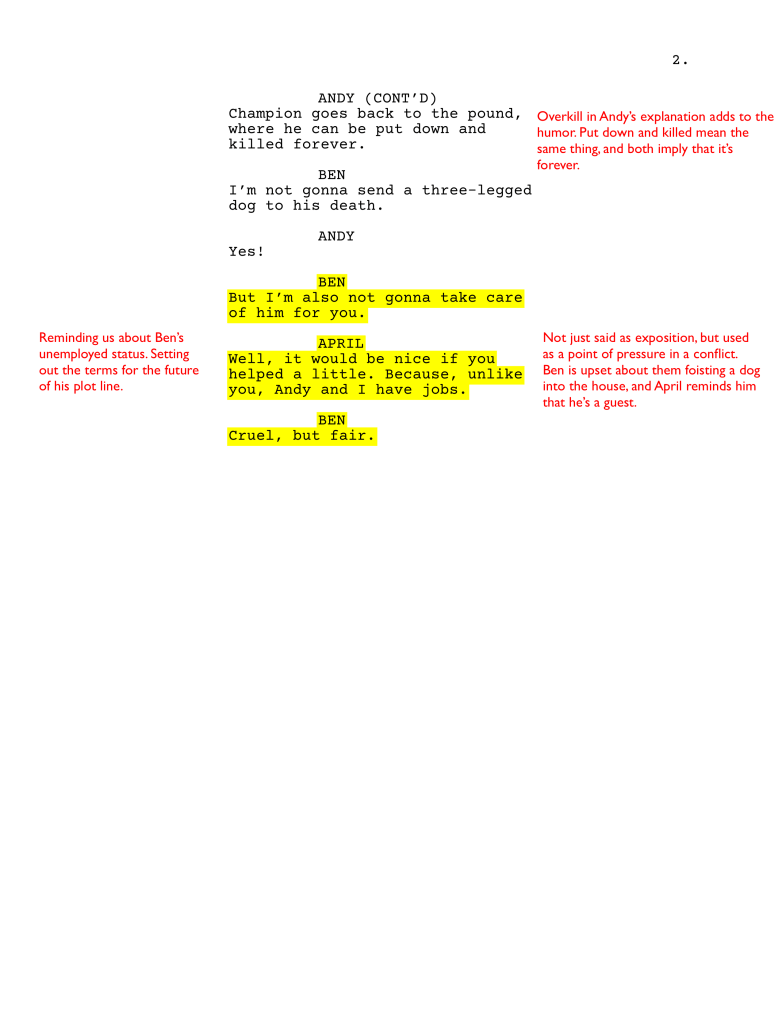
(Please note, this isn’t the actual script for the episode. It’s a transcription I made to help explain this point.)

I’ve added some notes to the scene highlighting where important plot threads are referenced or introduced, and adding specific notes on how these jokes introduce exposition and plant information in a way that avoids falling flat.

Comeback Kid - Example Scene 1.png
Comeback Kid - Example Scene 2.png

By disguising the planted elements with conflict and humor, the writers keep the audience’s attention on the present moment and don’t give too much away about what they have planned for Champion and Ben.

Tying it all together, these elements of conflict and humor are based in what the audience already knows about the characters. Ben is rigid in his behavior and frequently doesn’t understand other people’s enthusiasm. April & Andy are impulsive, and they regularly go all-in with their enthusiasm if it’s something they both care about.

We know these characters because we’ve grown to care about them. Without that emotional connection, the jokes can’t help to obscure the intent of the planted material, and the payoffs won’t land with full force.

We need to care if we’re going to laugh.

We need to care about Ben’s mental health, and his rebound from losing his job and sense of identity. We need to care about Leslie’s desire to win the election and become part of Pawnee’s City Council. We need to care about the desire of her friends and co-workers to help her.

We even need to care, at least a little bit, about Pistol Pete. A character we just met needs to be human enough that his decision to embrace his past and endorse Leslie with a dunk means something.

A man choosing to do something foolish, like try and dunk a basketball on a hockey rink, is funny. A man choosing to do something foolish because we know, in his heart, this is about rising up and coming to terms with a deep, internal pain… That’s comedy gold.

Mounting My Own Comeback

I used to write a lot more about film and television. I used to make a lot more time to watch film and television.

This blog was something I approached from a place of intense study and small a authority. Coming fresh out of grad school, I had a lot of information in my brain and not always a lot of clear outlets for it.

I don’t know what it is now. You’re just as likely to see me writing about my daughter and our cat as you are to see me dissect a television episode.

I’m not sure what it’s going to become, either.

I know this is my place on the internet to do what I wish. I know that I’ve got lots of ideas. I know that there are other things I’m writing and working on that aren’t even related to it.

Life is a lot messier than fiction. Not everything you plant pays off later.

But I care deeply about storytelling. And I care deeply about putting these ideas out there. I want to make sure I don’t leave that behind as I head toward whatever happens to come next.

I’ll leave the last words to Leslie Knope:

“Well, um, I can assure you people in the bleachers that, if you follow my campaign, it will be interesting.”

 

Heavy Clicky Touchy Feely

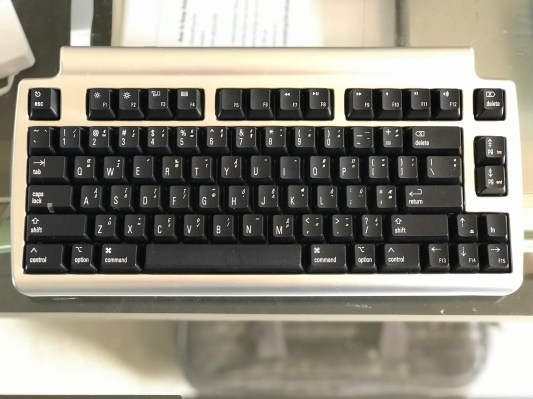
I ponied up the money for a mechanical keyboard.

I get it. People buy in, hook, line, and sinker to this craze the way marketing used to tell kids shoes would make you run faster and jump higher.

But it’s genuinely pleasant.

The Matias Laptop Pro for Mac

Does having a nice keyboard make me a better writer? Not in and of itself.

But does having a nice keyboard make me feel like my time spent writing is more enjoyable, encouraging me to favor this activity over other ways to spend my time? You bet!

The only thing that helps a person work on their craft is time and deliberate practice. You could argue any tool that helps create those conditions has some degree of positive impact.

But there’s also the nostalgia.

It reminds me of that feeling of the first time I learned how to type, working on a Commodore 64 in my parents’ living room. The chunkiness of the keys. The orange glow of the text when I fired up the word processor to do a research paper on Mars. The satisfying click as I made things happen on screen while following along with one of the library books that said they would teach me how to program in BASIC (Ron Howard Voice: “They did not.”)

It’s not that I wish that the computer I was using had the same limited capabilities as that old machine. What I wanted from purchasing a mechanical keyboard was comfort and joy.

There’s a strong sensory connection between the tactile experience of the keyboard and the sensation of enthusiastically discovering something new. An attempt to trigger those beginner’s mind feelings, even after years and years of using a computer.

Because there’s still so much to learn.

But even without any guarantee of that, I can say for certain that sitting down to type feels more joyful. It’s no longer just the pleasure of actually taking time to write something down and work out my ideas. There’s a rhythm to the keys that keeps me motivated just as much as any well-crafted writing playlist.

Hamilton GIF 'Why do you write like you're running out of time?'
Because he got a clicky mechanical keyboard, of course.

It’s a healthy reminder that we’re not just content-creation algorithms, trying to spit out data for dopamine rewards. There should be joy in the process. An awareness and appreciation for not just our ideas, but the tools we use to make them tangible.

Little touches can make a world of difference, like the right coffee mug.

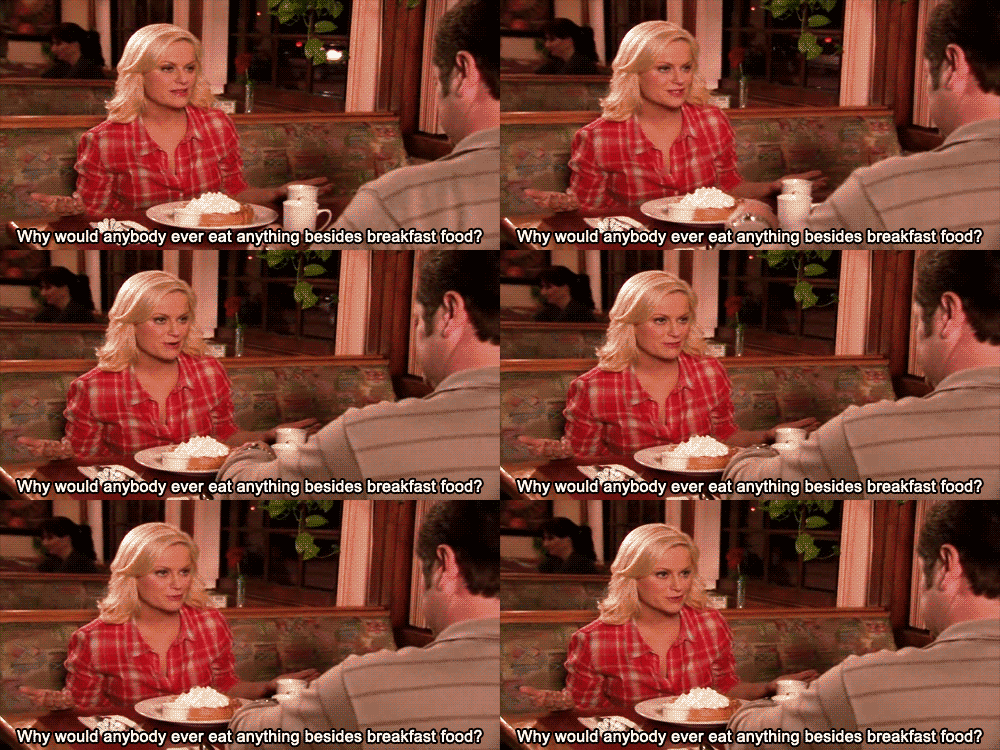
My favorite breakfast place in the entire United States is the Deluxe Town Diner in Watertown, MA. If you’re familiar with the love Leslie Knope has for J.J.’s Diner, you have a general idea of how much I rave about this place.

Leslie Knope: 'Why would anybody ever eat anything besides breakfast food?'

On my family’s most recent trip out to the east coast, I made sure that I took home a mug from Deluxe Town, because it is the perfect mug.

Mug.jpg

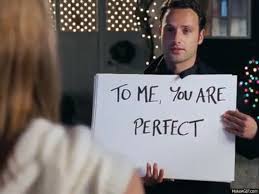
You are perfect.jpeg

This isn’t just nostalgia for the countless brunches over sour cream waffles or their perfectly tender and juicy in-house corned beef hash.

There’s a satisfying weight to the mug. It doesn’t make coffee taste better, but it makes the act of lifting the mug up to my lips feel substantial. You pay attention to the feeling in your hand and your arm as you raise it up.

You can’t ignore this mug. It’s not a paper cup. It’s not a cheap ceramic nothing. You are aware that you are drinking a good cup of coffee (so long as you put some good coffee in it).

Damn Good

If I appreciate my tools, the objects I surround myself with, they help me to remain present in time and space with them.

It’s not about the price tag. This isn’t a call for unchecked consumption, or for an endless deep dive into the world of The Best X You Can Buy listicles.

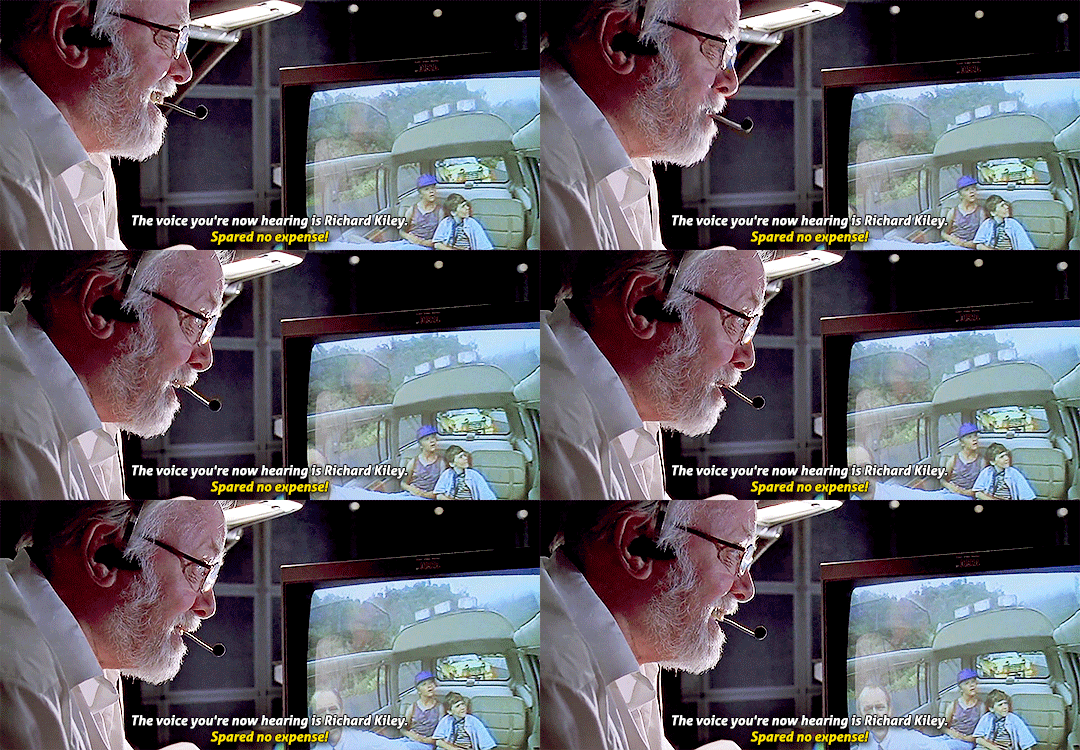
Spared no expense.gif

It’s a call to look for those objects and moments you interact with that matter. To consider how best to appreciate the tools of your trade.

What do you touch every day? Do you pay attention to it? Does it matter? Should it matter more?

When you are asked to give more and more of your mental energy and presence to things happening away from where you are, what things help anchor you? What objects can you use to keep yourself from drifting too far away, or getting lost down rabbit holes?

I am drinking this coffee. I am typing these words. I am here.

Let’s Talk About Cats

Picture a cat.

Now picture that cat in your home, somewhere near you.

What do you imagine that cat doing?

Don’t overthink it. Whatever immediately came to mind when I said to imagine a cat in the room with you works fine.

Got it?

So, what did you imagine?

Was it something you’ve seen a cat do before? Chase a laser pointer? Stare out a window at some birds? Knock something off a table? Curl up and purr in your lap?

Remember that. Keep your imaginary cat in the back of your mind for a few minutes.


Recently, my daughter looked down at our lazy, 13-year-old cat lounging on the carpet.

“When’s Luna gonna get bigger?”

I paused. “She’s already fully grown. That’s as big as she gets.”

Sprout started to pout. “So I’m never gonna get to ride her‽”

I didn’t see that one coming.

What Sprout did just then? That was beginner’s mind in action.


You see a cat, or you imagine a cat, and your experiences tell you about things that cats do. They tell you purposes cats have. You catalog and categorize the things you see in the world around you.

This thing is a cat. This thing is like a cat. This thing is not a cat.

Time passes. More things make their way into the matrix of your memory. All thoroughly cross-referenced and orderly.

And that’s why you didn’t consider riding your imaginary cat.

You have your reasons, and they’re good reasons. They’re true. It would be foolish to try and actually ride a housecat.

But that doesn’t mean it shouldn’t be an imaginary possibility.


I want to try to break down how Sprout came to this moment. My guess is she had some combination of these thoughts (not necessarily in this order):

  1. There’s Luna.

  2. I love my cat so much, I can’t handle it.

  3. I am small, and so is Luna.

  4. I am growing.

  5. Is Luna growing? Ask a grown up.

  6. I can ride animals, like that time I rode Oreo the pony.

  7. If Luna was bigger, I could ride her!

  8. When will Luna be big enough for me to ride? Ask a grown up!

Her creative process for this idea probably involved memories, established facts, and questions about the unknown.

It’s unlikely she’s seen anyone riding a cat, so that’s a novel element. It’s an aspect of the unknown.

It's just a picture of He-Man on Battle Cat.
I am absolutely certain Sprout has never watched He-Man in any form, so I’m ruling out this as an influence.

However, that element of the unknown is an extension of the known. She’s not just creating this possibility out of nowhere.


So why am I doing a deep dive on two sentences from my daughter, besides the fact that they made me laugh really hard?

What I saw in her in that moment was a piece of the larger creative process: The desire to create something that does not currently exist, except in the mind.

It reminded me of the beginning of Shunryu Suzuki’s Zen Mind, Beginner’s Mind:

“In the beginner’s mind there are many possibilities, but in the expert’s there are few.”

The more we learn about an idea, or a process, or an art form, the more it can constrict our thinking. That which has already been proven, or has already been done, suggests boundaries for what can still be learned or done.

It limits the questions you ask, or the solutions you attempt.

While I can’t deny there is value to be had in deep study of anything you want to work with, be it a creative medium, a scientific field, or any job with its set of processes and requirements, adhering to strongly to “the way things are done” can stifle novel solutions.

The best cinematic expression I’ve seen of this comes from Star Wars Episode V: The Empire Strikes Back. While training on Dagobah, Luke whines to Yoda about how he couldn’t possibly lift an X-Wing using the Force. He says that even though he can lift rocks with it, an X-Wing is much heavier.

Luke knows the weight of objects, and he knows his capacity to physically lift objects. He applies these rules to how he thinks the Force works.

And Yoda attempts to convince him that his strict adherence to just these facts isn’t helping him.

Yoda: 'You must unlearn what you have learned.'

In this example, Yoda lifts the X-Wing out of the swamp using the Force to make a point: This is something new to you that you don’t yet understand. It isn’t a muscle. It doesn’t use your body. You can’t hold onto the same rules you learned from interacting with heavy objects using your body.


There’s a method to test and explore ideas. To not feel like everything is already decided for you, or that what you already know is an impenetrable wall, halting your progress.

Anchor your ideas in what you know, but test those boundaries of possibility. Ask questions, the way Sprout did.

Think about what happens if something you see as a hard rule could bend, just a little.

Then chase that notion.

It’s mental jujitsu. Use the weight of the knowledge you already have against itself, and try to swing it to the side to see if it will make way for something unexpected.

To be clear: I do not have all the answers to this, or a simple, listicle-friendly process for people to follow. It’s something I wrestle with regularly, too.

What I do know is that some ideas are less solid and impenetrable than they seem, and it’s important to be able to test your ideas to understand them as they truly are.

It does you no favors to look at a suggestion and see it as a rule, or vice-versa, like the difference between a stop sign and a yield.


One caveat: This doesn’t mean that all ideas formed in this Beginner’s Mind state are great ideas.

I can’t tell you how many times since having this conversation with Sprout that I’ve had to stop her from straddling Luna in preparation to actually try to ride the cat.

Cutting with The Muppets

We ran into a problem while rehearsing for the table read of Ladies and Gentlemen, Miss Ida Walker: The read-through ran longer than the block of studio time we had reserved for the recording.

The traditional rule estimates that one screenplay page equals one minute of screen time. Whether or not you believe that measurement, you can chuck the ratio out the window when someone needs to read the action and description lines out loud.

I needed to make cuts, and there was one more restriction. These had to be straight cuts: No additions or substitutions.

(I was trying to be mindful of school resources since I’d already printed copies of the scripts for the actors once.)

As I sat down with a pencil and a copy of the script, I lost some of my nerve. The revision I did before handing the script over to actors already cut a number of pages. How was I supposed to know what else to trim?

That’s when my daughter’s obsession with The Muppets helped me get over my uncertainty.

Nearly every time we get into the car, she asks “Can we listen to the Muppet music?” I grew up on the Muppets, and all things Jim Henson, so I’m totally fine indulging her obsession.

The film’s soundtrack includes an extended cut of the villainous Tex Richman’s rap “Let’s Talk About Me,” where he explains how rich, powerful, and awesome he is to the Muppets.

It’s great. Academy Award Winner Chris Cooper chews the scenery so hard, you want to offer him a Tums. You should listen to it.

The difference with the film version? The soundtrack cut features an operatic bridge:

I recall a heartbreaking story
About my own tenth birthday party
Should’ve been a glorious day for me
I’d have been happy as can be
But the Muppets were there
To put on a show
They started to dance
They were telling their jokes
I didn’t laugh
I didn’t know how
Then my friends
They all turned around
And they laughed at me
They laughed at me
I hate you, Muppets so

It provides an explanation for why the character needs to say “Maniacal laugh” to his henchmen instead of laughing himself. It gives a motivation for why he buys the Muppet Studio. It informs why he’s so cruel to the Muppets. And it sets up the joke at the end of the movie where Gonzo hits him with a bowling ball and he learns how to laugh.

Seems necessary, right?

But without that verse, we can still understand why he buys the studio (he wants to drill for oil), and why he’s cruel to the Muppets (he’s an evil oil barron that wants to drill for oil).

The inability to laugh is funny even without an explanation, and the repeated action itself sets up the joke for when a comical concussion knocks some laughter into him.

Everything doesn’t need to be explained in full.

Humans are narrative-making creatures. We try to fill in the gaps and find sense in events. Allowing for small omissions understands this feature of human thinking and respects the audience.

Everybody writes Tex Bridges.

You don’t trust that people will understand a strange choice you made. You worry that something will cause your reader or audience to bump, so you try to solve a problem that hasn’t happened yet. You love the backstory you’ve come up with for a character and think everybody else will love it, too.

There’s nothing wrong with writing a Tex Bridge, but there’s also nothing wrong with cutting it and trusting your narrative momentum.

So I thought about Tex Richman, and looked for the places in my script that felt like that bridge: Places that might be entertaining, but over-explained something that the audience could infer from everything else.