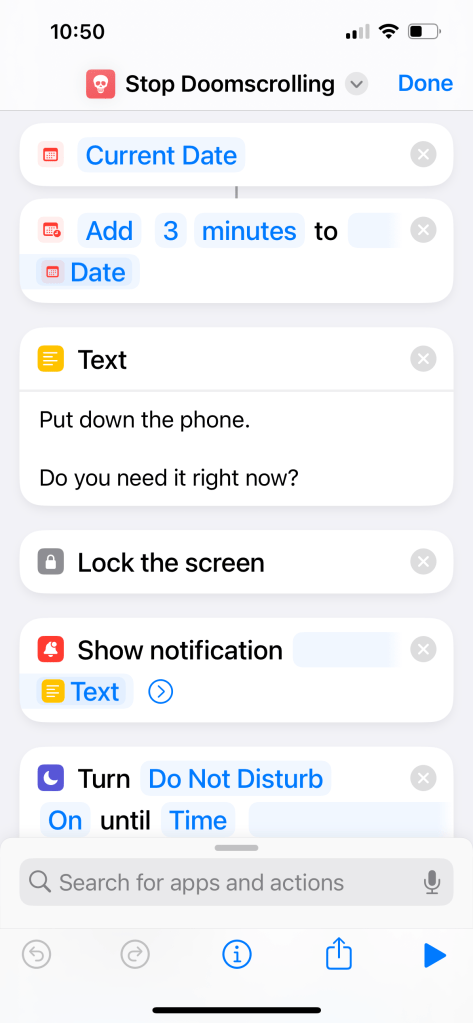
In looking for simple ways to help stay more mindful, I made an iOS shortcut for when I catch myself doomscrolling.
The problem I have comes when I realizing I’m just doomscrolling, but can’t move myself away. So I gave myself a clear next thing to do whenever I find myself in that spot.
The setup for the shortcut.
The part about it that makes it simple for me: I can just tell Siri the thing I want to do.
Then, I get this:
DND Lock Screen photo taken at a bookshop/cafe in Reykjavik.
Three things happen to disrupt the doomscrolling paralysis:
The phone is locked, pulling me out of whatever app I was in.
Do Not Disturb turns on for a short period giving me a moment to step back and think about what I want to do instead.
A Notification prompts me with a question to consider.
Maybe this will be an effective countermeasure for me?
It’s easy to say that it’s falling down a rabbit hole on Twitter. Or following a chain of recommended videos on YouTube.
Planning out a new keyboard build when I don’t actually need another one. Thinking through a new task management system when the old one would work fine if I used it instead of ignoring it to seek out something better.
But it’s all just filling time instead of using it.
Looking for something that’s already there, like a person with their glasses perched on top of their head.
My therapist keeps asking “What would it look like if you accepted yourself?” I haven’t had a good answer.
But I think what it wouldn’t look like is this dopamine-seeking loop. Hungry for something outside myself, but never really feeling full.
I always have a better day when I’m in the moment, with myself, paying attention and acknowledging what I care about.
But it’s often easy to let that slip. Not just because of how easy it is to find distraction, but how quickly the impulse to evade the present moment can take hold.
I would like to learn to be better at accepting the discomfort of the moment without having to expect that the result will be positive. That the outcome isn’t what gives something its value, but that the effort itself holds value.
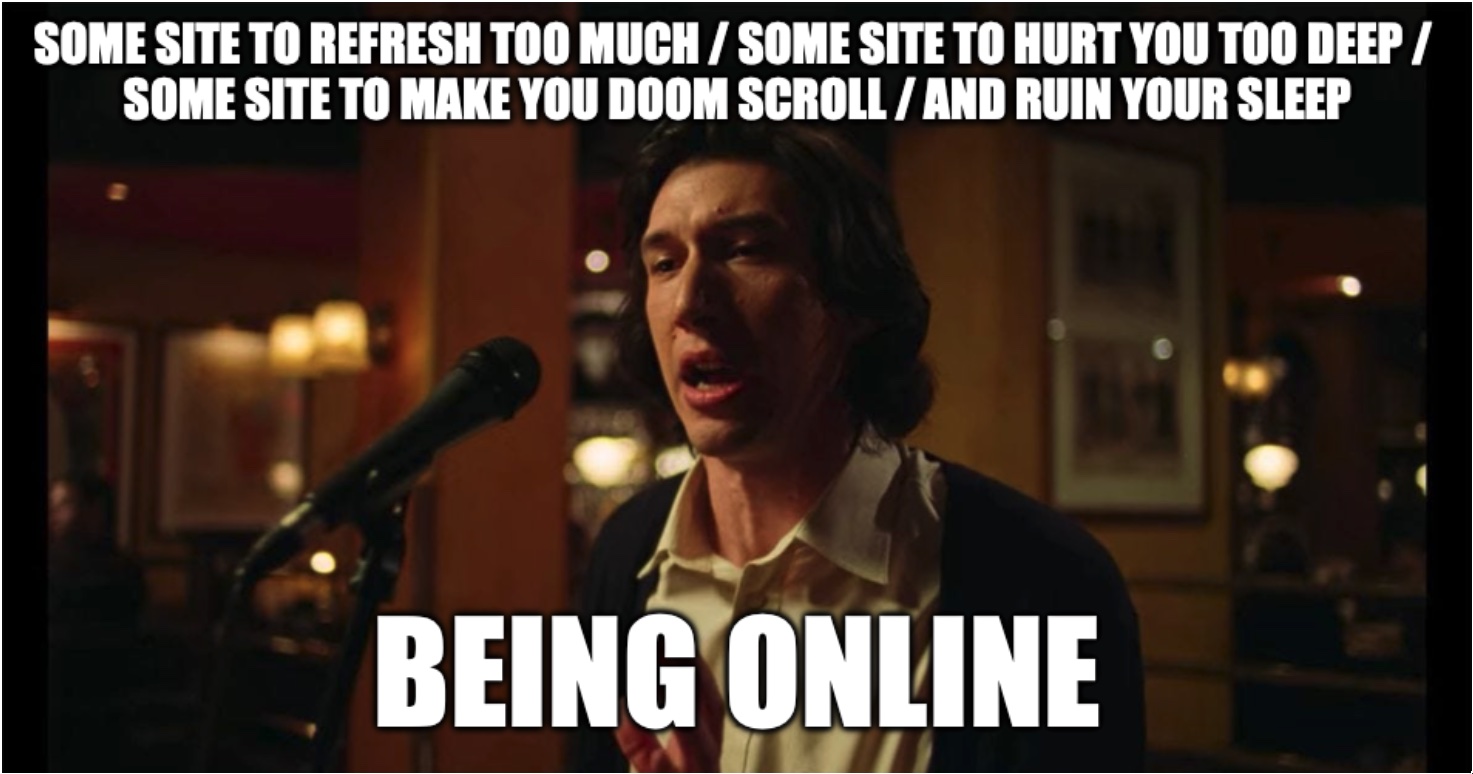
I used this joke for a newsletter, but decided it could use a fresh coat of meme paint.
There are situations where you want to spend time fine-tuning your writing, choosing the perfect word, and rewriting the same sentence until it’s perfect. I’d argue that a personal blog is not the place for that. Not because it’s not worth it but because it’s not really necessary. Personal blogs to me are more like conversations. When you talk to someone you don’t say the same thing four different times until you find the perfect phrase. You just talk, you communicate and if something is not clear you clarify it.
Humans, on the other hand, are complicated and messy and inconsistent. We are remarkably imaginative. Sometimes we are generous, sometimes we are kind, sometimes we lie and cheat. No matter who we are, we have autonomy, and (if we are lucky) are free to decide to do whatever we want for whatever reason we want. Then, we can change our minds and decide to do something altogether different. Or not.
When a person aspires to be a brand, they forfeit everything that is truly glorious about being human. Building any brand requires consensus. When we position ourselves as a brand, we are forced to project an image of what we believe most people will approve of and admire and buy into. The moment we cater our creativity to popular opinion is the precise moment we lose our freedom and autonomy.
It’s already happened in fits and starts, but this isn’t the blog I started.
Sure there’s plenty of writing on here about writing, but there’s also stories about depression, parenting, religion, and loss.
I started this blog as a newly minted MFA, thinking I had enough training and experience to sound authoritative. I wanted to create a space online that projected that confidence and intellect. I wanted to hide the messy parts I’d shared when I was younger on LiveJournal and Geocities.
I lectured instead of spoke.
Gradually that tone shifted, and topics have expanded as my experience expanded.
But now I’m 40, and supposedly that means something on its own. I know, I know: It’s not the years, it’s the mileage… but I’m going somewhere here…
I’m also finding a lot of things to take stock of and make decisions about. I’m wondering about how I’m supposed to define myself now.
How am I supposed to define myself for everyone else?
What if I don’t feel like doing that work right now?
What if I don’t feel like a concrete person who talks about one thing well?
What if I feel like a mess? And what if that’s okay? What if being messy and okay is worth putting out there?
Maybe it’s worth figuring out, and maybe putting it into words is the way to do that. We’ll see.
Ajahn Chah, the Thai forest monk and teacher, asked his students one day when they passed a big boulder, “Do you think that boulder is heavy?” His students said “Yes, it’s extremely heavy.” Ajahn Chah replied, “Only if you try to pick it up!”
– Kaira Jewel Lingo, Plum Village App
Happiness is simply the absence of desire. When you observe a cue, but do not desire to change your state, you are content with the current situation. Happiness is not about the achievement of pleasure (which is joy or satisfaction), but about the lack of desire. It arrives when you have no urge to feel differently. Happiness is the state you enter when you no longer what to change your state.
–James Clear, Atomic Habits
Discussing feelings of task paralysis takes up a decent portion of my therapy sessions lately.
The idea that when I start doing something distracting, like going down a rabbit hole on some internet search or doom scrolling, it’s hard to stop even if I can consciously acknowledge that there’s something else I’d rather be doing at that moment.
Sometimes the most effective way to stop is not to start.
Holding off the momentum of my attention going in a direction I’d rather avoid is harder than not giving the boulder that first gentle push down a hill.
I can simultaneously acknowledge the way that some things are designed to exploit my mind through dopamine loops as well as acknowledge that the demons can stay in the box a little bit longer if Pandora can get comfortable with not knowing what’s inside.
But it’s not just those smaller moments within the day that come to mind here, but the idea that if there’s something that could cause suffering if you choose to pick it up, sometimes it’s better to let it lie there.
Seeing the potential for suffering doesn’t create an obligation to take up that suffering in that moment.
You must be logged in to post a comment.