Eavesdropping and defining love

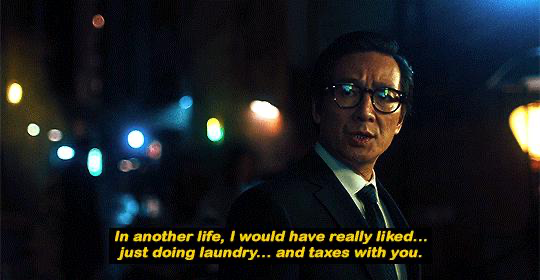
Waymond in Everything Everywhere All At Once saying "In another life, I would have really liked... just doing laundry... and taxes with you."
That moment when Everything Everywhere All At Once gleefully pushes me over an emotional cliff.

Doing some work at a coffee shop earlier this week I overheard two people playing We’re Not Really Strangers.

It may have been a first date (it kind of had that vibe), and one of the cards asked them to “Describe what love means to you in one word.”

While one of them was fumbling through their answer, I figured out mine.

Because I’m not the kind of asshole to jump into their conversation, I made a note to blog about it later.

Here it goes:

Presence.

Appreciating being with a person instead of thinking about where else you could be.

Not just seeing them, but witnessing them.

Sure, it’s an impossible ask for this to be 100% of your time with anybody.

But anything else, any other big feeling, needs to start with awareness and intention.

At least, that’s my answer.

A cold cup of coffee

An unfinished cup of coffee will never warm up on its own.

Maybe you chug it before it crosses the line from lukewarm to cold.

Or you pop it in the microwave, trying to bring some heat back at the expense of flavor.

You could always just brew another pot, and either add in a warm up or start with a fresh cup.

Whatever it is, you need to do something, or else hours later you’ll wind up finding a forgotten half a cup to pour down the drain.

Putting the video games in the family room

When my parents finally relented and got me a Nintendo Entertainment System, it made its home in the basement. Every subsequent video game system lived there, too.

Tucked away from the rest of the family so it wouldn’t tie up the TV in the living room or disturb anybody with its chiptune bleeps and boops.

But it also meant that video games were mostly a private thing for me.

Sure, my mother and I conquered Bubble Bobble together, and there were times my dad would join as player 2. Under special circumstances a console could come upstairs, like a sick day where I got to stay on the couch playing hockey on the Genesis, or a sleepover for the release of the N64.

But there was always this sense that the games weren’t something that deserved a spot upstairs in the space with the rest of the family.

This is why I think the Nintendo Switch is the perfect family game console.

Last night I had a Powerpoint Party as a belated birthday get-together. My topic:

Keynote slide titled Designing Super Mario Levels (for a three-year-old)

I based it on playing Mario Bros. with Button.

The Switch stays docked on our TV in the living room so that the primary way to play it is with the family. But if somebody wants to play on their own (like Sprout when they want to build in Minecraft), its portability allows for that.

Growing up on video games made it feel more acceptable to have them make a home in the family room. Not only did I want to share playing games with my kids, but I didn’t want to create a sense that it was something that required you to separate yourself from the rest of the family.

Finding that balance between making it so that we can easily play together, but still allowing for those individual, immersive journeys to new worlds.

Being ourselves and not our goals

In both of these, bolded emphasis is mine:

“Every man is the sum total of his reactions to experience. As your experiences differ and multiply, you become a different man, and hence your perspective changes. This goes on and on… So it would seem foolish, would it not, to adjust our lives to the demands of a goal we see from a different angle every day? How could we ever hope to accomplish anything… The answer, then, must not deal with goals at all… We do not strive to be firemen, we do not strive to be bankers, nor policemen, nor doctors. WE STRIVE TO BE OURSELVES. But don’t misunderstand me. I don’t mean that we can’t BE firemen, bankers, or doctors…but that we must make the goal conform to the individual, rather than make the individual conform to the goal… Beware of looking for goals: look for a way of life. Decide how you want to live and then see what you can do to make a living WITHIN that way of life.”

Hunter S. Thompson, (source)

The key to mitigating these losses of identity is to redefine yourself such that you get to keep important aspects of your identity even if your particular role changes.

“I’m an athlete” becomes “I’m the type of person who is mentally tough and loves a physical challenge.”

“I’m a great soldier” transforms into “I’m the type of person who is disciplined, reliable, and great on a team.

“I’m the CEO” translates to “I’m the type of person who builds and creates things.

When chosen effectively, an identity can be flexible rather than brittle. Like water flowing around an obstacle, your identity works with the changing circumstances rather than against them.

James Clear, Atomic Habits

Had the strange experience of thinking that Hunter S. Thompson and James Clear might have had a lot to talk about.

Or, at the very least, they’d agree on the idea that it’s not about goals or titles, but about knowing what you’re about.

I made time to meditate

Image of a line graph of time spent meditating from the Timeless meditation app showing an irregular set of peaks and valleys declining over the last six months.

I’ve gotten off track with my meditation practice.

I haven’t felt able to make consistent space for it.

But there was a good reminder for me today of why it’s important to make try.

I was listening to a guided meditation from the Plum Village app—A recording of Thich Nhat Hanh explaining some basic breathing exercises.

He said that taking the time to sit and breathe is a way to enjoy being alive. To enjoy having a body. To smile.

I roll my eyes a little at the Western/productivityist mindset about meditation as a tool for focus and self-improvement, even as I acknowledge that mindset was part of my journey toward mindfulness practice.

This was a necessary lesson about making space for peace for its own sake.

Not to make it easier to answer emails or get more things done or spend more focused time writing and generating new content. Not to strive toward peace like it’s some goal that needs to be checked off your to-do list.

Peace doesn’t have to be something you need to struggle to find.

It can come when you stop struggling.

It’s always on the threshold, waiting on your invitation to enter.