Simply Set It Down

On our way to a wedding in Massachusetts, my family stopped to visit some friends at their home in Vermont.

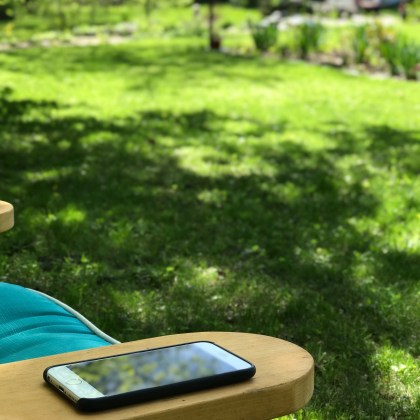
An iPhone sitting on the arm of a lawn chair.While sitting outside in the yard, Charlie got up to grab some weed killer to spray a few problem spots on his lawn. I noticed he left his phone on the arm of his chair.

I can get caught up in fussy things. Trying to find the “best” way to do something. Creating an additional layer of routine or ritual. Sometimes it’s necessary to break a bad habit or build a new one. Sometimes it helps if I’m trying to explain an idea to other people.

But a simple act can be enough.

It might be as simple as saying, “This comes next,” and setting down anything else for later.

Cutting with The Muppets

We ran into a problem while rehearsing for the table read of Ladies and Gentlemen, Miss Ida Walker: The read-through ran longer than the block of studio time we had reserved for the recording.

The traditional rule estimates that one screenplay page equals one minute of screen time. Whether or not you believe that measurement, you can chuck the ratio out the window when someone needs to read the action and description lines out loud.

I needed to make cuts, and there was one more restriction. These had to be straight cuts: No additions or substitutions.

(I was trying to be mindful of school resources since I’d already printed copies of the scripts for the actors once.)

As I sat down with a pencil and a copy of the script, I lost some of my nerve. The revision I did before handing the script over to actors already cut a number of pages. How was I supposed to know what else to trim?

That’s when my daughter’s obsession with The Muppets helped me get over my uncertainty.

Nearly every time we get into the car, she asks “Can we listen to the Muppet music?” I grew up on the Muppets, and all things Jim Henson, so I’m totally fine indulging her obsession.

The film’s soundtrack includes an extended cut of the villainous Tex Richman’s rap “Let’s Talk About Me,” where he explains how rich, powerful, and awesome he is to the Muppets.

It’s great. Academy Award Winner Chris Cooper chews the scenery so hard, you want to offer him a Tums. You should listen to it.

The difference with the film version? The soundtrack cut features an operatic bridge:

I recall a heartbreaking story
About my own tenth birthday party
Should’ve been a glorious day for me
I’d have been happy as can be
But the Muppets were there
To put on a show
They started to dance
They were telling their jokes
I didn’t laugh
I didn’t know how
Then my friends
They all turned around
And they laughed at me
They laughed at me
I hate you, Muppets so

It provides an explanation for why the character needs to say “Maniacal laugh” to his henchmen instead of laughing himself. It gives a motivation for why he buys the Muppet Studio. It informs why he’s so cruel to the Muppets. And it sets up the joke at the end of the movie where Gonzo hits him with a bowling ball and he learns how to laugh.

Seems necessary, right?

But without that verse, we can still understand why he buys the studio (he wants to drill for oil), and why he’s cruel to the Muppets (he’s an evil oil barron that wants to drill for oil).

The inability to laugh is funny even without an explanation, and the repeated action itself sets up the joke for when a comical concussion knocks some laughter into him.

Everything doesn’t need to be explained in full.

Humans are narrative-making creatures. We try to fill in the gaps and find sense in events. Allowing for small omissions understands this feature of human thinking and respects the audience.

Everybody writes Tex Bridges.

You don’t trust that people will understand a strange choice you made. You worry that something will cause your reader or audience to bump, so you try to solve a problem that hasn’t happened yet. You love the backstory you’ve come up with for a character and think everybody else will love it, too.

There’s nothing wrong with writing a Tex Bridge, but there’s also nothing wrong with cutting it and trusting your narrative momentum.

So I thought about Tex Richman, and looked for the places in my script that felt like that bridge: Places that might be entertaining, but over-explained something that the audience could infer from everything else.
The Farmer(‘s Wife)

A local nursery had a sale this weekend with a petting zoo, and Sprout wanted to wear her overalls. I didn’t think this would become a bigger conversation, but then —

“I’m going to be a farmer’s wife!” she said.

“Don’t you want to be a farmer?” I asked.

“Farmer’s wife.”

“Girls can be farmers, too.”

“I’m a farmer’s wife.”

I thought for a second. “Is Mom a librarian’s wife?”

“No.”

“Right, she’s a librarian. And is Grandma a teacher’s wife?”

“Noooooo.”

“Right. She’s a teacher. So could you be a farmer?”

“Okay. I can be a farmer and a lady. And an eye doctor. Actually, I just want to be an eye doctor.” She picked up a toy from her doctor bag. “This is my otoscope!”


This isn’t an outlier in the conversations I have with my daughter. And sometimes she’s the one who gets things started:

This wasn’t a one-off conversation, either. There was a day she refused to watch Sesame Street, and when I asked her why, she told me it was “Because they’re all boys!” A show with a tradition of quality isn’t above criticism, and my daughter was loud and clear on the problem: She wanted to see characters that were like her on the screen.

Are we using words like “representation” and “gender parity?” Not usually.

But that doesn’t mean we’re not talking about these things. When she sees something that doesn’t look like it includes her, or it’s not for her, she grapples with it.

Even a three-and-a-half year old can catch on to the idea that something’s wrong when the world on the screen doesn’t reflect the population of the world she lives in.


When Sprout wants me to make up a story to tell her, she says “Tell me a story with your mouth.”

Usually she asks for this when she’s supposed to be falling asleep, and she knows I won’t turn the light back on to read one (or four) more books.

The other day, I was feeling pretty worn out, so I asked her if she’d tell me a story with her mouth instead. “But I don’t know how.”

Jumping over to physicist Richard Feynman:

Feynman was once asked by a Caltech faculty member to explain why spin 1/2 particles obey Fermi-Dirac statistics. He gauged his audience perfectly and said, “I’ll prepare a freshman lecture on it.” But a few days later he returned and said, “You know, I couldn’t do it. I couldn’t reduce it to the freshman level. That means we really don’t understand it.” (source)

I was challenging myself to see if I could break down how to tell a story for a three-and-a-half year old. What I came up with was:

  • Pick someone
  • They’re trying to do something they like
  • Something makes it difficult to do that thing

It’s a setup she’s familiar with, from Moana to Daniel Tiger to Elephant & Piggie.

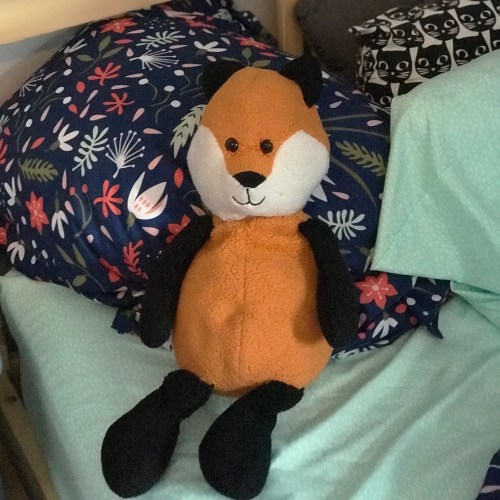
So I asked her who the story should be about. She chose Fletcher. If you haven’t met Fletcher before, he’s a stuffed fox from Target that Rosie got for her first birthday and has loved since first sight. Here he is:

IMG_6425.jpg

“Okay,” I said, “so what does Fletcher like to do?”

“Paint!”

“And when Fletcher goes to paint, what’s something that could go wrong.”

She thought for a moment. Then it dawned on her. “A volcano!”

“That’s cool! But what about something that could go wrong while he’s painting?”

“He could open the paint and there’s a volcano inside.”

We’ll work on plausibility and foreshadowing later.


Making Small Talk

I held the door open for an older woman carrying two tote bags full of books out of the library.

She said, “The sun’s nice. If only it were 40 degrees warmer!”

“At this point, I’d take 20.”

“True! Don’t want to get greedy.”

And that was that. We went to our cars. I cranked up the heater.

A big part of being taught how to write is all about removing unnecessary conversation. Trimming “shoe leather” from scenes.

It’s common for people to say they don’t “do” small talk, or that they’re uncomfortable with it.

But some days, I really like small talk.

It’s almost always about something directly in front of the two people having the conversation. It’s a moment of shared presence.

We could have absolutely nothing else in common other than both being at the same place at the same time, but we’re taking a moment to acknowledge that.

We are here. We’re here together.