21. La Strada

Giulietta Masina as Gelsomina rests her chin on a rope as she watches something on the left of frame.

While I was in college, I had a friend I worked with in the Mary Markley cafeteria who was as important to my film education as any of my professors. Any time I had a shift with him he had recommendations or DVDs for me to borrow, and we’d talk each others’ ears off during slow periods. I’d started to get interested in Fellini because of Martin Scorsese’s documentary My Voyage to Italy (which used to be one of my favorite things to put on at bedtime/a DVD menu I woke up to often), and he encouraged me to keep watching.

Sometimes there’s a moment from a film, or some aspect of the craft that sticks in my mind. But with La Strada, it was all about a story my friend told me during one shift when encouraging me to watch this movie.

Giulietta Masina was married to Federico Fellini and played Gelsomina in La Strada. The movie was beloved in Italy, and it was the kind of performance that an actor gets recognized for. They become that character in the minds of the audience.

One night Fellini and Masina were out together, and Masina’s purse was stolen. She wasn’t holding it at the time, so the thieves never directly saw her or Fellini. Some time that night, while rifling through its contents, they discovered whose purse it was.

The next day, the purse was returned to Masina. Nothing was missing. Inside was a note on a torn sheet of paper:

“Forgive us, Gelsomina.”

I’ve never been able to find another telling of that story, but that doesn’t bother me. When I think of this film, I think of the story, and being told the story, and the friendship and the joy of deepening my love for watching movies.

Whether or not those events happened in exactly that way, it’s still a good story. And it’s a story that does no one any harm, regardless.

Because we love a good story, and we love a story that makes us feel something. Fiction doesn’t always tell the truth, but it should be honest.

And I find it hard to watch this film and not believe that Gelsomina could soften the hardest heart.

20. Godzilla

Black and white image of Godzilla towering over a city with ominous clouds in the distance.

I’ve already written some about my love for this movie. There will always be a special place in my heart for giant monsters stomping buildings and making humanity question its dominion over our planet.

I worry that our expectations of special effects quality make it less likely for more modern viewers to give movies like this a chance. I have a hard enough time convincing Sprout to watch something in black & white.

Because the lack of modern polish on this movie isn’t a flaw. It’s part of the story. A film becomes a historical document of when it was made and a time capsule of the influences and motivations of the artists responsible.

You’re less likely to feel scared watching a man in a rubber suit walk through models of a city than a photorealistic rendering of something that looks more naturally animal seamlessly composited into shots of an actual city. But Godzilla has never just been about the scares of the monster.

It’s about the horrors of what humans will do to each other. It’s the atom bomb as a slow-moving villain instead of an instantaneous horror. It’s the memory of recent war and the feeling of civilian helplessness.

It’s less about horror than humanity. Re-learning how to feel compassion for not just other people, but humanity as a whole. Dr. Serizawa in the film creates the weapon capable of destroying Godzilla, but sacrifices himself when using it so the secret of its power dies with him. There are no human hands worthy of the destructive power of a god.

19. The Red Balloon

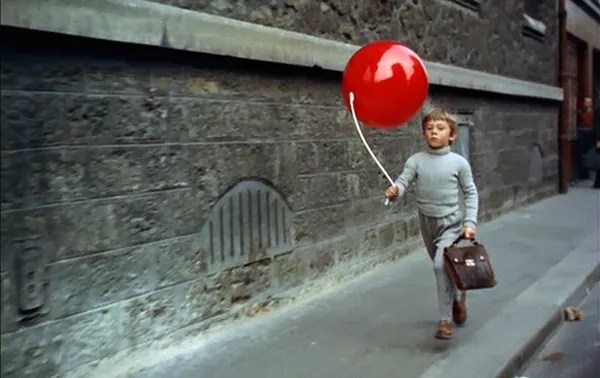
A young boy in gray walks down a gray street, holding the string of a large red balloon.

“I’m just a balloon, floating in front of a boy, asking him to love me.”

A beautiful thing about this movie is how it leaves space for interpretation while still telling a complete story. A boy meets a magical balloon that behaves like a pet. Other people have a problem with this, and the boy tries to juggle protecting his magical friend and taking care of his regular world responsibilities (like going to school).

It’s sweet. The Balloon shows real personality, and its movements are graceful and playful. It’s a great lesson in giving emotions and personhood to a nonhuman character.

There’s a timeless quality, too. Even with all the shots of the city that place it in its present day, the simplicity of the narrative makes it a story focused on childhood, and not just on a child in this time and place.

Flight and film go hand in hand when thinking about spectacle. A balloon on its own provides a little bit of wonder for a very small child, straining against the rules they already understand about gravity and falling. Now let that balloon maneuver like an animal with cognition and control—dipping, dodging, teasing, and soaring—and you have an object that can captivate all ages.

18. White Christmas

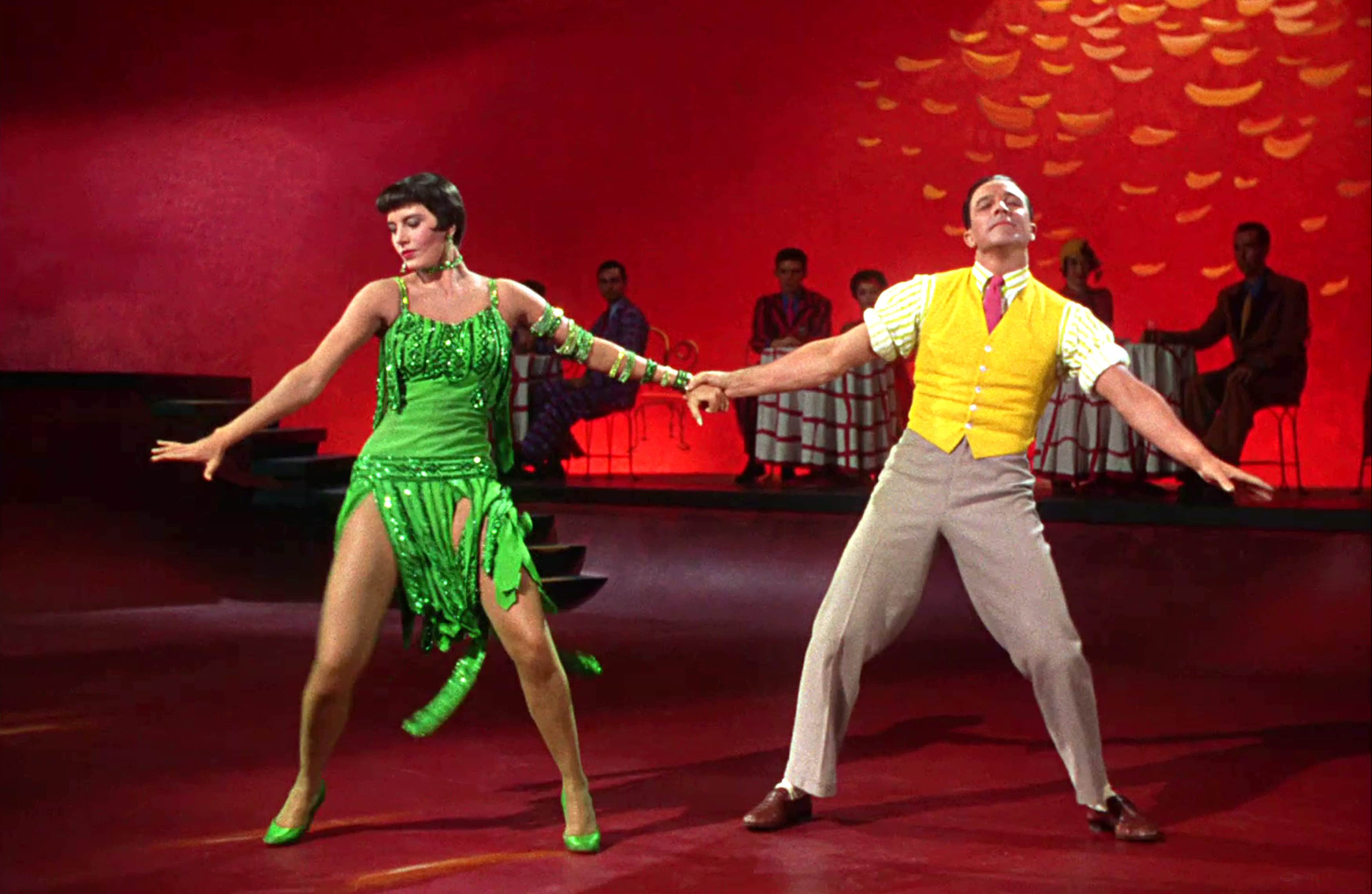
Bing Crosby, Danny Kaye, and Rosemary Clooney pose for the Minstrel Show number in White Christmas.
The puns are not the cringiest part of this musical number.

This was a holiday staple in my house when I was a kid, and its one my kids also like to watch.

It’s also a deeply regressive and conservative film that all the “Aw shucks, gang. Let’s put on a show!” sparkle can’t distract from its themes and motivations.

What am I talking about?

  • There’s a song all about wishing to be able to go see a minstrel show again like in The Before Times
  • There’s a song about how now theater is full of esoteric choreography instead of fun tap dancing.
  • The entire plot of it hinges on the idea that there is A Right Kind of Woman and a Wrong Kind of Woman, and that the only way to be happy is for a man to find that right kind of woman willing to give up her career to produce a baseball team worth of children for him.
  • Nostalgia for being in the army, including a song about how modern civilian life is terrible compared to serving in World War II. (Yeah, really roll that one around in your noggin for a minute.)
  • Literally every single moment of this movie is tied to the idea that things used to be better, and why can’t they be like that again.

Am I looking at this through a modern lens? Yes. Were there plenty of films at this time that didn’t share the same values? Also yes.

Is it also possible to see this desire for a reversion to an idealized past as a way of dealing with the trauma of war? Kinda?

The problem with that reading for me is all the idealization of army life. We don’t see much in terms of combat, save one air raid, but what we do see is a kind of jokey camaraderie and playfulness that makes it seem like military service was a guys only vacation weekend with matching outfits.

So why do I keep coming back?

  • Danny Kaye, Rosemary Clooney, and Vera-Ellen are all amazing performers who don’t know the meaning of phoning it in
  • The music is catchy as all get-out, and the performances that go with it are staged and shot with plenty of energy.
  • There is a kindness at the core of the story, where all the major actions are motivated by a desire to help others and honor the bonds of family, friendship, and shared service. Multiple times throughout the story, people perform a kind turn for someone else while simultaneously setting aside their own comfort or profit.
  • VistaVision with color by Technicolor. The picture pops.

17. The Hitch-Hiker

Still from The Hitch-Hiker. A killer sits in the back seat, shrouded in shadow, as his two hostages sit up front, driving him to Mexico.

It’s a pretty straight-forward plot: Two men headed to Mexico for a fishing trip pick up a passenger who turns out to be a serial killer on the run. A simple premise, but it gets complicated. It’s a tense question of if (and how) they’ll survive and escape as the murderer keeps working to break their spirits and get him out of the reach of the law.

But let’s talk about writer/director Ida Lupino.

She was a force of nature.

In school I took a class about actors as directors, focusing on the work of Orson Welles, John Cassavetes, and Ida Lupino. I already knew a lot about Welles, had heard a little about Cassavetes, but Lupino? She was news to me.

And she very quickly became The Good News that I wanted to tell everybody about.

She started as an actress, but made the move to the other side of the camera to make a series of B pictures with challenging subject matter. That B movie status allowed her more room to maneuver, and allowed for some empathetic portraits of people in crisis, like the single mother of Not Wanted, or the three people who didn’t all know they were in a love triangle in The Bigamist.

And don’t even get me started about the layered Tennis melodrama with the amazing title, Hard, Fast, and Beautiful.

If you’re not familiar with the Lupino-verse, consider this a nudge to go and change that.