“Now you may think Fear of Abandonment sounds like a little baby problem that’s easy to get over. Until it slashes at you here. Or here. Or maybe here, where it makes you retreat from your existing friends into isolation.”
The best way to describe last few weeks of meetings with my therapist is something like this: I feel like a paleontologist who keeps finding interesting fossils, but none of them fit together.
“This one is a leg bone, but it doesn’t belong with any of these feet, and the feet don’t belong with this neck. And there’s just a pile of skulls over there and none of them make any sense.”
I’m doing the work, but the work’s not cohering into anything clear at this point.
And I just keep digging, and hoping I can start making some connections soon.
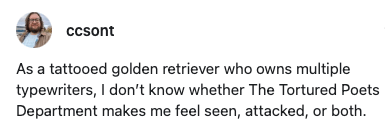
Full disclosure: I have listened to I Can Do It With a Broken Heart a great many times already.
I was thinking about this over the past week as The Internet dealt with a new album from Taylor Swift. It came out while I was sleeping Thursday night and by the time I woke up Friday morning The Internet was raft with exceptionally strong opinions already. Just over a week later and the internet now has a number of, “actually, there’s more here than I initially thought,” articles coming out.
I can think of a few times I felt this same kind of vibe.
The first was when we screened Breaking the Waves in my Intro to Film class in undergrad. Having just learned about the Dogme ’95 school, I spent a lot of effort grousing about how the film didn’t even fit the rules it claimed to be about. But the next semester, I watched and re-watched the film because it got such a strong reaction out of me. And eventually I stopped seeing how it wasn’t what I expected and started digging in to what was actually there.
I was late to the party with The Big Lebowski. After I watched it for the first time on DVD my reaction was little more than, “huh.”
So as soon as the menu came back up, I pressed play again. And it was that second viewing, where I knew more about what it was and could pay less attention to what I had learned second-hand about it where I started to find all the parts I enjoyed.
For the most part, if I didn’t like something I need to figure out why before I’ll speak to it. Part of that comes from spending so many years in writing workshops for school: You aren’t helping if you’re just pointing out flaws instead of working to understand choices. And there’s a healthy helping of being curious instead of judgmental.
I think Birchler picks a great example for this tension. Swift is an outsized force of entertainment, so lots of people are jockeying to get their reaction in first (or more likely in the first 10%). And those calculations aren’t just about reviewing the music itself, but about getting attention to the review.
If we want to serve capitalism, we rush to evaluate things as product and weigh its value to a consumer as a purchase. If we want to understand our connection to the work and let the art serve us, that takes time.
Obsession is when you are acquiring something for the sake of acquiring it or because it is supposed to be a collectible. Whenever I start to notice that I am veering into obsession, I take a moment to remind myself why I indeed have a hobby. What is the real joy that comes from that hobby?
There was a point where I could tell my interest in keyboards was about to cross this line. I kept spending time looking over sites for what should be the next one I buy, what switches I should use, and so on.
But I have several really good keyboards right now, and for the most part, they do what I need them to in a way that I enjoy.
I think the turning point was when I talked my therapist into the idea that buying another keyboard could be a therapeutic exercise. The challenge was that I had to accept the keyboard as is, and I could not tinker or tweak it in any way. “This keyboard is enough as it is, and when I remember that, I can remember that I am enough as I am.”
There’s also an element of identity that goes into crossing over to an obsession. “I’m the person who likes X, so I must always be pursuing and accumulating X.” It’s like if Ahab lost his leg to a Funko Pop.
I still check to see if there are new keyboards that seem like they’d be fun, and there’s a few specific types of typing experience I’d like to assemble for myself. But I also know that on any given day, what I have on hand is enough, and the fact that I take pleasure in the sound, the feel, and the look of these keyboards I already have is enough.
You are afraid of the pain in you, and so whenever there is a gap in your day, you fill it up with books or television so these blocks of suffering do not come up to the surface.
That is what most of us do. It’s a policy of embargo. You do your best to forget what is inside you, and consume whatever is available to help you do that. In this way you create bad psychological circulation, and mental problems will soon appear. While you are sleeping, accumulations of suffering will reveal themselves to you in your dreams. They cry out for help, but you continue to practice suppression and repression.
My therapist uses the framing device of the Window of Tolerance.
It’s the mental space where you’re able to function without triggering your fight/flight/freeze reflex. Plus or minus however far from your baseline mental state gives you that window. If the window is small, it’s easier to get pulled away from what you want to do, or what you’re trying to pay attention to.
You’re never going to stay within your window of tolerance 24/7, but the things I’m trying to pay more attention to are expanding my window (by spending more time staying with things that feel challenging or overwhelming to tell myself that I’m okay) and looking for ways to actually recharge so I can move myself back within that window (deep breaths over doomscrolling, etc.).
Because this isn’t about seeking out discomfort. Pain and frustration will find you on their own. Having a good wallow in something you know will make you angry is a different issue.
This morning I was thankful to my past self for loading up the dishwasher before bed, even though I was really tired, because it made the morning easier. Maybe that’s part of the attitude I need to take to support this: I’d rather feel gratitude toward my past self than pass off another burden to Future Chris. It took a little more effort to choose dishes over lying in bed, but the effort felt possible.
Finally diving in to Marcin Wichary’s Shift Happens, and already came across this gem on the early development of what would eventually become the Remington No. 1:
[T]he team put the ribbon behind the page, between the paper and the platen. A typebar strike would cause the imprint of a letter to appear on the other side, and this required paper to be thin enough for the letters to make an impression through it. Only later, in September 1869, did someone come up with the idea of putting the ribbon in front of the paper, making it possible to print on paper of regular thickness. “When this was discovered, Mr. Sholes laughed over his own obtuseness and that of his associates, that they should have been so long in discovering this simple little change which made so much difference in the character of the work.”
― Marcin Wichary, Shift Happens Volume 1, p. 24
I feel hopeful when I hear stories of people who eventually succeed having moments where they got things absurdly wrong.
I also love the detail about the reaction to finding a better way. Sholes laughs it off. Humility and appreciating iterative thinking.
You must be logged in to post a comment.